
Japanese punctuality is legendary around the world — in Japan, being on time isn’t just polite, it’s a deeply ingrained cultural value that reflects respect, reliability, and consideration for others.
Imagine standing on a train platform, checking your watch, and then looking up to see your train gliding into the station precisely as the clock hits the scheduled second. In many parts of the world, this might feel like a rare stroke of luck, a pleasant surprise. But in Japan, it’s simply the norm. The famed punctuality of Japanese trains, business meetings, and social gatherings isn’t merely a well-worn stereotype; it’s a fundamental aspect of the culture, deeply woven into the fabric of daily life. From the intricate dance of rush hour commuters to the unwavering promptness of professional interactions, Japan operates on a timeline that often astounds visitors. But why are Japanese people always on time? What cultural values, historical influences, and societal systems underpin this remarkable adherence to the clock? Join us as we explore the fascinating reasons behind Japan’s legendary precision, unraveling a cultural trait that extends far beyond mere scheduling.
Quick Facts: Japanese Punctuality
| Detail | Information |
|---|---|
| Japanese Name | 時間厳守 (jikan genshu) – Strict observance of time; 時間通り (jikan-doori) – on time |
| Type / Category | Cultural value, societal norm, practical principle |
| Origin | Blend of historical work ethic, post-WWII reconstruction, national identity, advanced infrastructure development |
| Element / Domain | Respect, efficiency, social harmony, reliability, community trust |
| Known For | World-renowned public transport punctuality (e.g., Shinkansen), strict meeting times, politeness, avoiding inconvenience |
| Modern Appearances | Embedded in daily life, business culture, education, public services, global reputation |
What Is Japanese Punctuality?
At its heart, Japanese punctuality is far more than just arriving at an appointed hour; it’s a profound expression of respect and a cornerstone of societal harmony. It embodies the understanding that one person’s lateness can inconvenience many, creating a ripple effect that disrupts collective schedules and workflow. This cultural emphasis elevates being on time from a mere logistical necessity to a moral imperative, deeply ingrained in the national consciousness. For Japanese people, respecting time is synonymous with respecting others, their commitments, and the collective rhythm of society.
This strict adherence to schedules is evident across all facets of life. From the meticulous planning of public transportation, where delays are rare and often met with formal apologies and compensation for commuters, to the precise timing of business appointments, social events, and even casual meet-ups, punctuality is an unspoken rule. It fosters an environment of trust and reliability, where everyone can depend on others to uphold their part of the collective commitment to timeliness, ensuring a smooth and efficient flow of daily activities.
Origins and History
The roots of Japan’s punctuality can be traced back through several historical and societal influences. One significant factor is the traditional concept of collective responsibility and interdependence, stemming from an agrarian society where the timing of rice planting and harvesting was crucial for community survival. This fostered a shared understanding that individual actions directly impacted the group’s welfare.
During the Edo period (1603-1868), the samurai code of conduct emphasized discipline, order, and precision, values that subtly influenced broader societal norms. However, the most profound modern emphasis on punctuality emerged during Japan’s rapid industrialization in the late 19th and 20th centuries, and especially during the post-World War II economic boom. To rebuild and compete on a global scale, efficiency became paramount. The development of advanced, reliable infrastructure, particularly the railway system, demanded and reinforced rigorous adherence to schedules. This created a positive feedback loop: a punctual society supported efficient systems, and efficient systems, in turn, reinforced a culture of punctuality.

The Essence of Japanese Punctuality
Japanese punctuality isn’t just about avoiding lateness; it’s about optimizing every minute and ensuring seamless transitions. This manifests in the extraordinary precision of public transport, particularly the Shinkansen, which famously boasts average delays measured in mere seconds annually. In meetings, everyone is expected to be seated and ready to begin precisely at the appointed time, often arriving 5-10 minutes early to prepare. This behavior extends even to social engagements, where tardiness, even by a few minutes, requires a sincere apology.
The ‘power’ of this punctuality lies in its ability to create a highly predictable and efficient society. It minimizes wasted time, reduces stress caused by uncertainty, and maximizes productivity. This collective commitment to time allows complex operations, from city-wide transportation networks to international business dealings, to run with remarkable fluidity and reliability, fostering a deep sense of trust among people and institutions.
The Value of “Meiwaku” (迷惑) and Respect
A crucial underlying principle driving Japanese punctuality is the concept of meiwaku (迷惑), which roughly translates to causing trouble or inconvenience to others. Japanese culture places immense value on not disturbing or burdening those around you. Being late is seen as a direct act of meiwaku, as it forces others to wait, disrupts their schedules, and implies that one’s own time is more valuable than theirs. This is considered highly disrespectful.
Therefore, punctuality becomes an active demonstration of respect – respect for the other person’s time, their plans, and their personal space. This deep-seated aversion to causing inconvenience fosters a proactive approach to time management, where individuals meticulously plan their journeys, account for potential delays, and always aim to arrive early, ensuring they never become a source of trouble for anyone else. This collective consideration is a powerful force for maintaining social harmony.
Operational Excellence and Systemic Support
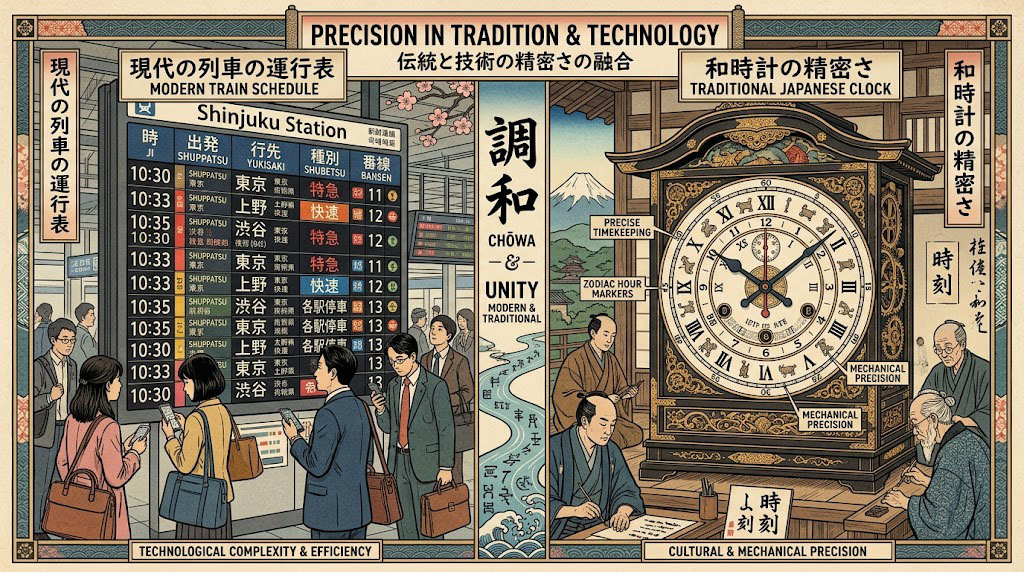
Beyond individual cultural values, Japan’s punctuality is heavily supported by robust operational systems and societal infrastructure. The public transportation network, especially the national railway system, is a marvel of engineering and precise scheduling. Trains, buses, and subways are designed for maximum efficiency and adhere to incredibly strict timetables. Delays are diligently tracked, analyzed, and minimized, with constant efforts to improve performance.
JR Central’s own figures put the Tokaido Shinkansen’s average delay at just 24 seconds per train in fiscal 2016 — a level of precision scholar Christopher Hood, in Shinkansen: From Bullet Train to Symbol of Modern Japan (2006), calls a defining marker of Japan’s postwar national identity.
Furthermore, education from a young age instills the importance of timeliness and responsibility. Schools emphasize punctuality, and workplaces reinforce it through strict policies and expectations. Companies provide comprehensive training, and employees are expected to manage their time effectively, often staying late if necessary to complete tasks, but always arriving on time. This systemic reinforcement creates an environment where punctuality is not only expected but also realistically achievable for most people.
Japanese Punctuality vs Similar Concepts
| Feature | Japanese Punctuality | Western Punctuality (e.g., Germany) | Flexible Punctuality (e.g., Mediterranean) |
|---|---|---|---|
| Cultural Roots | Meiwaku avoidance, respect for others, collective harmony, efficiency | Efficiency, personal responsibility, professionalism, contractual agreements | Interpersonal relationships, ‘being present’ over strict timing, fluid schedules |
| Daily Manifestation | Extreme precision (seconds), arriving early (5-10 min) is common, deep apologies for minor delays | Expected promptness (on the dot), minor delays (up to 5 min) might be acceptable in social contexts | Often ‘on time’ means within a 15-30 minute window, social time is flexible, less emphasis on strict clock time |
| Attitude Towards Lateness | Highly disrespectful, causing trouble (meiwaku), serious apologies required | Unprofessional, rude, implies disrespect for others’ time, apologies expected | Less severe, often excused if relationships are strong, ‘traffic’ or ‘unexpected events’ are common reasons |
| Impact on Society | High trust in systems, predictable daily life, peak efficiency in public services & business | Generally reliable systems, strong professional trust, efficiency in structured environments | Greater emphasis on human connection over rigid schedules, more adaptable to unforeseen circumstances |
| Public Transport | World-renowned for minute-by-minute accuracy, delays are rare and publicized | Generally reliable but not to the same second-by-second precision, minor delays are more common | Varies widely; often less emphasis on strict adherence to timetables, more prone to delays |
Japanese Punctuality in Modern Japan and Pop Culture
In modern Japan, punctuality continues to be a defining characteristic, shaping everything from national identity to international perception. The seamless operation of daily life, where millions commute efficiently in dense urban centers, is a testament to this ingrained value. It creates a low-stress environment in many ways, as people can generally trust that schedules will be upheld, allowing for more precise personal and professional planning.
This commitment to timeliness has become a symbol of Japan’s reliability and technological prowess on the global stage. It’s often showcased in documentaries, travelogues, and even subtly referenced in popular culture. Anime and manga might depict characters rushing to school or work, highlighting the societal expectation of promptness, or feature the Shinkansen as a symbol of speed and efficiency. The global appeal of Japanese reliability, often exemplified by its punctuality, resonates with people worldwide who value order, respect, and efficient living, making it an enduring aspect of Japan’s soft power.
Where to Experience This in Japan
To truly appreciate Japanese punctuality, you don’t need to look far. The most obvious place is on any of Japan’s public transportation systems. Ride the Shinkansen (bullet train) between major cities, and you’ll likely experience a train arriving and departing to the second. In Tokyo, observe the organized chaos of Shibuya Crossing, where thousands move with a synchronized efficiency, or take any local subway line during rush hour to witness disciplined queuing and precise train arrivals. For a more formal experience, attend a traditional tea ceremony or a specific cultural event, where adherence to the schedule is part of the respectful ritual. Even visiting a major department store or restaurant will showcase the efficient, time-conscious service that defines modern Japan.
Frequently Asked Questions
Why are Japanese trains so punctual?
Japanese trains achieve their legendary punctuality through a combination of meticulous planning, state-of-the-art technology, and a dedicated workforce. Train companies employ complex scheduling algorithms, high-tech signaling systems, and continuous maintenance to minimize delays. Furthermore, staff are highly trained to handle unforeseen issues swiftly, and there’s a strong cultural expectation among passengers to follow rules and board efficiently, contributing to the seamless operation.
Is being late considered rude in Japan?
Yes, being late in Japan is generally considered very rude and a sign of disrespect. It’s seen as causing meiwaku (inconvenience) to others, implying that your time is more valuable than theirs. For business meetings, being even a few minutes late is frowned upon and typically requires a sincere apology. For social engagements, while slightly more flexible, promptness is still highly valued, and excessive lateness would require a valid explanation and apology.
How do Japanese people manage to be so on time?
Japanese people manage punctuality through careful planning and a deep-seated cultural value. They often plan their journeys with ample buffer time, accounting for potential delays. Public transportation is highly reliable, making it easier to stick to schedules. Education from a young age emphasizes discipline and consideration for others, reinforcing the importance of timeliness as a societal norm. This combination of personal discipline, reliable infrastructure, and cultural expectation fosters a naturally punctual population.
What happens if you are late in Japan?
If you are late in Japan, the immediate expectation is to offer a sincere and humble apology. For professional settings, repeated lateness can negatively impact your reputation and career prospects. For public transportation, if a train or bus is significantly delayed, the railway company will often issue a ‘delay certificate’ (chien shōmei-sho) to passengers, which can be presented to employers or schools as proof, demonstrating the system’s accountability and the societal expectation of punctuality.