The Momotaro legend is Japan’s most beloved folktale — the story of a boy born from a giant peach who grows up to defeat fearsome oni demons with the help of animal companions.
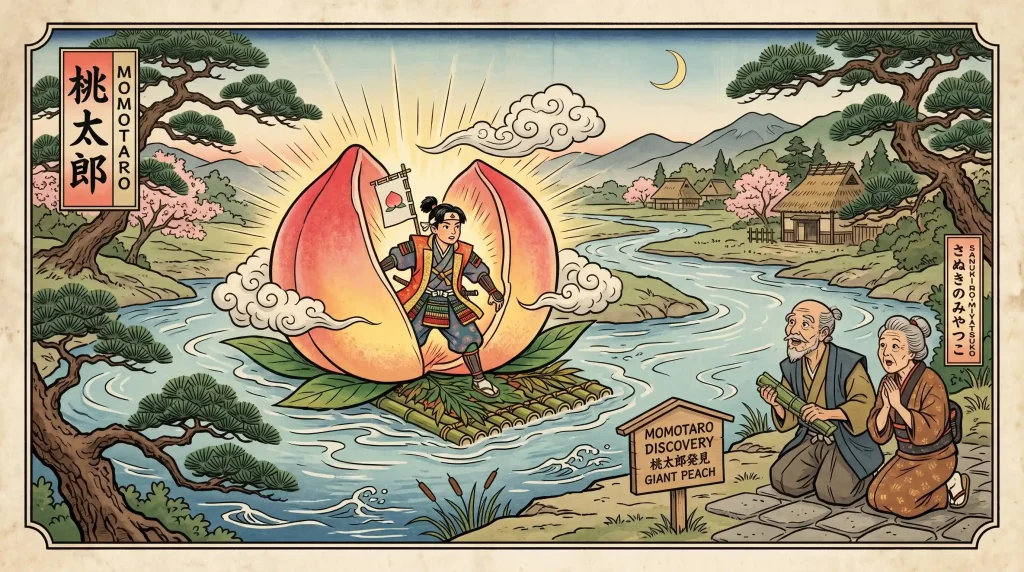
Imagine a tranquil river, its gentle current carrying something extraordinary: a colossal, glowing peach. An elderly couple, longing for a child, discovers this miraculous fruit, only to find a lively boy spring forth from its core. This is the wondrous beginning of Momotaro, the legendary Peach Boy, a hero whose tale has enchanted generations in Japan and around the world. More than just a whimsical story, Momotaro’s journey is a vibrant tapestry woven with themes of courage, loyalty, and the triumph of good over evil. Get ready to embark on an adventure as we uncover the enduring magic of one of Japan’s most beloved folktales, from his humble beginnings to his epic confrontation with fearsome demons.
Quick Facts: Momotaro (The Peach Boy Legend)
| Detail | Information |
|---|---|
| Japanese Name | 桃太郎 (Momotarō) |
| Type / Category | Japanese Folktale / Hero Legend |
| Origin | Often associated with Okayama Prefecture; origins debated but deeply rooted in oral tradition. |
| Element / Domain | Courage, loyalty, justice, defeating evil. |
| Known For | Born from a giant peach, befriending a dog, monkey, and pheasant, and defeating the oni (demons) of Onigashima. |
| Modern Appearances | Countless manga, anime (e.g., Momotaro Densetsu, Peach Boy Riverside), video games, films, and children’s books. |
What Is Momotaro (The Peach Boy Legend)?
The legend of Momotaro (桃太郎, Momotarō), literally meaning “Peach Tarō” (Tarō being a common name for the eldest son), is one of Japan’s most celebrated and foundational folktales. It recounts the extraordinary life of a boy who, against all odds, rises to become a heroic figure. His story begins with an elderly, childless couple discovering a gigantic peach floating down a river. Upon cutting it open, they are astonished to find a healthy, energetic boy inside. They name him Momotaro, cherishing him as a gift from the heavens and raising him with love and care.
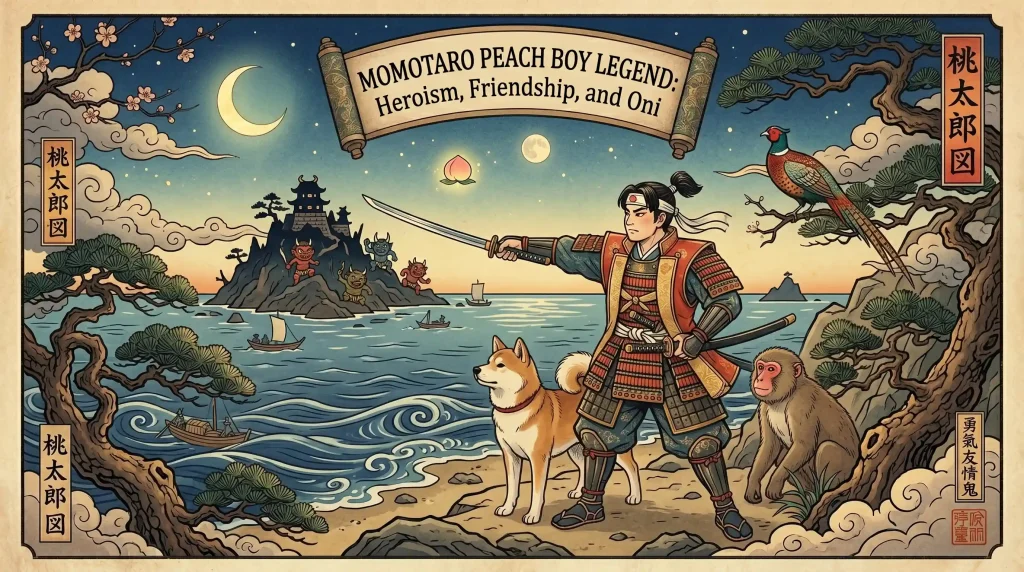
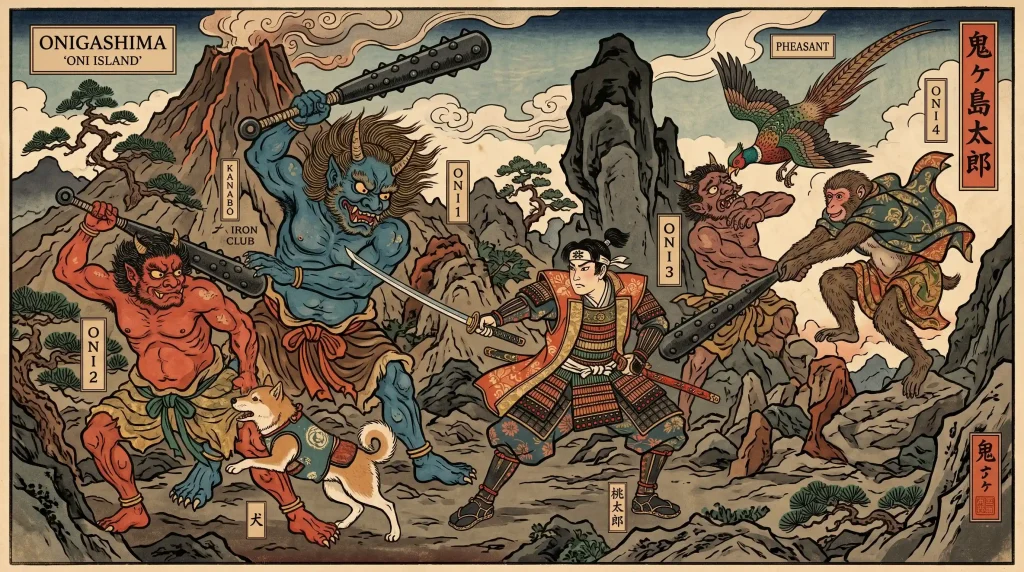
As Momotaro grows into a strong and virtuous young man, he learns of the terrifying oni (鬼, demons) who plague the nearby villages, stealing their treasures and terrorizing their people from their fortress on Onigashima (鬼ヶ島, Demon Island). Determined to protect his community, Momotaro bids farewell to his adoptive parents and sets off on a perilous journey to confront these fearsome creatures. Along the way, he encounters a talking dog, a clever monkey, and a brave pheasant, each of whom he befriends by offering them millet dumplings (きびだんご, kibi dango) and inviting them to join his noble quest, forming an unlikely but formidable alliance.
Origins and History
The precise origins of the Momotaro legend are somewhat shrouded in the mists of time, typical of ancient oral traditions. While various theories exist, including connections to ancient fertility cults or stories of actual historical figures, the tale gained widespread popularity during the Edo period (1603-1868). Early written versions and woodblock prints began to circulate, solidifying the narrative elements we know today. Over centuries, the story evolved, with regional variations emerging in different parts of Japan, but the core themes of bravery, justice, and the power of unity remained constant.
Okayama Prefecture in western Japan is often considered the spiritual home of Momotaro, with numerous local legends, shrines, and landmarks linked to the Peach Boy. Kibitsu Shrine in Okayama, for instance, is associated with Prince Kibitsuhiko-no-mikoto, a figure whose legends share striking similarities with Momotaro, leading some to believe he might have been an inspiration for the folk hero. The tale’s enduring popularity ensured its place as one of the first stories introduced to Japanese children, teaching them moral values and inspiring a sense of heroism from a young age.
Momotaro’s Appearance, Powers, and Behavior
Momotaro himself is typically depicted as a robust, handsome young man, often clad in traditional samurai-like attire, symbolizing his warrior spirit and noble purpose. He possesses no inherent supernatural powers in the way a yokai might, but his strength lies in his exceptional courage, unwavering determination, and innate goodness. It is these qualities that allow him to inspire loyalty in others, particularly his animal companions. His “power” is his heroic spirit and his ability to unite disparate forces for a common, righteous cause, proving that even a boy born from a peach can overcome formidable evil through sheer will and righteous intent.
The Unlikely Alliance: Animal Companions
A crucial element of the Momotaro legend is his assembly of a loyal, anthropomorphic entourage. First, he encounters a dog (犬, inu) who asks for one of his millet dumplings in exchange for joining him. Next, a monkey (猿, saru) requests a dumpling and pledges his allegiance. Finally, a pheasant (雉, kiji) joins the party, also after receiving a dumpling. Each animal brings unique attributes to the quest. The dog represents loyalty and direct combat, the monkey brings agility and cunning, and the pheasant offers aerial reconnaissance and diversion. These humble offerings of kibi dango are not merely snacks; they symbolize Momotaro’s generosity and the unbreakable bond of trust and mutual respect he forms with his allies, turning them into formidable warriors against the oni.
The Battle for Onigashima
Onigashima, the feared Demon Island, is the destination of Momotaro and his companions. It is typically described as a rocky, desolate fortress, heavily guarded by grotesque and powerful oni. These demons, often depicted with red or blue skin, sharp horns, and wielding iron clubs (金棒, kanabō), are the antagonists of the story, representing chaos and greed. Momotaro’s strategy involves a frontal assault, where each animal plays a crucial role: the pheasant acts as a scout and creates diversions, the monkey scales walls and infiltrates defenses, and the dog engages in ground combat. Momotaro himself, with his strength and courage, confronts the oni leader. The battle is fierce, but through their combined efforts, teamwork, and Momotaro’s unwavering resolve, the heroes defeat the oni, retrieve their stolen treasures, and force them to surrender, promising never to harm villagers again. Momotaro returns home a celebrated hero, laden with riches, and lives a long, prosperous life with his adoptive parents and loyal friends.
Momotaro vs Similar Japanese Hero Folktales
| Feature | Momotaro (Peach Boy) | Kintaro (Golden Boy) | Urashima Taro (Fisherman) |
|---|---|---|---|
| Type | Supernatural birth, hero’s quest, demon-slaying. | Supernatural strength, raised in mountains, animal friend. | Human travels to magical underwater realm. |
| Domain | Human world, travel to demon realm. | Mountains, nature, physical prowess. | Sea, Ryugu-jo (Dragon Palace). |
| Core Theme | Courage, loyalty, justice, overcoming evil through unity. | Strength, kindness, respect for nature. | Consequences of time travel, loss, beauty of other worlds. |
| Companions | Dog, Monkey, Pheasant (all join voluntarily). | Bear (often a loyal companion). | Sea turtles (guides), Princess Otohime. |
| Ending | Victorious return, riches, peaceful life. | Becomes a general, embodies strength. | Returns to a future he doesn’t recognize, quickly ages. |
Momotaro in Modern Japan and Pop Culture
The legend of Momotaro holds an unparalleled position in Japanese culture, acting as a foundational narrative for children’s moral education and a timeless symbol of heroism. Its themes of courage, perseverance, and the importance of friendship resonate deeply, teaching young audiences about right and wrong, and the value of protecting one’s community. This enduring appeal has naturally led to its widespread integration into modern Japanese pop culture. From classic animated films and television series like the “Momotaro Densetsu” franchise (spanning anime, manga, and video games) to contemporary adaptations like “Peach Boy Riverside,” Momotaro continues to inspire new generations of storytellers and audiences. He appears in everything from commercials and local mascots (especially in Okayama) to intricate manga narratives that reimagine his legend with darker or more complex themes. The story transcends its folkloric roots, becoming a global ambassador for Japanese storytelling and its rich tradition of hero myths.
Where to Experience This in Japan
For those eager to immerse themselves in the legend of Momotaro, a visit to Okayama Prefecture is a must. The region proudly embraces its connection to the Peach Boy, offering numerous attractions. You can visit Kibitsu Shrine (吉備津神社), believed to be linked to the mythical Prince Kibitsuhiko who some say inspired Momotaro. Along Okayama’s streets, you’ll find charming Momotaro statues and motifs. The Okayama Orient Museum also occasionally features exhibits related to folklore. Local shops sell kibi dango, allowing visitors to taste the very treat that forged Momotaro’s legendary animal alliance. Exploring Okayama provides a tangible link to this beloved tale, bringing the magic of the Peach Boy to life.
Frequently Asked Questions
Where did the Momotaro legend originate?
While the exact origins are lost to time, the Momotaro legend is deeply rooted in ancient Japanese oral tradition, with its popularity solidifying during the Edo period. Many scholars and local lore connect it most strongly with Okayama Prefecture, where tales of Prince Kibitsuhiko-no-mikoto, who defeated local oni, bear striking resemblances to Momotaro’s story. The tale has evolved over centuries, with various regional versions contributing to its rich tapestry.
What do Momotaro’s animal companions symbolize?
Momotaro’s animal companions—the dog, monkey, and pheasant—are integral to the story and symbolize the power of unity and the strength found in diversity. The dog represents loyalty and courage, the monkey embodies cleverness and agility, and the pheasant offers reconnaissance and aerial support. Together, they demonstrate how different strengths, when combined under a virtuous leader like Momotaro, can overcome formidable challenges.
What moral lessons does the Momotaro story teach?
The Momotaro legend is rich with moral lessons, primarily teaching children about courage, loyalty, and the triumph of good over evil. It emphasizes the importance of friendship and cooperation, showing that even a seemingly insurmountable task can be achieved through teamwork. Furthermore, it promotes generosity (the kibi dango) and respect for elders (Momotaro’s devotion to his adoptive parents) as core virtues.
Is Onigashima a real place in Japan?
Onigashima, or Demon Island, is a mythical place central to the Momotaro legend and is not a single, identifiable real island. However, several islands and locations across Japan are locally associated with the legend, particularly in Okayama Prefecture. For example, Megijima Island in the Seto Inland Sea near Takamatsu is often referred to as Onigashima due to its large caves, which locals say were once home to oni. These associations add a layer of tangible folklore to the mythical island.