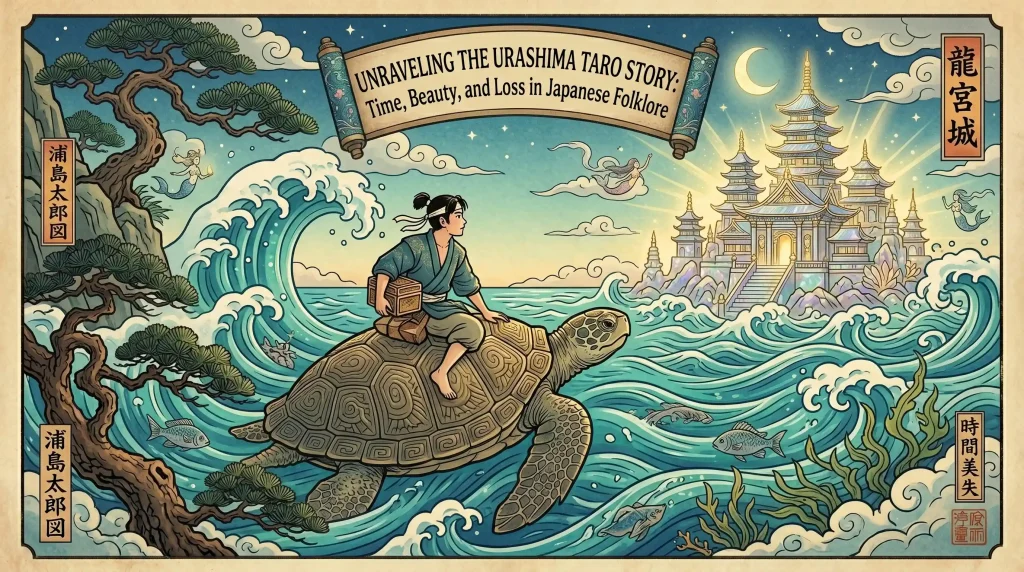
The Urashima Taro story is one of Japan’s most haunting folktales — a fisherman’s journey to an underwater palace that ends with a devastating confrontation with time itself.
The Urashima Taro story is one of Japan’s most haunting folktales — a fisherman’s journey to an underwater palace that ends with a devastating confrontation with time itself.
Imagine a world where time flows differently, where a single day can erase decades, and where the most beautiful gift carries the heaviest curse. This is the essence of Urashima Taro (浦島太郎, Urashima Tarō), a classic Japanese folktale that has captivated generations with its poignant narrative and profound themes. Beyond being a simple children’s story, it’s a deeply philosophical exploration of youth, love, loss, and the irreversible march of time. From its ancient origins to its pervasive presence in modern pop culture, the tale invites us to ponder the choices we make and the fragile nature of earthly existence. If you’ve ever been curious about the fisherman who journeyed to an undersea palace and returned to a world he no longer knew, prepare for the complete Urashima Taro story explained, unraveling every layer of this timeless Japanese legend.
Quick Facts: Urashima Taro
| Detail | Information |
|---|---|
| Japanese Name | 浦島太郎 (Urashima Tarō) |
| Type / Category | Classic Japanese Folktale / Fable |
| Origin | Ancient Japan (earliest records from 8th century, Nara period) |
| Element / Domain | Sea, Time, Immortality, Consequences |
| Known For | A kind fisherman who visits an undersea dragon palace, experiences time distortion, and suffers a tragic transformation upon his return to the surface world. |
| Modern Appearances | Countless children’s books, anime adaptations (e.g., Doraemon, Dragon Ball), manga, video games, traditional theater, popular culture references. |
What Is Urashima Taro?
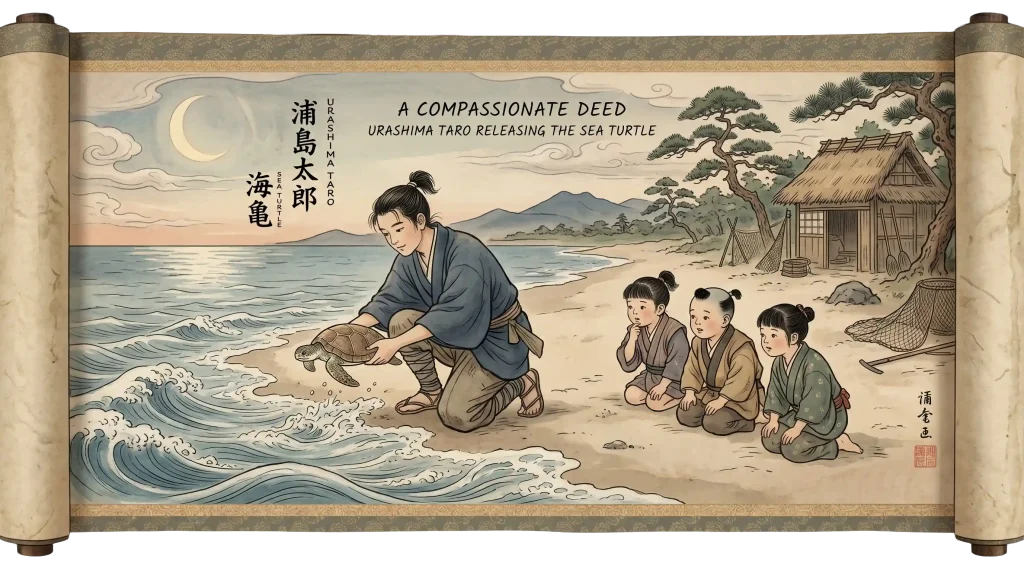
At its core, the Urashima Taro story is a poignant Japanese legend about a fisherman’s extraordinary journey to an enchanted undersea kingdom and the devastating consequences of his return. It is one of Japan’s most famous and beloved `mukashibanashi` (昔話, traditional folktales), deeply ingrained in the cultural consciousness. The narrative typically begins with Urashima Taro, a young, virtuous fisherman, saving a turtle from tormenting children on a beach. As a gesture of gratitude, the turtle, who is revealed to be an envoy of the Dragon King of the Sea, invites Urashima to the magnificent underwater palace of Ryugu-jo (竜宮城, Ryūgū-jō).
There, Urashima is welcomed by Princess Otohime (乙姫, Otohime), the benevolent daughter of the Dragon King, and enjoys several days of unparalleled feasting and entertainment. However, when he decides it’s time to return home, Princess Otohime presents him with a mysterious, ornate box called the Tamatebako (玉手箱, Tamatebako), strictly warning him never to open it. Upon his arrival back on the surface, Urashima discovers that while he spent mere days in Ryugu-jo, centuries have passed in his homeland, and everything and everyone he knew is gone. In despair, he opens the Tamatebako, unleashing its magical contents and sealing his tragic fate.
Origins and History
The tale of Urashima Taro boasts an incredibly long and complex history, making it one of the oldest recorded narratives of time travel or time slip in world literature. Early versions of the story can be found in 8th-century Japanese texts such as the `Fudoki` (風土記, records of provincial culture and geography) of Tango Province, specifically the `Tango Fudoki`, and the `Man’yōshū` (万葉集, Collection of Ten Thousand Leaves), the oldest extant anthology of Japanese poetry. These initial accounts often feature slight variations in details, such as the protagonist’s name or the specifics of his return, but the core elements of saving a turtle, visiting an undersea realm, and experiencing profound time displacement remain consistent.
Over the centuries, the Urashima Taro story evolved, passed down through oral tradition and refined in various literary forms, including illustrated scrolls and eventually children’s literature during the Edo period (1603-1868). The version we are most familiar with today was largely standardized during the Meiji period (1868-1912) as part of a national effort to compile and publish classic Japanese folktales, particularly through the renowned ‘Japanese Fairy Tale Series’ by Hasegawa Takejirō. This standardization cemented Urashima Taro’s place as a fundamental narrative in Japanese culture, teaching lessons about consequences, the fleeting nature of life, and the allure of the unknown.
The Journey to Ryugu-jo and the Tamatebako’s Secret
The journey itself to Ryugu-jo is a central, fantastical element of the Urashima Taro story. After the grateful turtle transforms into a magnificent vessel or takes Urashima on its back, they descend into the ocean depths. The descriptions of Ryugu-jo are consistently breathtaking: an opulent palace crafted from coral, crystal, gold, and silver, adorned with countless jewels and shimmering pearls. It’s a place where the seasons magically change from one room to another, representing a timeless paradise untouched by earthly concerns. The lavish hospitality extended by Princess Otohime is designed to enchant and distract, making Urashima forget his life above.
Princess Otohime and the Allure of Eternity
Princess Otohime is often depicted as a being of exquisite beauty and grace, sometimes a dragon princess, other times a divine maiden. She is the embodiment of the otherworldly allure that seduces Urashima. Her gifts – endless feasts, music, and eternal youth within her domain – are not malicious but rather a reflection of the different flow of time in her realm. Her warning about the Tamatebako is crucial; it implies a profound understanding of its power and the irreversible nature of his choice. Her sorrow upon his departure highlights the bond they formed, despite the vast differences in their worlds. Otohime represents the siren call of immortality and escapism, offering a temporary paradise at the cost of one’s mortal ties.
The Tamatebako: Symbol of Time and Fate
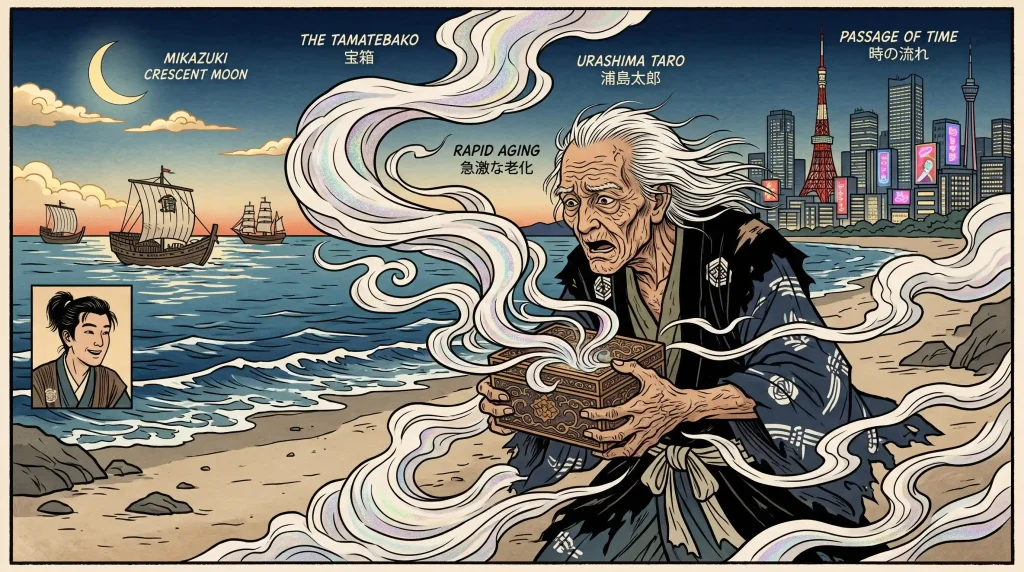
The Tamatebako, often translated as ‘jewel hand box’ or ‘treasure box,’ is the most iconic and symbolic item in the Urashima Taro story. Princess Otohime gives it to Urashima as a farewell gift, with strict instructions never to open it. This magical box contains the passage of time itself, or rather, the accumulated time that Urashima unknowingly avoided while in Ryugu-jo. When opened, it releases a white smoke or mist that instantaneously catches Urashima up with the centuries he missed, transforming him from a young man into an old, frail being. The Tamatebako serves as a powerful metaphor for the inevitability of time and the consequences of attempting to escape it. It’s a Pandora’s Box of regret, symbolizing the irreversible nature of choices and the harsh realities of mortality.
Urashima Taro vs Similar Japanese Folktales
| Feature | Urashima Taro | Momotaro (Peach Boy) | Kaguyahime (Tale of the Bamboo Cutter) |
|---|---|---|---|
| Protagonist’s Origin | Ordinary, kind fisherman | Born from a giant peach, supernaturally strong | Mysterious tiny girl found in a bamboo stalk, celestial origin |
| Main Journey | Undersea realm (Ryugu-jo) | Onigashima (Demon Island) | To the Moon (celestial home) |
| Central Theme | Time displacement, consequences of choice, loss, mortality | Heroism, courage, justice, loyalty | Fleeting beauty, sorrow of parting, divine origin, unattainable love |
| Supernatural Element | Talking turtle, time distortion, magical palace, Tamatebako | Talking animals (dog, monkey, pheasant), ogres (oni) | Mystical birth, celestial clothing, unearthly glow, moon people |
| Ending | Tragic transformation, profound loss of time and loved ones | Victorious return, riches, happy life | Sad departure to the moon, leaving heartbreak behind |
Urashima Taro in Modern Japan and Pop Culture
The Urashima Taro story remains incredibly popular in contemporary Japan, its themes and imagery resonating deeply with audiences of all ages. It’s a staple in elementary school curricula, teaching children about kindness, the value of home, and the passage of time. The story’s elements – the magical undersea palace, the beautiful princess, the talking turtle, and especially the tragic Tamatebako – have been extensively reinterpreted and referenced across various forms of modern entertainment. Anime and manga frequently draw inspiration from the tale, sometimes with direct adaptations, other times with subtle nods. For instance, the concept of time distortion after visiting another realm or receiving a forbidden gift is a common trope in fantasy and science fiction narratives, clearly owing a debt to Urashima Taro. Characters resembling Otohime or Ryugu-jo appear in numerous series, and the ‘Urashima effect’ is a recognized phenomenon within storytelling circles.
Beyond direct adaptations, the philosophical weight of the Urashima Taro story – particularly its exploration of time, memory, and the bittersweet nature of life’s transitions – continues to make it relevant. It speaks to universal human experiences: the longing for eternal youth, the fear of being left behind, and the regret over irreversible decisions. This universality is why the tale transcends cultural boundaries, captivating international audiences who appreciate its blend of enchanting fantasy and profound human drama. From video games to theme park attractions, Urashima Taro’s legacy is a vibrant tapestry woven into the fabric of both traditional and popular Japanese culture.
Where to Experience This in Japan
While Ryugu-jo is a mythical palace, visitors to Japan can still connect with the spirit of the Urashima Taro story. The legend is particularly strong in coastal regions. Many localities claim to be the setting of the tale, with Kagawa Prefecture on Shikoku island being one prominent example, featuring a shrine dedicated to Urashima Taro. Another significant site is Kotohira-gu Shrine (金刀比羅宮, Kotohira-gū) in Kagawa, which is associated with maritime safety and features imagery connected to the sea and the Dragon King. For a more direct artistic experience, look out for museums across Japan, such as the Edo-Tokyo Museum or regional folklore museums, which often feature exhibits on traditional folktales and their artistic depictions. You might also find charming Urashima Taro-themed merchandise, from stationary to confectionery, in souvenir shops throughout Japan, particularly in coastal towns.
Frequently Asked Questions
What is the moral of the Urashima Taro story?
The moral of the Urashima Taro story is multifaceted, but primarily it emphasizes the preciousness of time and the irreversible consequences of attempting to escape it. It teaches that one cannot avoid the natural progression of life and that attachment to one’s own time and place is vital. Additionally, it highlights the importance of living in the present, respecting one’s origins, and understanding that even the most beautiful paradise can lead to profound loss if it severs ties with reality.
Who is Princess Otohime in the Urashima Taro legend?
Princess Otohime is the benevolent and enchanting daughter of Ryujin, the Dragon King of the Sea, who rules the opulent undersea palace of Ryugu-jo. She welcomes Urashima Taro, extending lavish hospitality and showering him with gifts and entertainment. Often depicted as incredibly beautiful and graceful, she represents the allure of an eternal, timeless realm. Her relationship with Urashima is central to the tale, and she is the one who gives him the mysterious Tamatebako box upon his departure, with a strict warning not to open it.
What happens to Urashima Taro when he opens the Tamatebako box?
When Urashima Taro opens the Tamatebako box, a puff of white smoke or mist emerges, which contains all the time he unknowingly missed while in Ryugu-jo. Upon inhaling or being enveloped by this smoke, Urashima instantly ages by centuries. He transforms from a young man into an ancient, frail old man with white hair and wrinkles, losing all his youthful vigor and eventually dying, thus sealing his tragic fate and illustrating the profound time displacement he experienced.
Is the Urashima Taro story a real legend or a fairy tale?
The Urashima Taro story is a deeply rooted Japanese legend and a classic fairy tale, not a historical account. While it has evolved over centuries and has cultural significance, its fantastical elements, such as talking turtles, undersea palaces, and magical time-altering boxes, firmly place it in the realm of folklore and mythology. It serves as a narrative vehicle for conveying moral lessons, cultural values, and philosophical ideas rather than documenting actual events or people.