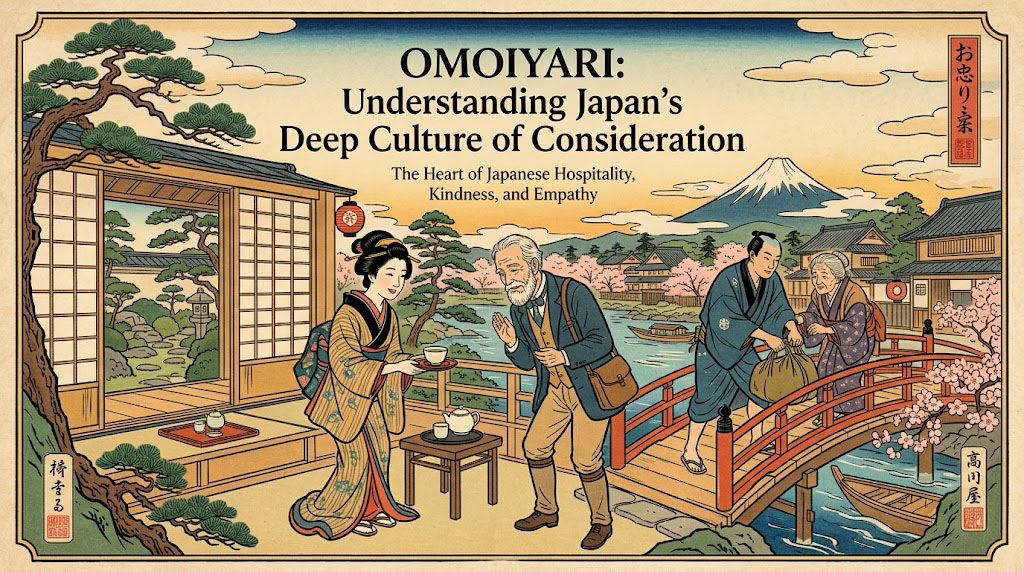
Omoiyari meaning in Japanese is “empathy and consideration for others” — the cultural art of intuitively sensing what someone needs before they ask, a concept that quietly governs Japanese social life.
Have you ever been in a situation where someone seemed to anticipate your needs before you even voiced them? Perhaps a server refilled your drink just as it was emptying, or a friend offered comfort precisely when you needed it most, without a word being exchanged. This profound, unspoken understanding, this deep-seated consideration for others, is not just a polite gesture in Japan; it’s a fundamental pillar of its societal fabric, encapsulated by the beautiful and often elusive concept of Omoiyari. Far more than simple empathy or kindness, Omoiyari is a proactive, heartfelt understanding of others’ perspectives and feelings, driving actions that foster harmony and connection. It’s a cultural value that shapes everything from daily interactions to national identity, and once you grasp its nuances, you’ll unlock a deeper appreciation for Japanese culture. Join us as we unravel the intricate layers of Omoiyari, exploring its origins, its manifestations, and its enduring influence on modern Japan.
Quick Facts: Omoiyari
| Detail | Information |
|---|---|
| Japanese Name | 思いやり (omoiyari) |
| Type / Category | Cultural Concept / Social Virtue |
| Origin | Deeply rooted in traditional Japanese social ethics and collectivist values, evolving through history. |
| Element / Domain | Social interaction, interpersonal relationships, communication, empathy, consideration. |
| Known For | Proactive, empathetic consideration for others’ feelings and needs, often expressed subtly or non-verbally, to maintain harmony. |
| Modern Appearances | Underpins social etiquette in anime, manga, and films (e.g., the quiet support shown in Studio Ghibli films like “My Neighbor Totoro,” or the respectful teamwork in sports manga). |
What Is Omoiyari?
At its heart, Omoiyari (思いやり, omoiyari) is the Japanese concept of empathetic consideration for others. It translates roughly to “thoughtfulness,” “compassion,” or “anticipatory care.” However, its true depth lies in the nuance: it’s not merely about being kind, but about truly understanding and anticipating the needs, feelings, and potential discomforts of those around you, and then acting proactively to address them, often without being asked or even noticed. It involves putting oneself in another’s shoes, perceiving their unspoken desires, and responding in a way that promotes comfort, ease, and harmony for everyone involved. This often manifests in subtle gestures, careful communication, and a general attentiveness to the atmosphere (kūki wo yomu, reading the air).
Omoiyari is a cornerstone of Japanese social etiquette and is deeply intertwined with the concept of wa (和, harmony). It fosters strong interpersonal relationships and contributes to the smooth functioning of society. Unlike Western notions of empathy which might emphasize verbal expression or explicit help, Omoiyari often thrives in the realm of the implicit and non-verbal. It’s about creating a comfortable environment for others, minimizing friction, and valuing collective well-being over individual assertiveness. This makes it a fascinating and sometimes challenging concept for non-Japanese speakers to fully grasp, as its most powerful expressions are often silent and understated.
Origins and History
The roots of Omoiyari are deeply embedded in Japan’s historical development, particularly within its agricultural past and the influence of Confucianism and Buddhism. In ancient farming communities, collective effort and mutual support were essential for survival. People learned to work together, anticipate each other’s roles, and minimize conflict to ensure successful harvests. This fostered a strong sense of group cohesion and a sensitivity to the needs of others within the community.
Philosophically, Omoiyari aligns with Buddhist principles of compassion (jihi, 慈悲) and the Confucian emphasis on humaneness (jin, 仁) and social order. These teachings encouraged individuals to cultivate virtues that prioritized the welfare of the group and harmonious coexistence. Over centuries, these values became ingrained in the Japanese psyche, manifesting in intricate social codes and the preference for indirect communication. The concept gained prominence in common discourse, particularly post-war, as Japan sought to rebuild its society based on core values that emphasized cooperation and mutual respect, solidifying Omoiyari’s place as a fundamental national trait.
Omoiyari’s Manifestations and Practice
Omoiyari is less about grand, declarative acts and more about the myriad small, considerate gestures that make daily life smoother and more pleasant for everyone. It’s the subtle way a train passenger might turn down their music even before you get on, anticipating the shared space. It’s a shop assistant noticing you’re juggling too many items and offering a small bag without being asked. It’s about thinking ahead, “What might this person need? How can I make their experience better or less stressful?” The practice of Omoiyari requires a high degree of observation, empathy, and a willingness to act on those perceptions. It’s often performed quietly, without seeking recognition, emphasizing the collective benefit over individual praise.
The Nuances of Non-Verbal Omoiyari
A significant aspect of Omoiyari is its strong reliance on non-verbal communication. In a culture that often values indirectness and avoids explicit confrontation, the ability to “read the air” (kūki wo yomu) becomes paramount. Omoiyari encourages individuals to pick up on subtle cues: body language, facial expressions, tone of voice, and even silences, to discern unspoken feelings or needs. For instance, a Japanese colleague might notice signs of fatigue in a coworker and quietly offer to take on part of their workload, rather than asking “Are you tired?” This indirect approach prevents the other person from feeling like a burden or needing to explicitly admit weakness, thereby preserving their face (mentsu) and maintaining harmony.
Omoiyari in Daily Life and Professional Settings
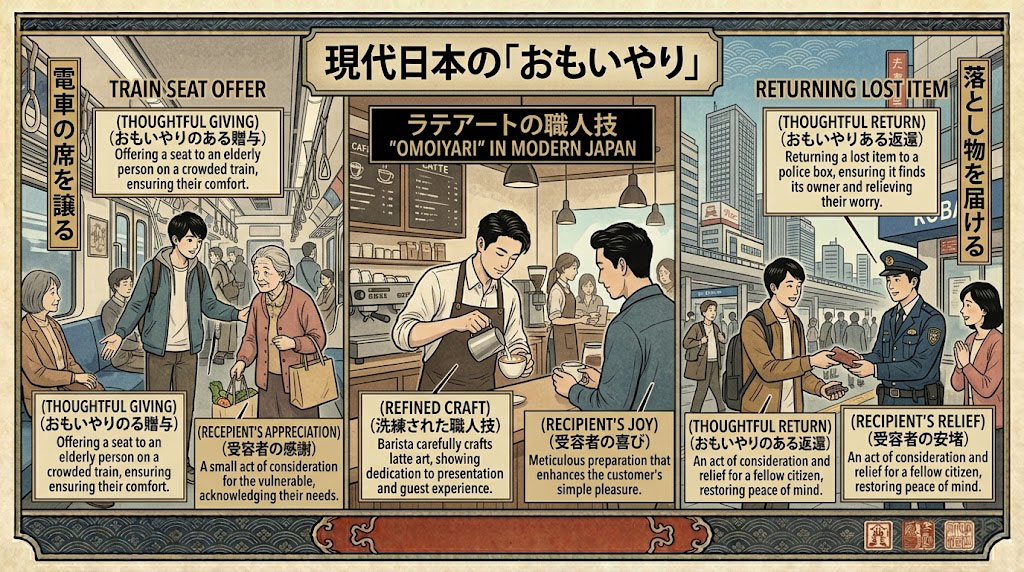
Omoiyari permeates nearly every facet of Japanese life. In professional settings, it manifests as colleagues offering support without being asked, anticipating project needs, or proactively cleaning a shared space. It’s why many Japanese workplaces maintain a high level of cleanliness and order – it’s an act of Omoiyari towards the next person who will use the space. In customer service, it means meticulously anticipating customer needs, such as providing a small basket for bags while dining, or a warm towel to clean hands. In personal relationships, it’s about choosing words carefully to avoid causing offense, listening intently, and showing understanding, often by not always speaking one’s mind directly if it might cause discomfort. This constant consideration creates a social lubricant that smooths interactions and builds trust.
Omoiyari vs Similar Japanese Concepts
| Feature | Omoiyari (思いやり) | Kikubari (気配り) | Giri (義理) |
|---|---|---|---|
| Type | Empathetic consideration | Attentive thoughtfulness | Social obligation/duty |
| Domain | Emotional understanding, proactive care | Practical foresight, attentiveness to details | Social ethics, maintaining relationships |
| Motivation | Genuine empathy, desire for others’ comfort | Practical consideration, good manners | Duty, reciprocation, avoiding shame |
| Expression | Often subtle, non-verbal, anticipatory | Action-oriented, detail-focused, observant | Explicit actions, gift-giving, favors |
| Context | Deep personal relationships, public spaces | Professional settings, hospitality, daily tasks | Social hierarchy, family, business relationships |
Omoiyari in Modern Japan and Pop Culture
In modern Japan, Omoiyari remains a deeply cherished value, influencing everything from urban planning (e.g., universal design for accessibility) to disaster preparedness, where communities often self-organize to support each other with remarkable efficiency and consideration. While the pressures of modern life and globalization might bring challenges to maintaining traditional values, Omoiyari continues to be taught in homes and schools as an essential aspect of being a responsible and harmonious member of society. Its presence is less about rigid rules and more about a cultivated sensibility.
In popular culture, Omoiyari often appears subtly, woven into the fabric of narratives rather than explicitly stated. Many slice-of-life anime and manga, for example, showcase characters demonstrating thoughtful gestures and unspoken understanding, highlighting the beauty of understated compassion. Films frequently depict protagonists who navigate social situations with grace and consideration, solving problems not through direct confrontation but through empathetic action. This subtle portrayal resonates with international audiences because, despite cultural differences, the core human desire for connection and understanding is universal. It invites viewers to appreciate a different way of showing care, one that values the implicit over the explicit, and collective well-being over individualistic expression.
Where to Experience This in Japan
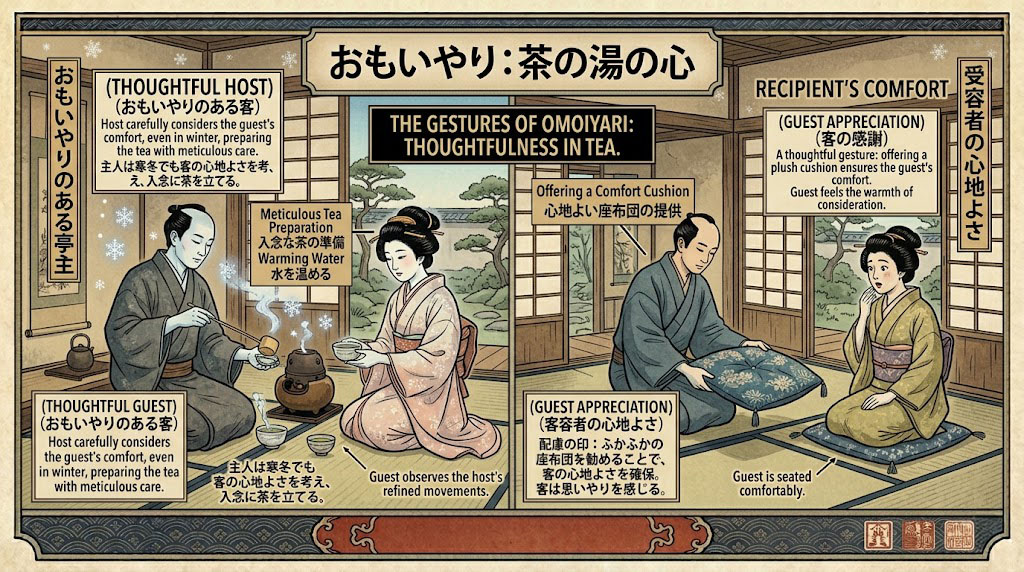
Experiencing Omoiyari firsthand in Japan is less about visiting a specific location and more about observing daily interactions with an open mind. You can witness it in action almost anywhere: in the impeccable service at a ryokan (traditional inn) where staff anticipate your every need, at a local ramen shop where the chef might offer a small towel after a sweaty meal, or in the silent deference given to elderly individuals on public transport. Visiting a tranquil Japanese garden, you might notice the meticulous care taken in its design, an act of Omoiyari towards visitors seeking peace. Participating in a traditional tea ceremony offers a profound lesson in Omoiyari, as every gesture is performed with the comfort and enjoyment of the guest in mind. Simply being observant and respectful in your own interactions will allow you to notice and appreciate these beautiful acts of consideration.
Frequently Asked Questions
Is Omoiyari the same as empathy or kindness?
While Omoiyari shares similarities with empathy and kindness, it is distinct. Empathy is often about feeling what another person feels, and kindness is about being friendly or generous. Omoiyari goes further by adding a proactive, anticipatory element: it’s not just feeling or being friendly, but actively thinking about what another person might need or feel, and then taking subtle action to address that need or ensure their comfort, often before it’s even expressed. It involves a deeper layer of cultural understanding and social responsibility.
How does Omoiyari influence communication in Japan?
Omoiyari significantly influences Japanese communication by promoting indirectness and subtlety. Rather than stating needs or opinions directly, which could potentially cause discomfort or disrupt harmony, people often use hints, implications, or non-verbal cues. The expectation is that others will practice Omoiyari by “reading the air” (kūki wo yomu) and understanding these unspoken messages. This approach aims to preserve harmony, maintain “face” for everyone involved, and foster a comfortable, unspoken understanding in interactions.
Can foreigners learn to practice Omoiyari effectively in Japan?
Absolutely, foreigners can certainly learn to appreciate and practice Omoiyari, though mastering its nuances takes time and deep cultural immersion. The key is to cultivate heightened observation skills, practice active listening, and develop a sensitivity to subtle cues. Being mindful of public spaces, anticipating others’ needs (e.g., offering help, keeping quiet on public transport), and prioritizing group harmony are excellent starting points. While explicit verbal communication is common for foreigners, making an effort to embody Omoiyari shows respect and will be deeply appreciated.
What is the difference between Omoiyari and Kikubari?
While often used interchangeably and both involving thoughtfulness, Omoiyari (思いやり) is generally understood as a deeper, more empathetic, and emotional consideration for others’ feelings and well-being. It stems from genuine compassion and a desire for harmony. Kikubari (気配り), on the other hand, is more about practical, attentive thoughtfulness and foresight in specific situations. It’s about paying attention to details and acting considerately to make things run smoothly, often in a more functional or logistical sense. Omoiyari is the heart; Kikubari is the attentive hand.