The torii gate meaning in Japanese culture is profound — these iconic red-orange gateways mark the transition between the everyday human world and the sacred realm of the kami in Shinto tradition.
Imagine stepping onto a path, quieted by ancient trees, as a vibrant vermilion arch suddenly breaks through the foliage, rising against the sky. This is often the first encounter with the spiritual heart of Japan: the 鳥居 (Torii). More than just an architectural marvel, these iconic gates are profound symbols, spiritual sentinels that mark the threshold between our mundane world and the sacred realm of the kami (Shinto deities). Their presence evokes a sense of awe, reverence, and an immediate understanding that you are about to enter a space infused with divine energy. But what exactly is the Shinto torii gate meaning, and how did it become such an indispensable part of Japanese spiritual landscape? From its ancient, mysterious origins to its diverse forms and deep symbolism, the torii holds secrets waiting to be unveiled. Prepare to embark on a journey that will transform your understanding of these beautiful, enigmatic structures.
Quick Facts: Shinto Torii Gates
| Detail | Information |
|---|---|
| Japanese Name | 鳥居 (Torii) |
| Type / Category | Sacred Gate / Shinto Architecture |
| Origin | Ancient Japan / Shintoism |
| Element / Domain | Boundary, Sacred Space, Passage, Purification |
| Known For | Marking the entrance to Shinto shrines, separating the spiritual world of the kami from the human world. |
| Modern Appearances | Japanese tourism, cultural iconography, art, media (e.g., films, video games like Ghost of Tsushima, pop culture symbolism). |
What Is a Torii Gate?
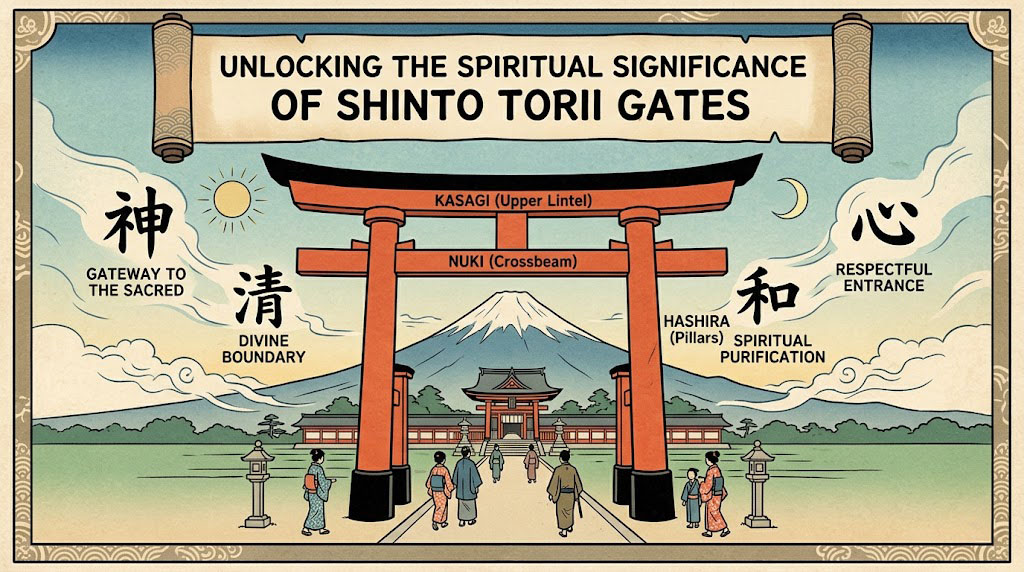
At its core, a torii gate is a traditional Japanese gateway most commonly found at the entrance of or within a Shinto shrine, where it symbolically marks the transition from the profane to the sacred. Consisting of two upright posts (hashira) topped by two horizontal lintels (the upper kasagi and lower nuki), their striking form is instantly recognizable worldwide as a symbol of Japan. Every torii stands as an invitation to a different kind of space, a physical and spiritual demarcation line where the everyday concerns of humanity give way to the spiritual presence of the kami.
More than mere architectural elements, torii gates serve as the primary identifier of a Shinto shrine, guiding visitors and worshippers alike into a space dedicated to divine spirits. Passing through a torii is often the first step in a Shinto pilgrimage or visit, initiating a sense of purification and reverence. The simplicity of its design belies the profound depth of its spiritual role, embodying the core Shinto belief in the sacredness of nature and the omnipresence of kami.
Origins and History
The exact origins of the torii are shrouded in the mists of ancient Japanese history, making it a subject of fascinating speculation. While often associated with the earliest forms of Shinto worship, which predates organized religion and writing, concrete historical records are scarce. One prominent theory suggests that the torii might have evolved from ancient gates or structures used to separate sacred areas, perhaps influenced by similar architectural forms from other Asian cultures, such as the Chinese paifang or the Indian torana. However, distinct Japanese characteristics are undeniable.
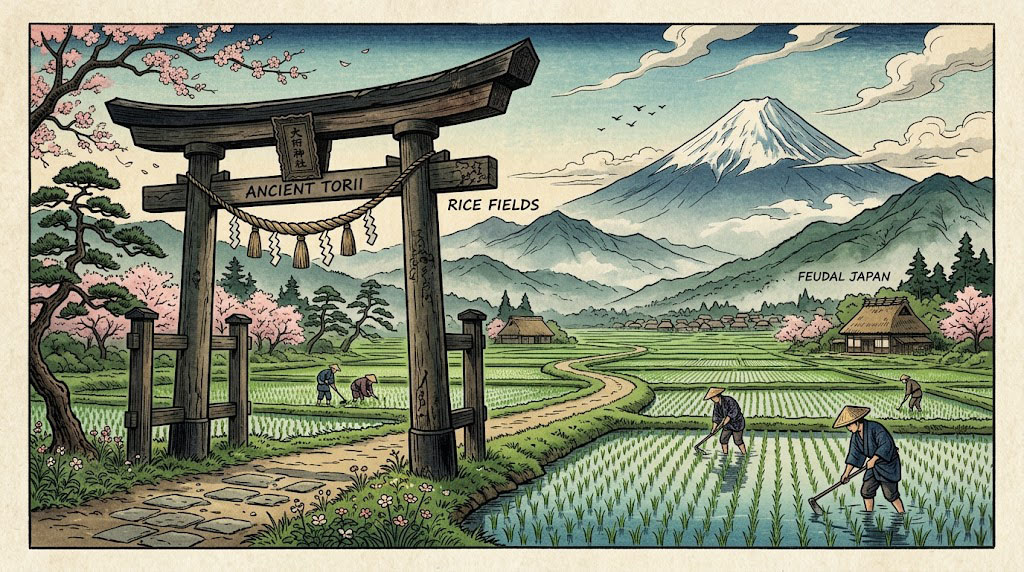
The earliest known torii gates were likely simple wooden structures, perhaps even just two posts with a rope (shimenawa) strung between them, designed to mark a sacred space where kami were believed to reside or descend. Early literary accounts, such as the Kojiki (古事記, Records of Ancient Matters) and Nihon Shoki (日本書紀, The Chronicles of Japan), make mention of structures resembling torii, though not always by that specific name. Over centuries, these humble markers evolved into the more elaborate and diverse forms we see today, adopting more sophisticated carpentry techniques and becoming integral features of shrine complexes as Shintoism developed into a more formalized religion across Japan.
Torii Gate’s Appearance, Meaning, and Purpose
The Shinto torii gate meaning is multifaceted, extending beyond its physical form to its symbolic role. Visually, torii gates vary greatly in material, color, and specific structural details, yet they all adhere to the fundamental two-post, two-lintel design. The most famous torii are often painted vermilion, a color traditionally associated with protection, vitality, and the warding off of evil, echoing ancient Chinese and Buddhist influences. However, many torii, especially older or more rustic ones, are left as natural wood or stone, allowing them to blend seamlessly with their natural surroundings and emphasize Shinto’s connection to nature.
Symbolism and Spiritual Significance
The primary spiritual significance of a torii gate is its role as a sacred boundary. It represents the transition from the mundane world (sokkai) to the sacred world (shinkai) of the kami. Passing beneath a torii is a symbolic act of purification, where one leaves behind worldly concerns and prepares to enter a divine space. It encourages visitors to adjust their mindset, becoming more mindful and respectful as they approach the shrine’s inner sanctuary. This act of passage is not merely physical; it is a spiritual cleansing, a preparation of the mind and spirit to engage with the sacred.
Furthermore, torii gates are often seen as markers for the presence of kami. They indicate that the space beyond is under the protection or influence of a deity. The presence of multiple torii along an approach path (like at Fushimi Inari Taisha) signifies increasingly sacred territory, drawing worshippers deeper into the spiritual realm. The torii itself can be imbued with a sacred presence, sometimes even acting as the dwelling place for lesser kami or spirits, reinforcing its profound spiritual role within Shinto belief.
Types of Torii and Their Construction
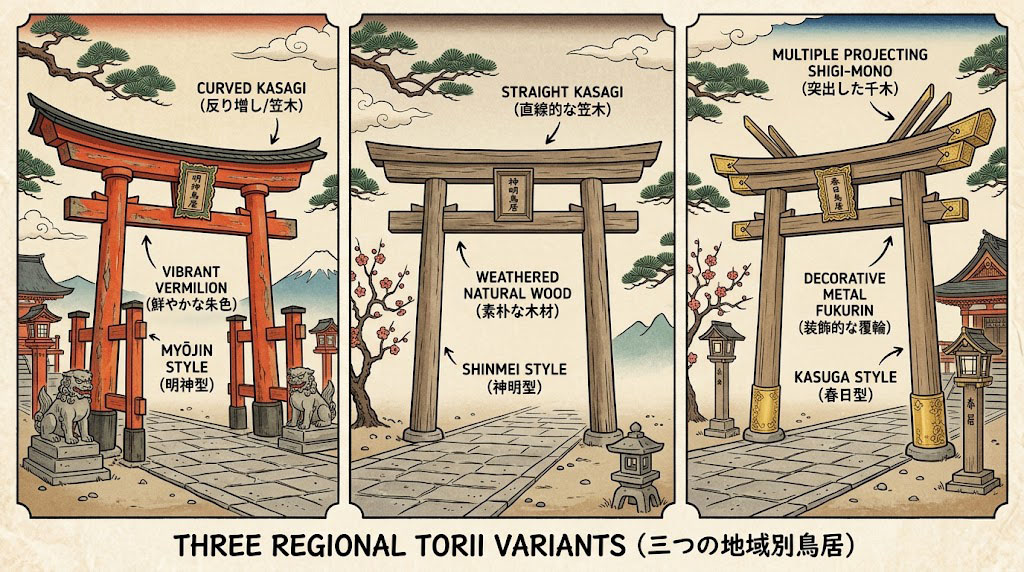
While the basic structure remains consistent, there are several distinct styles of torii, each with its own architectural nuances and historical background. The two most common classifications are the Myōjin torii (明神鳥居) and the Shinmei torii (神明鳥居).
The Myōjin torii is characterized by its curved top lintels (kasagi and nuki) that project upwards and often has a reinforced vertical support (chūzuka) connecting the two lintels. Its posts often lean slightly outwards. This style is perhaps the most famous, exemplified by the iconic vermilion gates of Fushimi Inari Taisha and Itsukushima Shrine. In contrast, the Shinmei torii is simpler and more ancient in appearance. Its lintels are straight, with the upper kasagi merely resting atop the posts without any upward curve or projection, and there is no reinforcing chūzuka. This style is commonly associated with older, more rustic shrines and reflects a simpler, more unadorned aesthetic, often found at Ise Grand Shrine. Other variations include the Kashima torii, Hachiman torii, and Kasuga torii, each with subtle differences in their lintel shapes, post angles, or decorative elements, reflecting regional styles or the specific lineage of the shrine.
Shinto Torii Gate vs Similar Shinto Concepts
| Feature | Torii Gate (鳥居) | Shimenawa (注連縄) | Tamagaki (玉垣) |
|---|---|---|---|
| Type | Sacred Gateway | Sacred Rope | Sacred Fence/Wall |
| Domain | Entrance/Boundary | Demarcation/Purification | Enclosure/Protection |
| Primary Function | Marks transition from profane to sacred space | Designates sacred objects/spaces, purifies | Delineates and protects the inner sacred precinct of a shrine |
| Key Symbolism | Threshold, purification, entrance to kami’s realm | Purity, presence of kami, warding off evil spirits | Boundary, reverence, guarding the main sanctuary |
| Visibility | Prominent, often iconic symbol of a shrine | Can be prominent or subtle, tied around trees, rocks, gates | Surrounds the main buildings, often less visible than torii |
Torii Gates in Modern Japan and Pop Culture
The torii gate’s compelling aesthetic and deep cultural resonance have cemented its place not only as a quintessential symbol of Japan but also as a globally recognized icon. In modern Japan, torii gates are ubiquitous; they are found not only at major shrines but also at smaller, local shrines, in private gardens, and even as miniature household altars (kamidana). Their presence serves as a constant reminder of Shinto’s enduring influence and the continuous connection between the physical and spiritual worlds. For many Japanese, passing through a torii is an ingrained ritual, a moment of reflection and respect that connects them to generations of ancestors and timeless spiritual traditions.
Beyond Japan, the torii has transcended its religious origins to become a powerful cultural motif. It features prominently in international tourism campaigns, inviting visitors to experience Japan’s unique spiritual landscape. In pop culture, torii gates appear frequently in anime, manga, and video games (such as the visually stunning torii gates in games like Ghost of Tsushima or Okami). These portrayals often highlight the gates’ mystical qualities, their association with spirits and ancient power, reinforcing their allure for a global audience. The image of a torii standing against a natural backdrop resonates deeply, symbolizing tranquility, tradition, and a doorway to another world, making it a beloved and iconic representation of Japanese heritage worldwide.
Where to Experience This in Japan
To truly appreciate the Shinto torii gate meaning and grandeur, experiencing them firsthand in Japan is essential. One of the most breathtaking experiences is at Fushimi Inari Taisha in Kyoto, famous for its thousands of vermilion torii gates forming a tunnel up Mount Inari. It’s an unforgettable visual spectacle. Another iconic site is the “floating” torii gate of Itsukushima Shrine (厳島神社) on Miyajima Island, a UNESCO World Heritage site that appears to float on the water during high tide. For a glimpse of a more ancient and simple style, visit Ise Grand Shrine (伊勢神宮) in Mie Prefecture, where the unpainted wooden Shinmei torii gates embody a serene, primal beauty. These locations offer a profound connection to the spiritual heart of Japan.
As Ian Reader and George Tanabe argue in Practically Religious: Worldly Benefits and the Common Religion of Japan (1998), the pursuit of worldly benefit through objects like omamori sits at the center, not the margins, of everyday Japanese religious life.
Frequently Asked Questions
What is the spiritual significance of a Shinto torii gate?
The spiritual significance of a Shinto torii gate is profound; it primarily serves as a symbolic gateway marking the transition from the everyday, profane world to the sacred realm of the kami (Shinto deities). Passing through a torii is considered an act of purification, where visitors leave their worldly concerns behind and prepare their minds and spirits to enter a divine space. It signifies a threshold where one must show reverence and mindfulness as they approach the shrine’s inner sanctuary and the presence of the gods.
Are all torii gates red? What do the colors mean?
No, not all torii gates are red. While the vibrant vermilion (red-orange) color is perhaps the most famous and striking, many torii gates are also found in their natural wood color or made of stone. The vermilion color, often associated with Myōjin torii, traditionally symbolizes vitality, protection, and the warding off of evil spirits. It is believed to bring good luck and ward off misfortune. Natural wooden or stone torii, often of the Shinmei style, tend to emphasize simplicity, purity, and a closer connection to nature, reflecting an older, more understated aesthetic of Shintoism.
How should one properly pass through a torii gate?
When approaching a torii gate, it is customary to pause, bow slightly, and then pass through. It is considered most respectful to avoid walking directly through the center, as the very middle path is traditionally reserved for the kami themselves. Instead, one should walk slightly to the left or right of the center. After passing through, it is also polite to turn back towards the torii and offer another slight bow as a sign of respect before continuing towards the shrine’s main buildings.
What are the different types of torii gates and where can they be found?
There are numerous types of torii gates, but the two main classifications are the Myōjin torii and the Shinmei torii. The Myōjin torii features curved, upward-sloping top lintels and is often painted vermilion; examples can be seen at Fushimi Inari Taisha (Kyoto) and Itsukushima Shrine (Miyajima). The Shinmei torii is simpler, with straight, uncurved lintels, often made of natural wood; it is characteristic of the Ise Grand Shrine (Mie Prefecture). Other styles like Kasuga torii, Hachiman torii, and Kashima torii have unique structural details and are typically found at shrines associated with their respective namesakes or regions.