Kami Japanese spirits are the divine forces at the heart of Shinto — sacred beings that inhabit nature, ancestors that watch over the living, and mysterious presences that permeate every aspect of Japanese spiritual life.
Imagine standing before an ancient cedar tree, its roots delving deep into the earth for centuries, its branches reaching towards the heavens like grasping fingers. Do you feel a presence? A subtle energy, a profound sense of awe? In Japan, this feeling is deeply ingrained in the culture, attributing a divine essence to such natural wonders. This isn’t merely poetic sentiment; it’s the core of Shinto, Japan’s indigenous belief system, where the sacred manifests in countless forms. Forget the Western notion of an omnipotent, singular deity; Shinto introduces us to Kami, a fascinating and diverse pantheon of Japanese gods, spirits, and fundamental forces. They are everywhere, in everything, and understanding them is key to unlocking the spiritual heart of Japan. This article will guide you through the multifaceted world of Kami, revealing their origins, nature, and profound influence on Japanese life.
Quick Facts: Kami – Japanese Gods
| Detail | Information |
|---|---|
| Japanese Name | 神 (kami) |
| Type / Category | Shinto Deity / Spirit / Divine Essence |
| Origin | Ancient Japan (Jomon period onward) |
| Element / Domain | Nature, ancestors, virtues, specific places, objects |
| Known For | Imbuing natural phenomena, revered ancestors, and exceptional beings with divine power and sacredness, forming the core of Shinto worship. |
| Modern Appearances | Anime (e.g., “Spirited Away,” “Princess Mononoke”), manga, video games (“Okami”), festivals, daily life reverence. |
What Is Kami?
Kami (神) are the gods, spirits, and sacred forces at the heart of Shinto, Japan’s native religion. Rather than ruling from a distant heaven, they dwell within the world itself — in nature, in revered ancestors, and in places of great power.
The term Kami (神, kami) is central to Shinto, Japan’s native religion, yet its meaning is far more expansive and nuanced than the English word “god.” Kami are not transcendent, omnipotent beings ruling from a distant heaven, but rather immanent forces that exist within the world, often residing in nature, exceptional individuals, and even abstract concepts. They embody the sacredness and awe-inspiring power found in the universe. Rather than a distinct pantheon like Greek or Roman gods, Kami are a continuum of divine essences, ranging from the creators of the world, like Amaterasu-Omikami, to the spirits of ancestors, revered leaders, or even a specific mountain, river, or rock. To understand Kami is to appreciate a worldview where the divine is not separate from the mundane but deeply interwoven with it, manifesting in moments of profound beauty, awe, and power. They represent the sacred mysteries and vibrant life force that permeate all existence.
Shinto is often described as the “way of the Kami” (神道, Shintō), a practice centered on worshipping and honoring these spirits. This reverence takes many forms, from grand festivals (matsuri) at meticulously maintained shrines (jinja) to simple, heartfelt prayers offered at home altars (kamidana). The presence of Kami is felt in the rustle of leaves, the roar of a waterfall, the birth of a child, or the wisdom of an elder. They are not merely objects of worship but active participants in the world, capable of blessing or bringing misfortune, guiding human destiny, and maintaining the harmony of the cosmos. Understanding Kami is essential to grasping the unique spiritual fabric that has shaped Japanese culture for millennia.
Origins and History
The concept of Kami is deeply rooted in Japan’s prehistoric animistic beliefs, stretching back to the Jomon period (10,000 BCE – 300 BCE). Early Japanese people observed the awesome and sometimes terrifying power of nature – earthquakes, typhoons, volcanic eruptions, the life-giving force of the sun and rain – and attributed these phenomena to unseen divine entities. Mountains, rivers, trees, and unusual rocks became focal points for reverence. As agricultural societies developed, Kami associated with harvests, fertility, and protection gained prominence. The earliest written records, such as the Kojiki (Records of Ancient Matters, 712 CE) and Nihon Shoki (Chronicles of Japan, 720 CE), codified these ancient myths, establishing genealogies for the major Kami, particularly those related to the Imperial Family, and forming the foundational narratives of Shinto. These texts also detailed the creation of Japan and the roles of various Kami in shaping the world and human society.
Over centuries, the understanding and worship of Kami evolved, incorporating elements from Buddhism and other foreign influences while retaining its unique indigenous character. The practice of enshrining deceased emperors, heroes, and even scholars as Kami further expanded the pantheon, transforming individuals of great merit into objects of veneration. The continuous development of shrine architecture, rituals, and festivals solidified the organized practice of Shinto, ensuring that the reverence for Kami remained a vibrant and integral part of Japanese identity and daily life, even as the country embraced modernity.
Kami’s Appearance, Powers, and Behavior
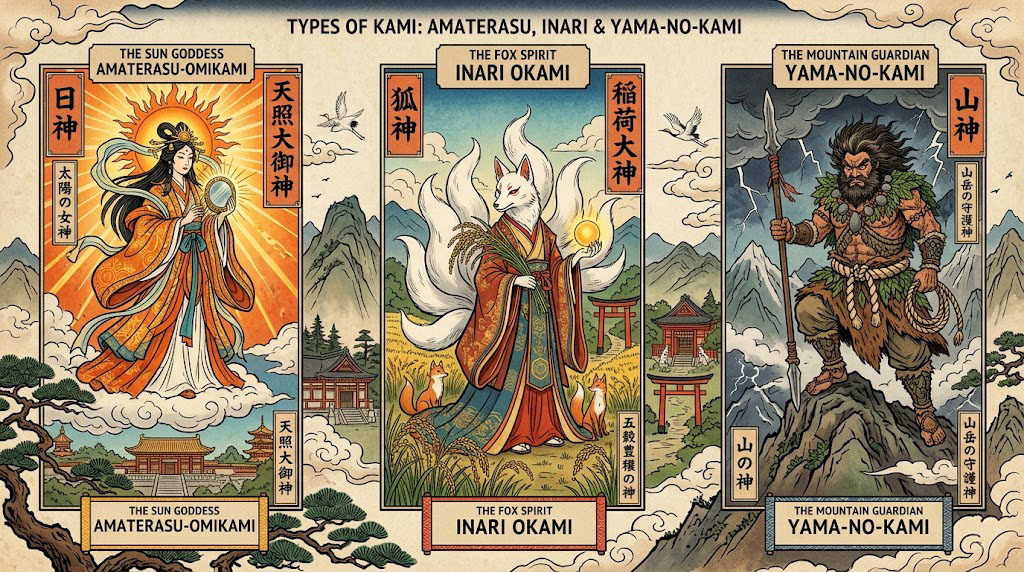
Unlike the anthropomorphic gods of many Western religions, Kami do not typically have fixed “appearances.” They are often unseen forces, perceived through their effects or symbolized by specific objects and locations. A mountain itself can be a Kami, or the spirit within it. However, in art and mythology, some Kami are depicted with human-like forms, animal characteristics (like the fox messengers of Inari Okami), or even abstract representations such as mirrors (representing Amaterasu). Their “powers” are equally diverse, ranging from controlling natural phenomena like storms and harvests, to bestowing blessings of good fortune, health, or protection, to inspiring courage or creativity. They are believed to influence human endeavors and the well-being of the nation.
The “behavior” of Kami is often a reflection of the natural world – sometimes benevolent and nurturing, sometimes fierce and destructive. They can be appeased through respectful offerings, purification rituals (oharai), and sincere prayers. Conversely, neglect or disrespect can lead to misfortune or anger. The concept of tataru (祟る), or divine retribution from an angry Kami, highlights the importance of maintaining harmony and respect. Their presence is often marked by a sense of purity and spiritual cleanliness (kegare), making rituals of purification paramount in Shinto practice to ensure proper interaction with the sacred.
Rituals and Practices
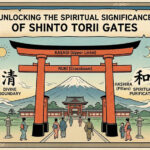
Interaction with Kami primarily occurs through various rituals and practices at Shinto shrines. Central to these is the act of worship, which often involves specific procedures. Visitors typically approach the main shrine hall (honden or haiden), offer a monetary donation (osaisen), ring a bell to attract the Kami’s attention, clap their hands twice, and bow before offering a silent prayer. This simple act is known as ni-rei ni-hakushu ichi-rei (two bows, two claps, one bow). Purification rituals, such as washing hands and rinsing mouths at the temizuya (purification fountain) upon entering a shrine, are crucial for cleansing oneself before approaching the divine. These acts demonstrate respect and sincerity.
More elaborate rituals are performed by Shinto priests (kannushi) during festivals (matsuri) or special occasions. These may involve offerings of food and drink (shinsen), ceremonial dances (kagura), and formal prayers (norito) to invoke the Kami’s presence and blessings. The goal of all these practices is to foster a harmonious relationship with Kami, ensuring their continued benevolence and maintaining the balance between the human and spiritual worlds. The essence of these rituals is not about asking for favors, but about expressing gratitude and maintaining a state of purity and reverence.
Diversity and Classification
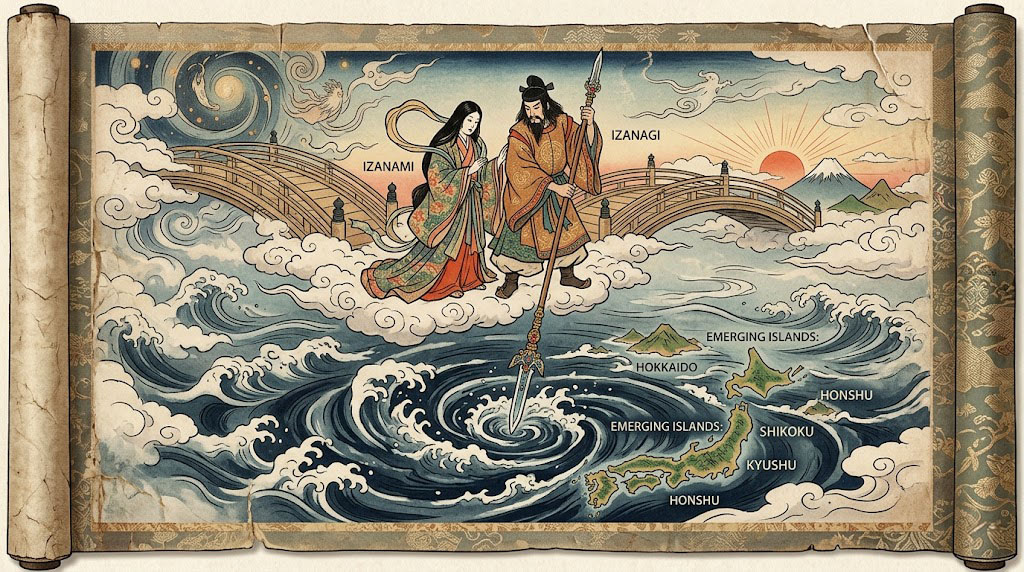
The sheer diversity of Kami is astounding, reflecting the comprehensive nature of Shinto. They can be broadly categorized. Amatsukami (Heavenly Kami) include the primordial deities who created Japan, such as Izanagi and Izanami, and major deities like Amaterasu-Omikami, the sun goddess. Kunitsukami (Earthly Kami) are those associated with the land, mountains, rivers, and specific regions, embodying the spirit of local places. A third category, Magatsukami, represents malevolent or destructive spirits, often requiring appeasement. Furthermore, deceased emperors, historical heroes, and distinguished individuals can be enshrined as Kami, becoming Hitogami (Human Kami) – examples include Emperor Meiji or Sugawara no Michizane, now Tenjin, the Kami of scholarship.
This classification is not rigid, and many Kami defy simple categorization, often having multiple aspects or domains. For instance, Inari Okami, while often associated with foxes, is primarily the Kami of rice, agriculture, business, and fertility. Regional variations in Kami worship are also common, with local communities often revering specific Kami unique to their area, perhaps a protective deity of a particular village or a spirit residing in a unique natural landmark. This localized worship contributes to the rich tapestry of Shinto beliefs, making the spiritual landscape of Japan incredibly vibrant and diverse, with countless shrines dedicated to myriad Kami.
Kami vs Similar Concepts
| Feature | Kami | Yōkai | Hotoke |
|---|---|---|---|
| Type | Shinto Deity/Spirit | Supernatural Creature/Monster | Buddhist Deity/Enlightened Being |
| Domain | Nature, ancestors, virtues, specific places, objects | Folklore, supernatural occurrences, specific places | Buddhism, enlightenment, karma, rebirth |
| Nature | Primarily revered, can be benevolent or destructive, but fundamentally sacred | Often mischievous, dangerous, or strange; rarely worshipped directly | Objects of veneration, enlightened beings, guides to salvation |
| How to interact | Worship, offerings, prayers, purification at shrines | Avoid, appease, trick; often feared or respected through lore | Pray to, meditate on, seek guidance from in temples |
| Origin | Indigenous Japanese animism, ancient myths, deified humans | Folk beliefs, legends, oral traditions | Indian Buddhism, introduced to Japan via China/Korea |
These contrasts grow even sharper once you step outside Shinto altogether.
Buddhist cosmology, for instance, describes the warrior demigods of the Ashura realm — powerful beings ruled by pride and rage rather than the sacred harmony of the kami.
Kami in Modern Japan and Pop Culture
The concept of Kami permeates Japanese culture, extending far beyond the walls of Shinto shrines. From the meticulous care taken in gardening to the respect for elders, the spirit of Kami can be seen influencing daily life. The annual cycle of festivals (matsuri) across Japan is a vibrant testament to this enduring reverence, with communities coming together to honor their local Kami, celebrate harvests, and pray for prosperity. Even in a highly modernized society, the spiritual connection to the land and its inherent sacredness remains strong. This deep-rooted belief also shapes the Japanese aesthetic, emphasizing harmony with nature, purity, and appreciation for the subtle beauty in the world.
In modern pop culture, Kami have found new life and international appeal, captivating audiences worldwide. Studio Ghibli films like “Spirited Away” (千と千尋の神隠し, Sen to Chihiro no Kamikakushi) and “Princess Mononoke” (もののけ姫, Mononoke Hime) beautifully portray a world where Kami, nature spirits, and ancient gods coexist with humans, exploring themes of environmentalism and spiritual balance. Video games like “Okami,” which features Amaterasu as a white wolf goddess, bring Shinto mythology to an interactive format. Manga, anime, and traditional arts continue to draw inspiration from the vast pantheon of Kami, ensuring their stories and significance are passed down through generations and shared with a global audience, proving the timeless resonance of these unique Japanese gods.
Where to Experience This in Japan
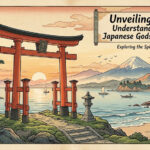
To truly experience the world of Kami, a visit to a Shinto shrine is essential. The Ise Grand Shrine (伊勢神宮, Ise Jingū) in Mie Prefecture, dedicated to Amaterasu-Omikami, is Japan’s most sacred shrine and offers a profound glimpse into Shinto’s spiritual heart. Another significant site is Fushimi Inari Taisha (伏見稲荷大社) in Kyoto, famous for its thousands of vermilion torii gates winding up the mountain, dedicated to Inari Okami, the Kami of rice and business. For a more direct encounter with nature Kami, explore the ancient cedar forests of Yakushima Island, a UNESCO World Heritage site, where monumental trees are revered as living Kami, embodying the very spirit of the earth. Attending a local matsuri, like Kyoto’s Gion Matsuri or Tokyo’s Kanda Matsuri, also provides an immersive experience of community worship and vibrant celebration of Kami.