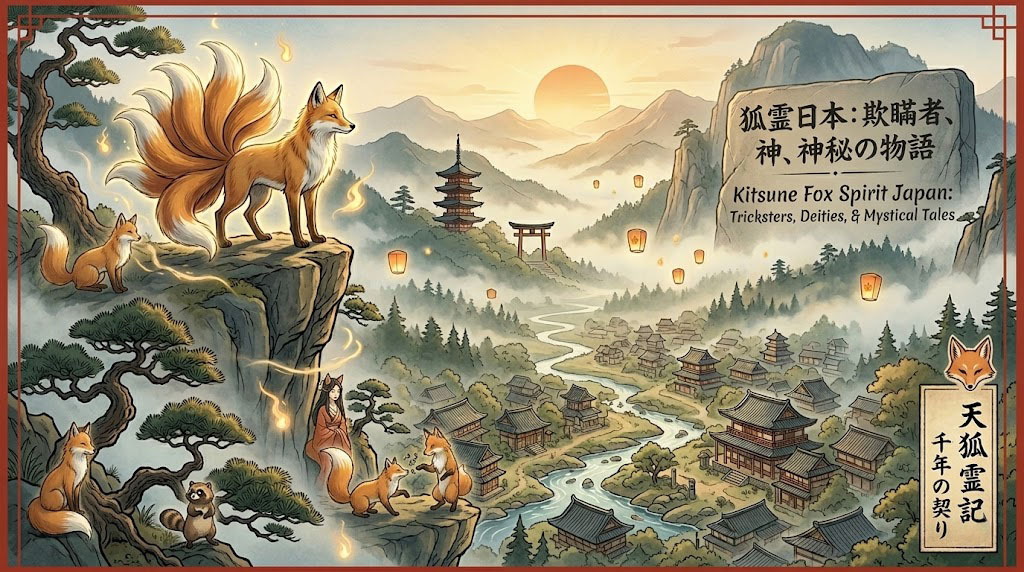
The kitsune fox spirit is one of Japan’s most captivating mythological beings — an intelligent, shapeshifting fox that can be a trickster, a divine messenger, or a powerful supernatural force.
Imagine wandering through a hushed bamboo forest as dusk settles, the air growing cool and still. Suddenly, a flash of red-orange fur darts through the undergrowth, its eyes glinting with an unnerving intelligence. Was it just an ordinary fox, or something far more ancient, far more powerful? In Japan, a simple fox is rarely just a fox. It might be a kitsune (狐, kitsune), a legendary fox spirit, master of illusion and shapeshifting, a creature capable of both profound benevolence and devastating trickery. For centuries, these enigmatic beings have woven their way into the very fabric of Japanese culture, inspiring awe, fear, and reverence. They guard sacred shrines, seduce unwary travelers, and even bestow wisdom upon emperors. But what truly lies beneath their captivating fur and cunning smiles? Prepare to delve into the captivating world of the Japanese kitsune, where myth intertwines with reality, and the line between animal and deity blurs.
Quick Facts: Kitsune Fox Spirit
| Detail | Information |
|---|---|
| Japanese Name | 狐 (kitsune) |
| Type / Category | Yokai / Kami (Shinto Deity) |
| Origin | Ancient Japanese folklore, possibly influenced by Chinese fox spirits |
| Element / Domain | Fire (foxfire), spiritual realm, forests, Inari shrines |
| Known For | Shapeshifting, illusions, possession, intelligence, longevity, multiple tails (sign of power) |
| Modern Appearances | Naruto, Pokémon, Okami, Nioh, Kamisama Kiss, Spirited Away, League of Legends (Ahri) |
What Is Kitsune?
The kitsune (狐, kitsune) is perhaps one of Japan’s most iconic and complex supernatural entities, holding a unique dual role as both a formidable yokai (supernatural being) and a revered servant of the Shinto deity Inari Okami, the kami of rice, sake, and prosperity. Unlike a mundane fox, a kitsune possesses supernatural intelligence, immense magical abilities, and an exceptionally long lifespan, which it uses to influence the human world. Their power is often visually represented by the number of tails they possess, with a nine-tailed fox (kyuubi no kitsune) being the most potent and ancient.
In Japanese culture, kitsune are not simply ‘good’ or ‘evil’; their nature is multifaceted and often dictated by circumstance or their relationship with humans. They can be benevolent guardians, loyal companions, and wise mentors, bestowing good fortune, protection, or ancient knowledge upon those they favor. Conversely, they can be mischievous tricksters, vengeful spirits, or dangerous seductresses, ensnaring humans with illusions, causing misfortune, or even possessing individuals. This fluidity makes encounters with kitsune unpredictable and deeply fascinating, reflecting the intricate balance of the natural and spiritual worlds in Japanese belief.
Origins and History
The legends of kitsune are deeply rooted in ancient Japanese folklore, with some scholars suggesting early influences from similar fox spirits in Chinese mythology, such as the huli jing. However, the Japanese kitsune evolved with distinct characteristics and a profound connection to native Shinto beliefs, particularly with the widespread veneration of Inari Okami. Early records of fox lore appear in texts like the Nihon Shoki (Chronicles of Japan, 720 AD) and the Konjaku Monogatarishu (Tales of Times Now Past, 12th century), which feature stories of foxes displaying uncanny intelligence and supernatural powers.
During the Heian period (794-1185 AD), kitsune legends flourished, often depicting them as seductive women or tricky monks. Their association with Inari shrines became firmly established during this period, solidifying their role as divine messengers and protectors. As Buddhism spread, kitsune were sometimes incorporated into Buddhist narratives, depicted as wise spirits or even as manifestations of bodhisattvas. Over centuries, these tales were passed down through oral tradition, refined in literature, and depicted in art, leading to the rich and diverse body of kitsune folklore we know today, emphasizing their adaptability and enduring presence in the Japanese imagination.
Kitsune’s Appearance, Powers, and Behavior
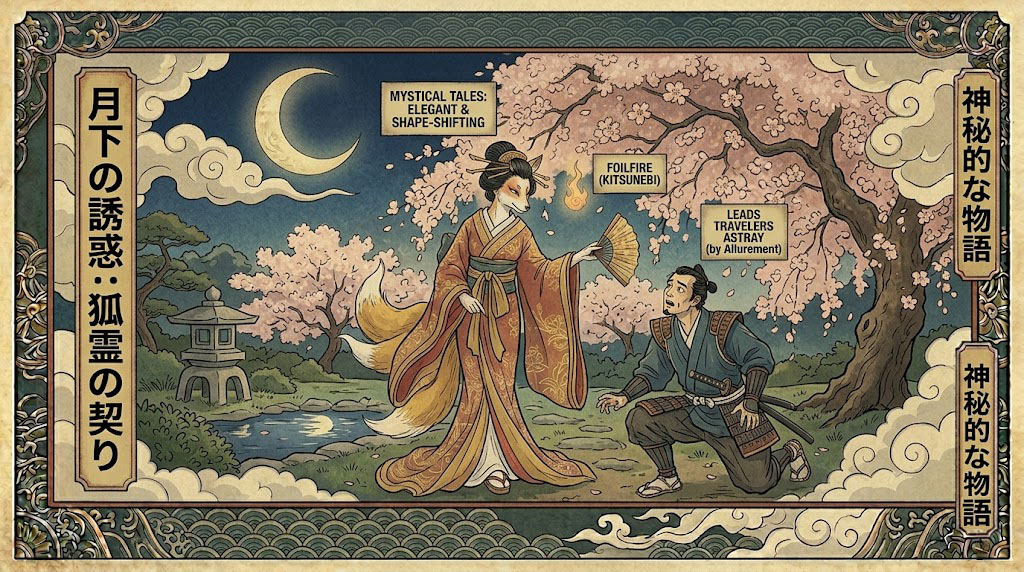
In their natural form, kitsune are indistinguishable from ordinary foxes, though they often possess an uncanny beauty or a strikingly vibrant coat. However, their true power lies in their ability to manifest in various guises. The most common and iconic transformation is into a human, usually a beautiful woman, but they can also appear as men, children, or even inanimate objects. What often betrays a kitsune in human form is a lingering fox-like trait, such as a shadow of their true form visible in water, a peculiar fear of dogs, or an inability to fully conceal their tail, which might peek out from under clothing.
Powers and Abilities of the Kitsune
The magical prowess of a kitsune grows with its age and the number of its tails. Their most renowned ability is shapeshifting (化け狐, bake-gitsune), allowing them to assume almost any form. Closely related is their mastery of illusions (幻術, genjutsu), capable of creating entire phantom realities, tricking humans into seeing things that aren’t there, or making them believe they are experiencing something entirely different. They are also known for kitsunebi (狐火, foxfire), ghostly flames often blue or green, which they breathe or conjure from their tails to lure travelers astray or set things alight.
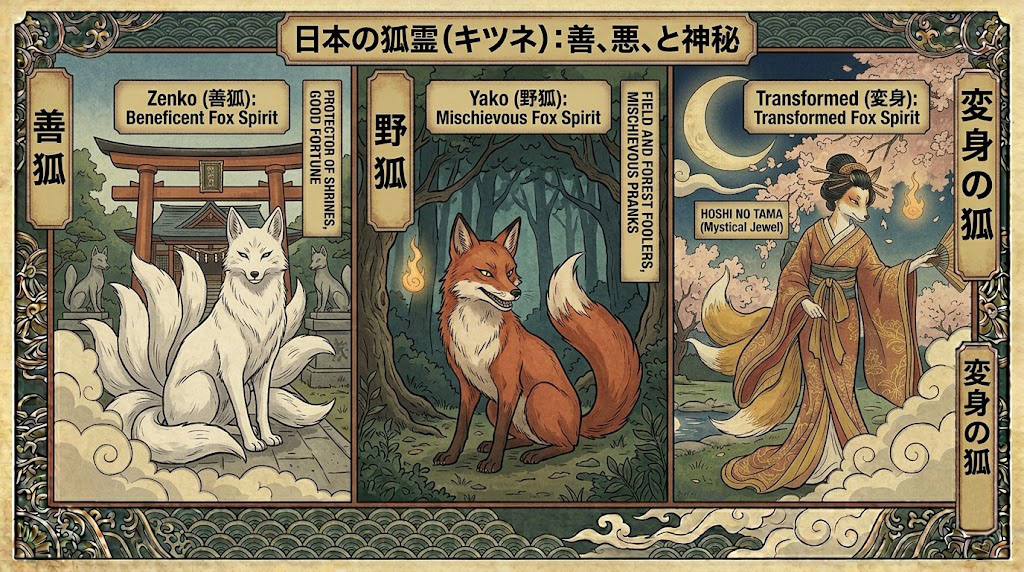
Beyond these, kitsune can possess humans, granting their host enhanced strength or madness, and some are said to be able to create dreams, generate lightning, or even manipulate time and space. The mythical Hoshi no Tama (星の玉, star ball) is a small white ball or jewel that a kitsune often carries, said to contain its spirit or immense power. If a human obtains it, the kitsune might bargain to retrieve it, offering wishes or services in return.
Types of Kitsune and Their Roles
Kitsune are broadly categorized into two main types: the benevolent Zenko (善狐, good foxes) and the mischievous or malevolent Yako (野狐, field foxes), also known as Nogitsune. Zenko are celestial foxes associated with Inari Okami. They serve as divine messengers, guardians of shrines, and bringers of good fortune, often depicted with white fur. Their presence is usually a blessing, offering protection from evil and bestowing prosperity upon worthy individuals. These are the kitsune you’d hope to encounter.
Yako, on the other hand, are the more earthly and often unpredictable kitsune. While some may simply be mischievous tricksters, playing pranks on humans, others can be outright malicious, causing misfortune, possessing people, or leading them to their doom with their illusions. Their actions are driven by various motives, from hunger for power to simple amusement or revenge. The power of any kitsune is also tied to the number of their tails; a kitsune with one tail is relatively young and less powerful, while a nine-tailed kitsune (kyuubi no kitsune) is ancient, incredibly powerful, and capable of seeing and hearing all things across the world, often revered as a minor deity itself.
Kitsune vs Similar Japanese Yokai
| Feature | Kitsune (Fox Spirit) | Tanuki (Raccoon Dog Spirit) | Bakeneko (Cat Spirit) |
|---|---|---|---|
| Type | Fox spirit, Yokai, Shinto deity messenger | Raccoon dog spirit, Yokai | Cat spirit, Yokai |
| Domain | Forests, Inari shrines, spiritual realm | Forests, rural areas, human homes (sometimes) | Human homes, urban areas, specifically old cats |
| Danger Level | Varies (benevolent deity to dangerous trickster/seducer) | Mostly mischievous, rarely malicious; brings good fortune | Can be mischievous, but also highly dangerous and vengeful |
| How to appease | Offerings at Inari shrines (fried tofu – Aburaage), respect | Offerings of sake, money, food, showing respect to statues | Respectful treatment, good care of cats, sometimes specific offerings |
| Modern pop culture | Naruto, Pokémon, Okami, Inari Konkon, League of Legends | Pom Poko, Super Mario Bros. 3, Animal Crossing, Ghibli films | Persona, GeGeGe no Kitaro, Natsume’s Book of Friends, various horror films |
Kitsune in Modern Japan and Pop Culture
Even today, the presence of kitsune in Japan is palpable, extending far beyond ancient scrolls and folklore. Inari shrines, instantly recognizable by their rows of red torii gates and numerous fox statues, are found throughout the country, from bustling cities to quiet mountaintops. These statues, often adorned with red bibs and holding symbolic items like keys or scrolls, serve as a constant reminder of the kitsune’s revered status as Inari’s messengers. Festivals dedicated to Inari Okami, such as the Hatsu-Uma Matsuri, often feature fox masks and decorations, celebrating their sacred connection.
Globally, the kitsune’s mystique has captivated audiences through countless appearances in popular culture. Anime and manga frequently feature kitsune characters, from the iconic nine-tailed beast in Naruto to the divine messengers in Kamisama Kiss and the trickster yokai in Natsume’s Book of Friends. Video games like Okami, Nioh, and Pokémon (with characters like Ninetales) draw heavily on kitsune lore, allowing players to interact with or even embody these powerful spirits. This enduring fascination stems from their unique blend of beauty, power, and moral ambiguity, making them perfect archetypes for complex characters and compelling narratives that resonate with people worldwide, symbolizing nature’s wild, untamable spirit and the hidden magic within the world.
Where to Experience This in Japan
To truly immerse yourself in the world of kitsune, a visit to Japan offers incredible opportunities. The most famous destination is Fushimi Inari-taisha (伏見稲荷大社) in Kyoto, renowned for its thousands of vermillion torii gates and countless fox statues. You’ll feel the kitsune’s presence at every turn. Another fascinating spot is Zao Fox Village (蔵王キツネ村) in Miyagi Prefecture, where you can observe over a hundred free-roaming foxes up close. While these are living foxes, not spirits, the experience offers a glimpse into their captivating nature. For a deeper spiritual connection, many local Inari shrines across Japan, even small neighborhood ones, maintain the tradition of honoring kitsune and provide a serene space to reflect on their enduring legacy.
One particularly evocative tradition comes from Oji, in Tokyo. Local legend held that foxes from across the Kanto region gathered near Oji Inari Shrine every New Year’s Eve — a belief famous enough in the Edo period that Utagawa Hiroshige devoted one of his celebrated 100 Famous Views of Edo prints (1857) to the scene. The print is now held in museum collections including the Met and the Art Institute of Chicago, and the “fox fire” procession is still reenacted at the shrine every New Year’s Eve today.
Kitsune are one of many shapeshifting and spectral figures in Japanese folklore — the tragic Yuki-Onna and the broader distinction between yokai and yurei offer further ways to explore this supernatural world.
Frequently Asked Questions
What exactly is a kitsune fox spirit in Japanese folklore?
A kitsune is a supernatural fox spirit from Japanese folklore, distinguished from ordinary foxes by its advanced intelligence, magical abilities, and extended lifespan. They are masters of shapeshifting and illusion, capable of appearing as humans, often beautiful women. Kitsune hold a complex place in Japanese culture, acting as both benevolent messengers of the Shinto deity Inari Okami and as mischievous or even malevolent tricksters, reflecting the unpredictable nature of the spiritual world.
Are kitsune inherently good or bad, or does their nature vary?
The nature of a kitsune is not strictly good or bad; it varies significantly. They are broadly categorized into Zenko (good foxes), who are divine messengers associated with Inari and bring good fortune, and Yako (field foxes), who are often mischievous tricksters or even malevolent spirits. Their actions typically depend on their individual temperament, motivations, and how they are treated by humans. A kitsune’s power, indicated by the number of its tails, also influences its potential for both good and harm.
How many tails can a kitsune have, and what does it signify?
A kitsune can have up to nine tails, with the number of tails signifying its age, wisdom, and power. A young kitsune typically has one tail, while a kitsune that has lived for a thousand years is said to gain its ninth tail, becoming a powerful kyūbi no kitsune (nine-tailed fox). These nine-tailed kitsune are considered highly intelligent, almost god-like beings with vast magical abilities, including omniscience and omnilocation. Gaining more tails is a mark of significant spiritual development and magical prowess.
Where do the legends of kitsune originate in Japanese mythology?
The legends of kitsune are deeply embedded in ancient Japanese mythology, with their earliest mentions appearing in texts from the 8th century like the Nihon Shoki and Konjaku Monogatarishu. While there might have been some influence from Chinese fox spirits (huli jing), the Japanese kitsune developed its own distinct identity and a strong connection to native Shinto beliefs, particularly with the widespread veneration of Inari Okami, the deity of rice and prosperity. Their role as divine messengers and magical beings evolved over centuries, becoming an integral part of Japanese folklore.