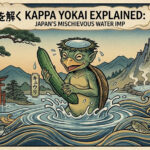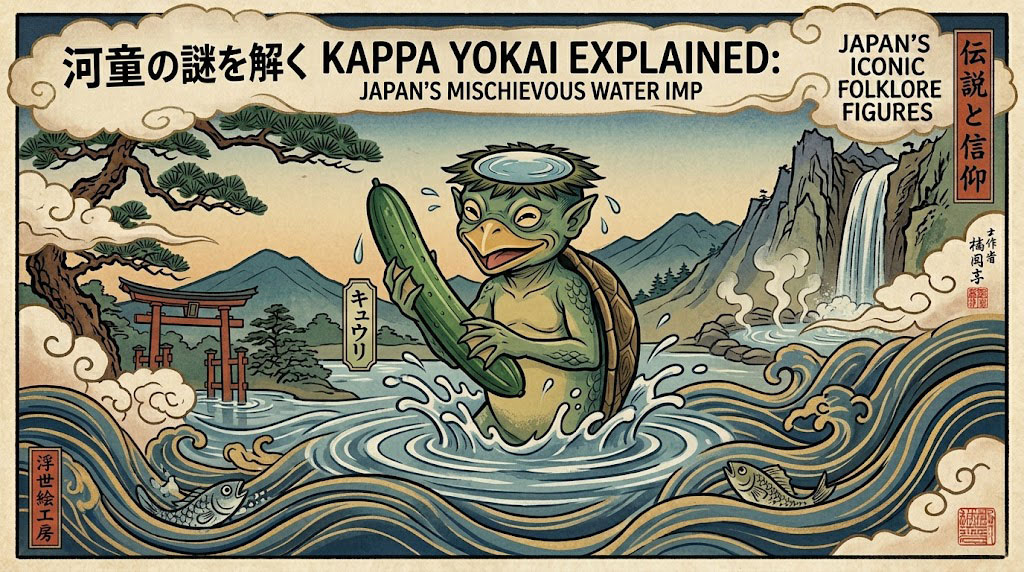
The kappa yokai is one of Japan’s most iconic supernatural creatures — a mischievous water imp with a turtle shell and a water-filled dish on its head that inhabits rivers and lakes across Japan.
Imagine a quiet Japanese river, sunlight dappling through the willows, when suddenly, a scaly hand reaches out from beneath the murky surface. A creature with a turtle-like shell, frog-like skin, and a distinctive dish on its head emerges, its eyes gleaming with mischief. This is the Kappa, (河童, kappa) one of Japan’s most famous and enduring yokai, a figure woven deeply into the fabric of the nation’s folklore. For centuries, these enigmatic water imps have captivated imaginations, serving as cautionary tales for children, symbols of nature’s untamed power, and even objects of reverence. From their insatiable love for cucumbers to their surprising politeness, the Kappa is a creature of intriguing contradictions that embodies the ancient mysteries lurking beneath Japan’s serene waters. Prepare to dive deep as we explain everything you need to know about these legendary aquatic beings.
Quick Facts: Kappa Yokai
| Detail | Information |
|---|---|
| Japanese Name | 河童 (kappa) |
| Type / Category | Water Yokai / Amphibious Spirit |
| Origin | Nationwide, but especially prominent in Tono (Iwate Prefecture) and Kyushu |
| Element / Domain | Rivers, ponds, lakes, canals, and other freshwater bodies |
| Known For | Cucumber obsession, sumo wrestling prowess, stealing children’s shirikodama (a mythical organ), and a peculiar politeness when bowed to. |
| Modern Appearances | GeGeGe no Kitaro, Natsume Yuujinchou, Yo-kai Watch, Animal Crossing, Pokemon (indirectly), Dragon Ball, Spirited Away (implied), various manga and anime. |
What Is Kappa?
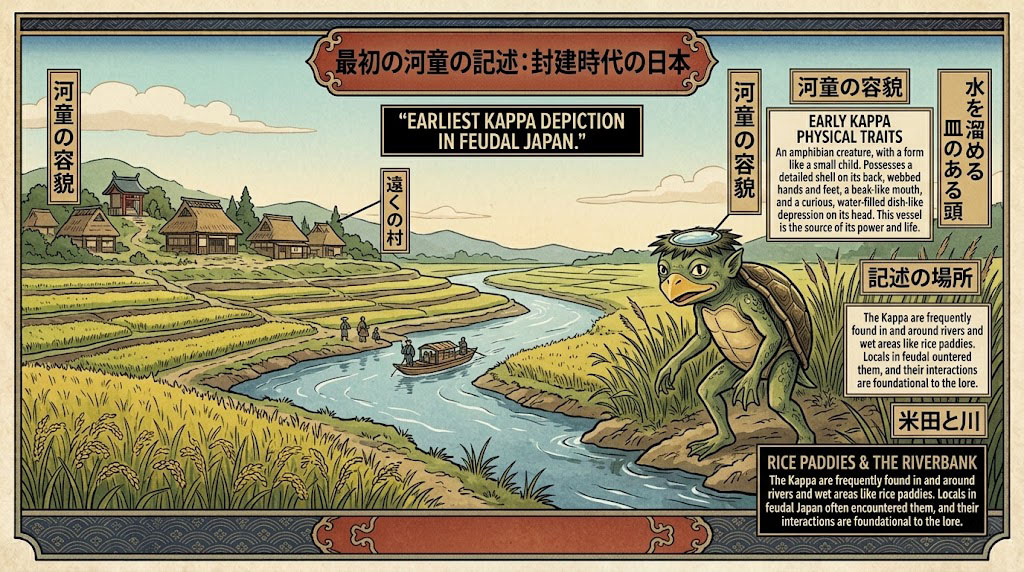
The Kappa is a quintessential Japanese water yokai, often described as an amphibious, human-like creature with reptilian features. They are typically portrayed as mischievous, sometimes malevolent, spirits that inhabit rivers, lakes, and ponds across Japan. While their exact appearance can vary by region, common traits include a turtle-like shell on their back, webbed hands and feet, scaly or frog-like green skin, and a distinctive, beak-like mouth. However, their most iconic feature is the “sara” (皿), a dish-like depression on the top of their head that must remain filled with water for them to maintain their strength and vitality. If this dish dries out or spills, the Kappa becomes weakened or even paralyzed, making it vulnerable.
More than just a frightening monster, the Kappa holds a complex place in Japanese culture. They serve as cautionary figures, warning children away from dangerous waters and reminding communities of the unpredictable power of nature. Yet, they are also associated with fertility, bounty, and even healing. Some legends suggest that if a Kappa is caught or helped, it might share valuable medical knowledge or assist in irrigation, highlighting their dual nature as both a threat and a potential benefactor. This nuanced portrayal reflects the ancient Japanese reverence for nature, acknowledging its capacity for both destruction and sustenance.
Origins and History
The legends of the Kappa are deeply rooted in Japan’s agrarian history and its reliance on water for rice cultivation. While the precise origin is shrouded in antiquity, tales of water-dwelling creatures can be traced back to early Shinto beliefs in nature spirits (kami). Some folklorists suggest that the Kappa’s imagery might have been influenced by sightings of real creatures like the giant salamander (オオサンショウウオ, ōsanshōuo), or perhaps even ancient Chinese water deities. The earliest recorded mentions of Kappa-like beings date back to the Nara Period (710-794 AD), with clearer depictions emerging in the Edo Period (1603-1868).
During the Edo Period, Kappa lore flourished, appearing in scrolls, woodblock prints, and popular literature. Merchants and travelers spread local legends across the country, leading to a rich tapestry of regional variations. For instance, the legends were particularly strong in regions like Tono in Iwate Prefecture and across Kyushu, where specific Kappa-buchi (Kappa pools) and shrines dedicated to these spirits can still be found today. These early narratives often highlighted the Kappa’s cunning and strength, emphasizing the need for respectful caution when interacting with the natural world.
Kappa’s Appearance, Powers, and Behavior
The typical Kappa is depicted as roughly the size of a child, though some accounts describe them as larger. Their skin is often green, but can also be blue, red, or even mottled, resembling that of a frog or reptile. Beyond the iconic turtle shell and the water-filled “sara” on their head, they possess a strong, bird-like beak for a mouth and often emit a croaking sound. Their hands and feet are webbed, making them formidable swimmers. It is said that the water in their head-dish is the source of their immense strength; if it’s spilled, they become helpless. This detail provides a crucial weakness for anyone unfortunate enough to encounter one.
Powers and Abilities
Kappa are renowned for their incredible physical strength, especially when in water. They are said to enjoy sumo wrestling and are nearly unbeatable in their aquatic domain. Their most infamous ability is pulling people, particularly children and horses, into rivers to drown them. Once submerged, they are believed to extract a mythical organ called the “shirikodama” (尻子玉) from their victim’s anus, which is said to contain the person’s soul or life force, leaving the victim a lifeless husk. Beyond their physical prowess, some legends attribute Kappa with knowledge of medicine and bone-setting, hinting at an ancient connection to natural healing traditions.
Regional Variations and How to Encounter It Safely
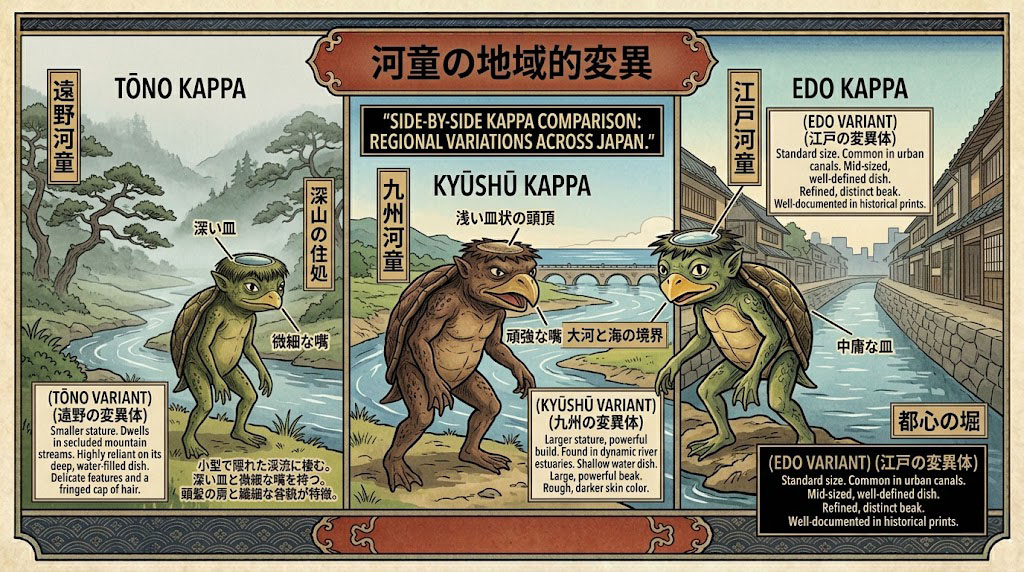
While the core characteristics of the Kappa remain consistent, regional folklore offers fascinating variations. In some areas, Kappa are described as having hair on their heads, while others differentiate them by color or size. For instance, the Kappa of Kyushu are sometimes said to be larger and more aggressive than their counterparts in the Tohoku region. Regardless of region, the most effective way to protect oneself from a Kappa is to exploit its inherent politeness. If you encounter a Kappa, a deep bow will compel the Kappa to return the gesture. When it bows, the water in its head-dish will spill, rendering it weak. A kind person might then refill the dish, earning the Kappa’s eternal gratitude or even a favor. Offering cucumbers, their favorite food, is also a universally accepted appeasement.
Kappa Yokai vs Similar Japanese Water Yokai
| Feature | Kappa (河童) | Ningyo (人魚) | Umi-bozu (海坊主) |
|---|---|---|---|
| Type | Amphibious freshwater imp | Mermaid/fish-human hybrid | Giant sea monster/spirit |
| Domain | Rivers, lakes, ponds, canals | Oceans, deep sea | Open sea, coastlines |
| Danger Level | High (drowning, shirikodama theft) but can be appeased/outsmarted | Medium (can lure sailors, sometimes brings bad luck or immortality if eaten) | Very High (capsizes ships, brings storms) |
| How to appease | Bow to spill head water, offer cucumbers/sumo challenge | No direct appeasement, but respectful caution is advised | Cannot be appeased; best to remain silent or throw a barrel overboard |
| Modern pop culture | GeGeGe no Kitaro, Yo-kai Watch, Natsume Yuujinchou, Dragon Ball | Ponyo, Animal Crossing, One Piece, various folklore retellings | One Piece, Princess Mononoke (spirit of the sea), various horror manga |
Kappa in Modern Japan and Pop Culture
Even in modern, technologically advanced Japan, the Kappa remains a beloved and highly visible figure. They continue to appear as cautionary figures in signs near rivers, warning children about water safety. Beyond folklore, Kappa have transitioned seamlessly into mainstream pop culture, becoming iconic characters in countless manga, anime, and video games. Their distinctive appearance and complex personality make them ideal for various roles, from friendly companions to formidable foes. Classic series like Shigeru Mizuki’s “GeGeGe no Kitaro” prominently feature Kappa, solidifying their place in the collective consciousness. They appear in “Natsume Yuujinchou” as minor but memorable characters, and are often referenced or appear in games like “Yo-kai Watch.”
The Kappa’s enduring appeal extends beyond Japan, captivating international audiences fascinated by Japanese mythology. Their unique blend of human-like traits, animalistic features, and supernatural abilities makes them endlessly intriguing. They serve as a powerful reminder of Japan’s deep respect for nature and the spiritual world, even in an increasingly urbanized society. From cute mascots to philosophical symbols of nature’s balance, the Kappa continues to resonate globally, embodying the vibrant imagination and rich cultural heritage of Japan.
Where to Experience This in Japan
For those eager to connect with Kappa legends, several locations in Japan offer unique experiences. The town of Tono in Iwate Prefecture is often called the “Land of Kappa” and is home to the renowned Kappa-buchi (カッパ淵), a river pool where Kappa are said to live, attracting visitors hoping for a glimpse.
Tono’s reputation as kappa country isn’t just tourism branding — it dates back to 1910, when folklorist Kunio Yanagita published Tōno Monogatari (遠野物語), a collection of 119 legends gathered from local storyteller Kizen Sasaki. The book is now considered the founding work of Japanese folklore studies, and it’s the reason Tono still calls itself a “yokai hometown” today.
Here, you can even purchase a “Kappa fishing license”! Another significant spot is Sogen-ji Temple (曹源寺), often called the “Kappa Temple,” in Asakusa, Tokyo, which houses what is claimed to be a mummified Kappa hand. Finally, local festivals in many rural areas, especially during summer, might feature Kappa-themed events or parades, keeping the tradition alive.
Kappa share the yokai stage with many other iconic figures — the mountain-dwelling Tengu and the fearsome Oni are two of the most famous, each reflecting a different side of Japan’s supernatural landscape.
Frequently Asked Questions
What is a Kappa in Japanese folklore?
A Kappa is a legendary amphibious human-like yokai (spirit or monster) from Japanese folklore. It typically inhabits rivers, lakes, and ponds, known for its mischievous to dangerous behavior. Kappa are often depicted as green-skinned, with a turtle-like shell and a distinctive, water-filled dish on their head that grants them strength.
What are the key characteristics of a Kappa’s appearance?
A Kappa’s most recognizable features include a turtle-like shell on its back, scaly green or blue skin, webbed hands and feet, and a beak-like mouth. Most importantly, they possess a bald, dish-like depression (sara) on the top of their head, which must remain filled with water for them to retain their immense power and vitality.
How can you protect yourself from a Kappa?
The most famous method to protect oneself from a Kappa is to exploit its profound politeness. If you encounter one, bow deeply. The Kappa, being compelled to return the bow, will spill the water from its head-dish, rendering it weak. Offering cucumbers, their favorite food, as a tribute is another effective way to avoid their mischief or even gain their favor.
Why are Kappa associated with cucumbers?
Kappa are strongly associated with cucumbers because folklore depicts them as having an insatiable craving for them. It is believed that offering cucumbers (often with names written on them, to prevent Kappa from harming those individuals) to a river will appease the Kappa, preventing them from harming humans or livestock. This has made cucumbers almost synonymous with Kappa in Japanese culture.