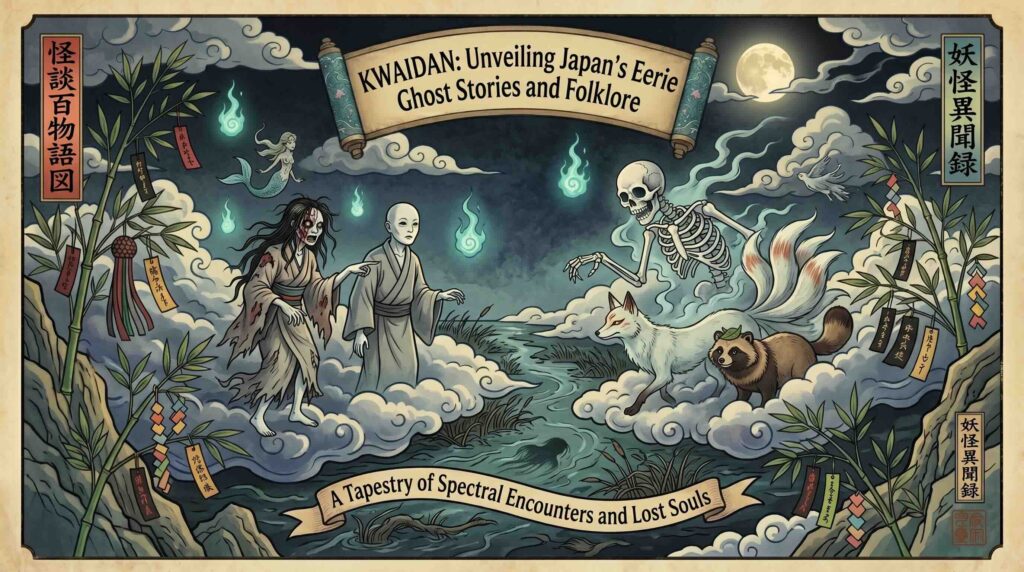
Imagine wandering through a moonlit Edo-period forest, a chill running down your spine. Was that a mischievous fox spirit darting between trees, or the mournful wail of a spectral woman seeking vengeance? In the rich tapestry of Japanese folklore, distinguishing between these encounters is crucial. While both are supernatural, the world of yokai (妖怪, ‘strange apparition’) and yurei (幽霊, ‘faint spirit’) are as distinct as night and day, each with unique origins, motivations, and cultural significance. Misunderstanding this fundamental difference isn’t just a minor slip; it means missing out on the profound depth and nuance of Japan’s spiritual landscape, where ancient beliefs still shape modern stories. Prepare to embark on a journey that will forever change how you perceive Japan’s spectral inhabitants, revealing why not every bump in the night is a ghost, and not every monster is an undead spirit.
Quick Facts: Yokai vs Yurei Difference Explained
| Yokai (妖怪) | Yurei (幽霊) | |
|---|---|---|
| Type | Supernatural creatures, monsters, spirits, shapeshifters, phenomena | Ghosts, spirits of the deceased, specters |
| Origin region/period | Ancient Japanese folklore, animistic beliefs, Shinto, Buddhism | Buddhist beliefs, traditional ghost stories (kaidan), specific tragic events |
| Cultural significance | Embodies natural forces, moral lessons, explains unknown, cultural identity | Warns against injustice, explores grief, fear of the unknown, morality |
| Modern appearances | Anime (Yokai Watch, Inuyasha), Manga, Games (Nioh, Persona), Art, Festivals | Horror films (The Ring, Ju-on), Games (Fatal Frame), Traditional theater (Kabuki, Noh), Literature |
The Full Story: Yokai vs Yurei Difference Explained
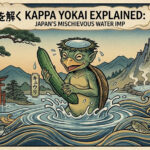
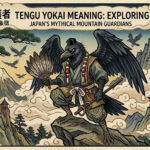
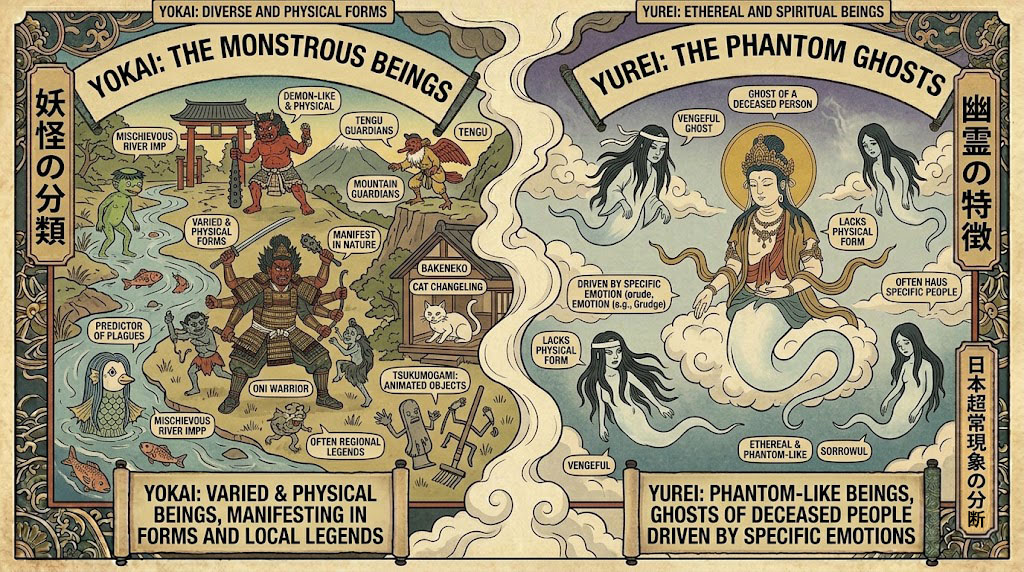
Yokai are an incredibly diverse category, encompassing everything from mischievous goblins to terrifying demons, sentient objects, and even inexplicable phenomena. They are not necessarily spirits of the dead. Their origins are deeply rooted in Japan’s animistic past, where elements of nature, everyday objects, and even abstract concepts were believed to possess a spirit or energy, particularly when old or neglected. From the playful Kappa (河童, kappa), a water imp known for its cucumber obsession and mischievous pranks, to the wise and powerful mountain-dwelling Tengu (天狗, tengu), a half-human, half-bird entity often associated with martial arts and asceticism, yokai defy simple classification. Consider also the Tsukumogami (付喪神), household objects like umbrellas (Karakasa-kozo, 唐傘小僧) or lanterns that come to life after a hundred years, or the eerie Noppera-bo (のっぺら坊), the faceless ghost who unnerves rather than harms. They can be benevolent guardians, bringers of fortune, terrifying monsters, or mere nuisances, often reflecting the fears, values, and humor of the communities that created their legends. Their existence often serves to explain natural occurrences, warn against dangers, or simply add wonder to the world, embodying the vibrant imagination of Japanese folklore. They are a fundamental part of the natural and cultural landscape, not just inhabitants.
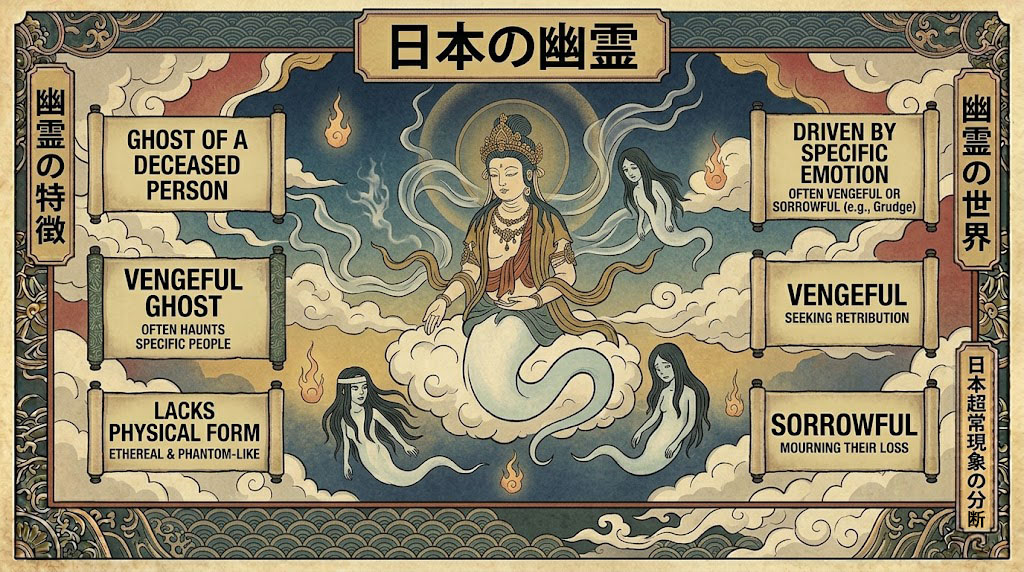
In stark contrast, yurei (幽霊, yurei) are specifically the ghosts of deceased humans who, for various reasons, cannot find peace in the afterlife. Their existence is almost always tied to unresolved emotional trauma: a tragic death, a lack of proper burial, unfulfilled vengeance, profound grief, or a powerful attachment to the living world. The classic image of a yurei is hauntingly specific: clad in a white burial kimono (kyokatabira), with long disheveled black hair, and often depicted as lacking feet, giving them a chilling, floating appearance. Their motivation is rarely random mischief; instead, they are driven by the circumstances of their death or the injustice they suffered. The story of Oiwa (お岩), a vengeful yurei from the famous Kabuki play “Yotsuya Kaidan,” exemplifies the Onryo (怨霊) type – a wrathful spirit seeking revenge. Another poignant example is the Ubume (産女), the ghost of a woman who died in childbirth, often seen carrying a child or trying to buy sweets for her phantom baby, embodying maternal grief and attachment. Yurei are tragic figures, trapped between worlds, embodying human suffering and the powerful consequences of moral failings and emotional torment.
The fundamental difference, therefore, lies in their very essence. Yokai are creatures or phenomena born from folklore, animism, and imagination; they are “supernatural beings” that existed alongside humanity for centuries. Yurei are “supernatural beings” born from the human experience of death and unresolved suffering; they are “ghosts” – echoes of human tragedy. A yokai exists because it is a yokai – a fox spirit, a sentient umbrella, a river monster, part of the fabric of the natural world. A yurei exists because a person died tragically and could not move on, their spirit lingering due to specific earthly ties. This distinction manifests profoundly in their appearances and motivations. Yokai are wildly diverse, from animalistic forms to grotesque humanoids, sometimes whimsical, sometimes terrifying. Yurei, while having individual stories, largely conform to the iconic spectral image of the mournful, white-clad figure, embodying a universal sense of loss and unresolved suffering. Yokai can be reasoned with, tricked, or sometimes even befriended, becoming part of the local lore; yurei are typically bound by their emotional chains, seeking resolution, vengeance, or simply peace, making them far more focused, often more terrifying, and typically more dangerous in their single-mindedness.
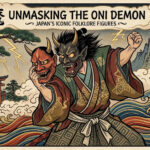
While the distinction is clear, the lines can sometimes appear blurred in casual conversation or within certain narratives, particularly as some folkloric figures may have elements that seem to cross boundaries. Some tales might feature a human transforming into a yokai (like an oni (鬼) due to overwhelming rage or a kitsune (狐) due to powerful magic), or a deceased human’s spirit might manifest in a way that resembles a monstrous yokai in its terrifying aspects. However, even in these cases, the underlying principle holds: if it’s the spirit of a specific dead person, tied to their earthly identity and suffering, it’s a yurei. If it’s a creature from folklore that exists independently of a singular human death, or a human who became a distinct type of supernatural being, it’s a yokai. The Japanese language and cultural understanding consistently uphold this divide, allowing for a much richer appreciation of each entity’s distinct place in the vast supernatural tapestry. Understanding this allows one to appreciate the specific fears, wisdom, and wonder each category brings to Japanese storytelling and cultural expression.
Cultural Context and Modern Influence
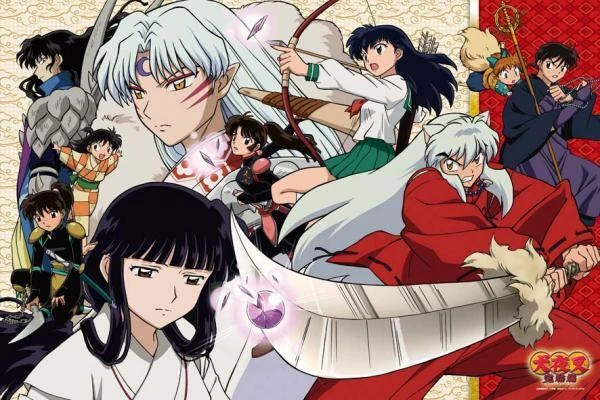
The enduring fascination with both yokai and yurei speaks volumes about their deep roots in Japanese culture. They are not merely relics of the past but vibrant presences in modern media. Yokai, with their whimsical and diverse forms, have spawned entire franchises like “Yokai Watch,” charming children worldwide, and feature prominently in epic anime such as “Inuyasha” and “Natsume’s Book of Friends,” where their complex relationships with humans are explored. Similarly, yurei have solidified Japan’s reputation for psychological horror, giving birth to iconic figures like Sadako from “The Ring” (Ringu) and the vengeful spirits of “Ju-on: The Grudge.” These cinematic specters have terrified global audiences, showcasing the unique chilling power of Japanese ghosts. From traditional Kabuki plays to modern video games like “Fatal Frame” (known as “Zero” in Japan) where players confront vengeful yurei with a camera, the legacy of these supernatural beings continues to evolve, drawing new generations into their captivating and sometimes terrifying worlds. They serve as cultural touchstones, reflecting anxieties, hopes, and the boundless human imagination.
To see these categories in action, consider figures like the shapeshifting Kitsune or the wintry Yuki-Onna — both firmly rooted in yokai tradition rather than the yurei category.
Frequently Asked Questions
Can a yokai become a yurei, or vice-versa?
Generally, no. A yokai is a supernatural creature or phenomenon, while a yurei is specifically the spirit of a deceased human. While a human might transform into a yokai-like entity (e.g., an oni due to overwhelming rage), that entity would be considered a yokai, not a yurei, as its existence is no longer purely tied to the identity of a specific deceased person in a lingering, spectral sense. Their origins and fundamental natures are distinct, forming separate categories within Japanese supernatural lore.
What is the most famous example of a yokai versus a yurei?
For yokai, popular examples include the mischievous Kappa (河童, kappa) or the wise and powerful mountain-dwelling Tengu (天狗, tengu), figures deeply embedded in regional folklore. For yurei, the vengeful spirit of Oiwa (お岩) from the Kabuki play “Yotsuya Kaidan” is a classic, as are modern horror icons like Sadako Yamamura from “The Ring.” These figures perfectly embody their respective categories, illustrating their distinct characteristics and roles in storytelling.
How are yokai and yurei typically depicted visually in traditional art?
Yokai have an incredibly wide range of appearances, from human-like to animalistic, monstrous, or even abstract and whimsical. Think of the long-necked Rokurokubi (ろくろ首) or the single-eyed Hitotsume Kozo (一つ目小僧). Yurei, on the other hand, often conform to a specific, iconic image: a figure in a white burial kimono, with long black hair obscuring the face, floating without visible feet, signifying their detachment from the physical world and their tragic circumstances.
Why is it important for an international audience to understand this distinction?
Understanding the difference between yokai and yurei provides a deeper appreciation for the nuances of Japanese culture, folklore, and storytelling. It allows for a more accurate interpretation of Japanese art, literature, film, and games, revealing the specific fears, moral lessons, and imaginative wonders each category embodies. Recognizing this distinction is not just about semantics; it’s a key to unlocking richer cultural insights and a more profound engagement with Japan’s supernatural heritage, enhancing one’s overall cultural literacy.