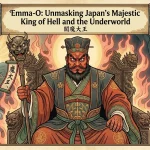
Emma-O Japan‘s fearsome King of Hell is the supreme judge of the underworld — a powerful Buddhist deity who examines the deeds of the dead and determines their fate in the afterlife.
Imagine standing before a towering, crimson-faced judge whose eyes pierce through the very essence of your being, weighing every deed, every thought, every whispered secret of your life. This is the daunting prospect awaiting every soul that crosses into Jigoku (地獄, jigoku), the Japanese Buddhist hell. At the heart of this formidable bureaucracy of the afterlife sits Emma-O (閻魔大王, Enma Dai-Ō), the King of Hell himself. More than just a fearsome punisher, Emma-O is the ultimate arbiter of karmic justice, a figure whose presence looms large in Japanese folklore, art, and spiritual consciousness. His judgment is absolute, his wisdom profound, and his realm a stark reminder of the consequences of our earthly actions. Join us as we journey beyond the veil, into the chilling yet fascinating world presided over by Japan’s majestic King of Hell, uncovering his origins, his awesome powers, and his lasting impact on both the living and the dead.
Quick Facts: Emma-O King of Hell
| Detail | Information |
|---|---|
| Japanese Name | 閻魔大王 (Enma Dai-Ō) |
| Type / Category | Buddhist Deity / King of Hell / Underworld Judge |
| Origin | Indian Buddhism (as Yama) via Chinese Buddhism (as Yanluo Wang) |
| Element / Domain | Justice, Judgment, Karma, The Underworld, Death |
| Known For | Presiding over Jigoku, judging the dead based on their earthly deeds, determining their reincarnation or suffering in hell. |
| Modern Appearances | Dragon Ball Z (King Yemma), GeGeGe no Kitaro, Nura: Rise of the Yokai Clan, various anime and manga. |
What Is Emma-O King of Hell?
Growing up in Japan, there’s a saying almost everyone hears at some point, usually from a grandparent: “Tell a lie, and Emma-sama will pull out your tongue.” It’s meant half as a joke, half as a real warning — and it says a lot about how deeply this one figure is woven into everyday Japanese life, long before you ever learn who he actually is in Buddhist cosmology.
Emma-O stands as one of the most significant and formidable deities within the tapestry of Japanese Buddhist cosmology. He is not merely a demon but a king, a supreme judge who holds the fate of all deceased sentient beings in his mighty hands. Presiding over Jigoku, the complex and multi-layered realm of hell, Emma-O meticulously reviews the karmic ledger of each individual, determining their post-mortem destiny. Whether a soul is reborn into a higher state, consigned to one of Jigoku’s many punishing realms, or even granted passage to a heavenly abode, it is Emma-O’s unyielding and impartial judgment that dictates their path.
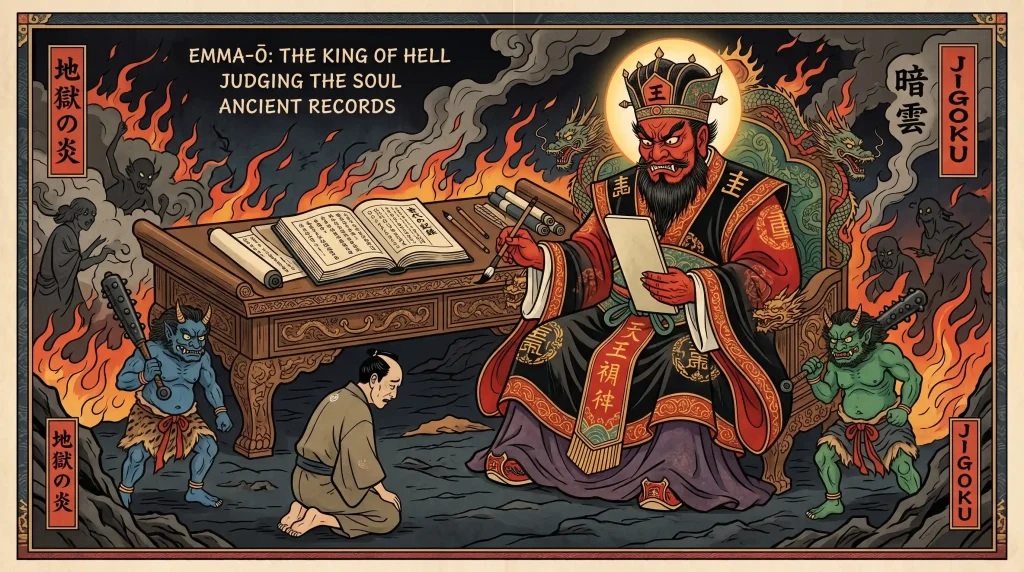
His court, bustling with various Oni (鬼, ogres or demons) and scribes, is a meticulous bureaucracy dedicated to justice. Far from being an embodiment of evil, Emma-O represents the inescapable law of cause and effect – karma. His fearsome appearance and the terrifying nature of Jigoku serve not as arbitrary cruelty but as a powerful deterrent, encouraging the living to lead virtuous lives. He is a constant reminder that actions have consequences, extending beyond the grave and into the eternal cycle of reincarnation.
Origins and History
The concept of Emma-O in Japan boasts a rich and ancient lineage, tracing its roots back to the venerable Vedic traditions of ancient India. Here, he originated as Yama, the first mortal man who, upon dying, became the ruler of the deceased. As Buddhism spread from India into China, the figure of Yama evolved into Yanluo Wang (閻羅王, Yánluó Wáng), the sovereign of the underworld, absorbing elements of local Chinese beliefs concerning the afterlife and bureaucracy.
It was through China and Korea that this powerful deity made his way to Japan, likely by the 6th or 7th century, alongside the introduction of Buddhism itself. In Japan, he became known as Emma-O, integrating seamlessly into the emerging Buddhist narrative of Jigoku. Early Japanese Buddhist texts and sermons frequently depicted Emma-O as the central figure of the afterlife, emphasizing the importance of repentance and good deeds. His image was popularized through vivid Jigoku-e (地獄絵, hell scrolls) displayed in temples, serving as potent visual sermons to the populace and deeply embedding his stern visage into the collective Japanese consciousness.
Emma-O’s Appearance, Powers, and Behavior
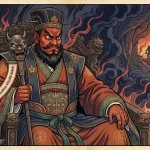
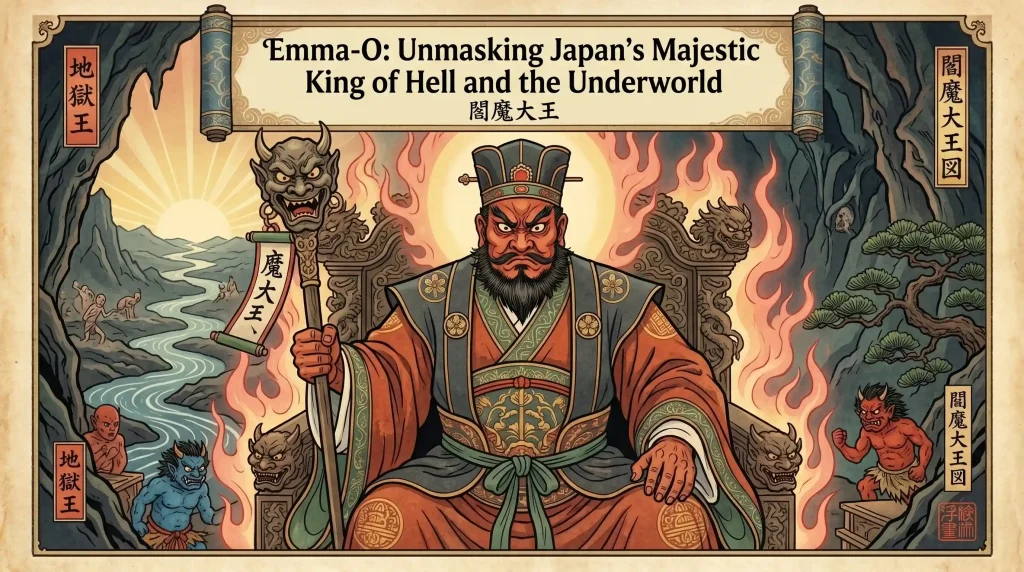
The visual representation of Emma-O is instantly recognizable and designed to evoke both awe and dread. He is typically depicted as a colossal figure, with a deep crimson or dark red face, often adorned with a long, flowing beard and fierce, bulging eyes that seem to penetrate one’s very soul. He wears elaborate Chinese-style imperial robes and a magistrate’s cap, signifying his supreme authority and bureaucratic function. In his hand, he often holds a scepter or a tablet, symbolic of his power to decree judgment. His expression is invariably stern, a testament to his unwavering commitment to justice, devoid of personal bias or sentimentality. Around him are often his loyal, fearsome Oni attendants, who carry out his commands and inflict punishments, along with scribes meticulously recording every aspect of a soul’s life.
Powers and Abilities
Emma-O’s powers are largely centered around his role as the ultimate judge of the dead. His most renowned ability is his infallible capacity to discern the truth of a deceased person’s life. He possesses the mystical Kagami no Hari (浄玻璃の鏡, Jōhari no Kagami), or “Mirror of Karma,” which reflects all the deeds, good and bad, performed by the soul during its earthly existence, leaving no sin or virtue unrevealed. This mirror is said to show events exactly as they transpired, stripping away all deception and self-justification.
Beyond the mirror, his judgment is aided by his record keepers, who consult vast registers detailing every human action. Based on these immutable records and the undeniable truth revealed by the mirror, Emma-O weighs the karmic balance. He determines which of the numerous Jigoku realms (such as the Eight Hot Hells or Eight Cold Hells) a soul must endure for purification, or if they are worthy of a more favorable rebirth. His rulings are absolute, signifying his complete and unwavering authority over the cycles of death and rebirth.
The Judgment Process and the Ten Kings
While Emma-O is the most prominent King of Hell, Japanese Buddhist tradition, heavily influenced by Chinese concepts, actually describes a court of Ten Kings of Hell (十王, Jū-Ō) who preside over different stages of judgment. Emma-O typically serves as the Fifth King, overseeing the most crucial judgment on the 35th day after death, a period when the deceased’s fate hangs most precariously in the balance. It is at his court that the Mirror of Karma is consulted and the gravest decisions are made regarding a soul’s entry into one of the Jigoku realms, or their path to reincarnation.
The entire process, from crossing the Sanzu River (三途の川, Sanzu no Kawa) to facing Emma-O and the other kings, is a ritualistic journey designed to impress upon the living the importance of morality and compassion. Each king, including Emma-O, scrutinizes different aspects of a soul’s life, ensuring a comprehensive and just assessment. The journey through these courts is not just a passage for the dead but a profound spiritual lesson for the living, emphasizing accountability and the interconnectedness of all actions.
Emma-O vs Similar Buddhist & Shinto Figures
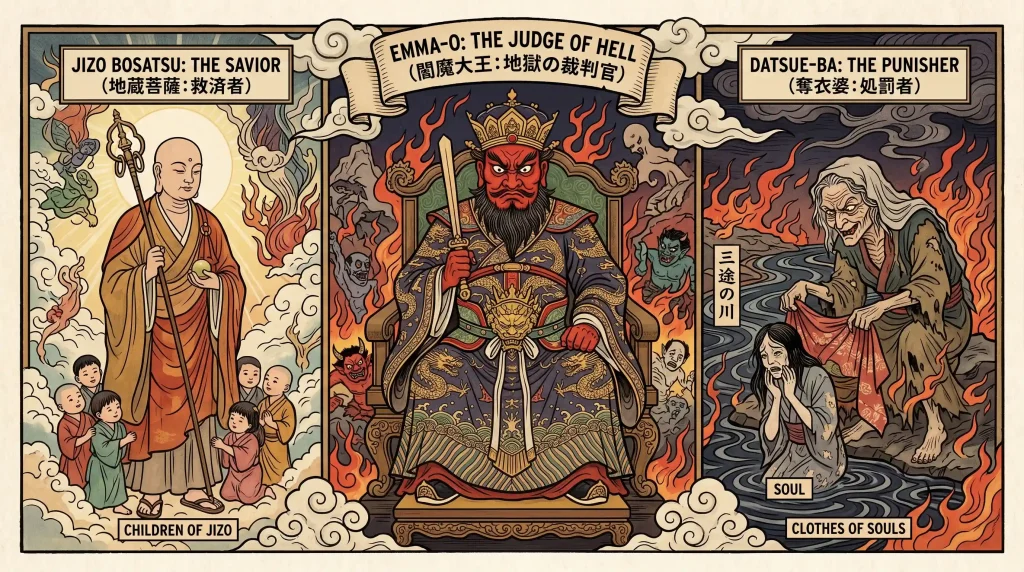
| Feature | Emma-O (閻魔大王) | Datsue-ba (奪衣婆) | Jizo Bosatsu (地蔵菩薩) |
|---|---|---|---|
| Type | King of Hell / Underworld Judge | Underworld Figure / Punisher | Bodhisattva / Savior |
| Domain | Jigoku (Buddhist Hell), Karma, Judgment | Sanzu River (River of Three Crossings), Crossroads to Hell | Underworld, Children’s Protector, Travelers’ Guardian |
| Danger Level | Terrifying but just; enforces karmic law | Frightening; strips clothes and inflicts minor punishments before judgment | Benevolent and protective; offers salvation and solace |
| How to appease | Live a virtuous life, make offerings for the dead, engage in Buddhist practices | No direct appeasement; avoid by living morally so she has nothing to take | Prayers, offerings (especially stones, small toys), building small shrines |
| Modern pop culture | Dragon Ball Z, GeGeGe no Kitaro, various anime/manga | Mentioned in folklore, less direct pop culture presence | Widely depicted in temples, manga, often as a gentle protector |
Emma-O in Modern Japan and Pop Culture
Even in contemporary, technology-driven Japan, Emma-O continues to hold a significant place in the cultural imagination. He embodies the universal concept of ultimate justice and the consequences of one’s actions, resonating deeply with traditional Japanese values of responsibility and moral conduct. His image is still found in Buddhist temples, particularly in Jigoku-e (hell scrolls) and statues, which serve as potent reminders for temple-goers to lead upright lives. These artistic depictions, often vivid and graphic, have a lasting impression, particularly on children, teaching them about karma and morality.
Beyond religious contexts, Emma-O has transcended into mainstream Japanese pop culture. One of his most famous portrayals is as King Yemma in the globally popular anime and manga series Dragon Ball Z, where he is a giant, green-skinned bureaucrat overseeing the afterlife. He also appears in the classic yokai series GeGeGe no Kitaro and in the video game Yokai Watch, often retaining his authoritative, though sometimes comedic, persona. These appearances introduce Emma-O to new generations and international audiences, keeping his legend alive and highlighting his enduring appeal as a powerful, iconic figure of the Japanese underworld.
Where to Experience This in Japan
For travelers interested in connecting with the mystique of Emma-O and Jigoku, Japan offers several compelling sites. Many Buddhist temples house detailed Jigoku-e (hell scrolls) or statues of Emma-O. For instance, Kyoto’s Enma-dō (閻魔堂), officially known as Zenrin-ji Temple, has a famous, imposing statue of Emma-O, offering a direct encounter with his formidable presence. Another significant site is Hōzan-ji Temple (宝山寺) in Nara Prefecture, renowned for its vivid Jigoku-e that graphically depict the various tortures and judgments of hell, often with Emma-O presiding. Visitors can also find numerous Jizo Bosatsu statues, Emma-O’s compassionate counterpart, at virtually any temple or roadside, symbolizing the hope of salvation even in the darkest realms of Jigoku.
East of Tokyo, in Hinode, Hōsen-in Temple holds a wooden Emma-O statue attributed to the sculptor Ryōkai and dated to 1473 — now designated a Tokyo Tangible Cultural Property. Its original lacquer colors, hidden for centuries, were only uncovered during a conservation project in 2006.
Frequently Asked Questions
Who is Emma-O in Japanese mythology and what is his role?
Emma-O, known as Enma Dai-Ō in Japanese, is the powerful King of Hell and the chief judge of the deceased in Japanese Buddhist mythology. His primary role is to preside over Jigoku, the Buddhist underworld, where he impartially assesses the karmic deeds of every departed soul. Based on these actions, he determines their post-mortem destiny, assigning them to one of the various hell realms for purification or guiding them towards a favorable reincarnation.
How does Emma-O determine the fate of the dead in Jigoku?
Emma-O determines the fate of the dead through a rigorous judgment process. He uses the magical Kagami no Hari, or “Mirror of Karma,” which reveals all the good and bad deeds performed by the soul during its earthly life. With the assistance of his scribes and various Oni attendants, who consult comprehensive records, Emma-O weighs the karmic balance. His verdict is absolute, dictating whether a soul will endure suffering in a specific Jigoku realm or be reborn into a new life.
What is the historical connection between Emma-O and the Indian deity Yama?
Emma-O’s origins are deeply rooted in ancient Indian mythology, where he is known as Yama, the first mortal who died and subsequently became the ruler of the dead. As Buddhism expanded into China, Yama evolved into Yanluo Wang. This figure was then introduced to Japan, likely during the 6th or 7th century alongside Buddhist teachings, eventually becoming Emma-O, retaining his essential role as the benevolent yet fearsome judge of the afterlife.
Are there any real places in Japan where visitors can learn more about Emma-O or Jigoku?
Yes, several places in Japan offer insights into Emma-O and Jigoku. Many Buddhist temples across the country feature statues of Emma-O and vividly illustrated Jigoku-e (hell scrolls), used for teaching moral lessons. Notable examples include Enma-dō (Zenrin-ji Temple) in Kyoto, which houses a prominent Emma-O statue, and Hōzan-ji Temple in Nara, known for its detailed depictions of hell. These sites provide a tangible connection to this fascinating aspect of Japanese spiritual culture.