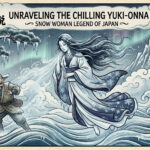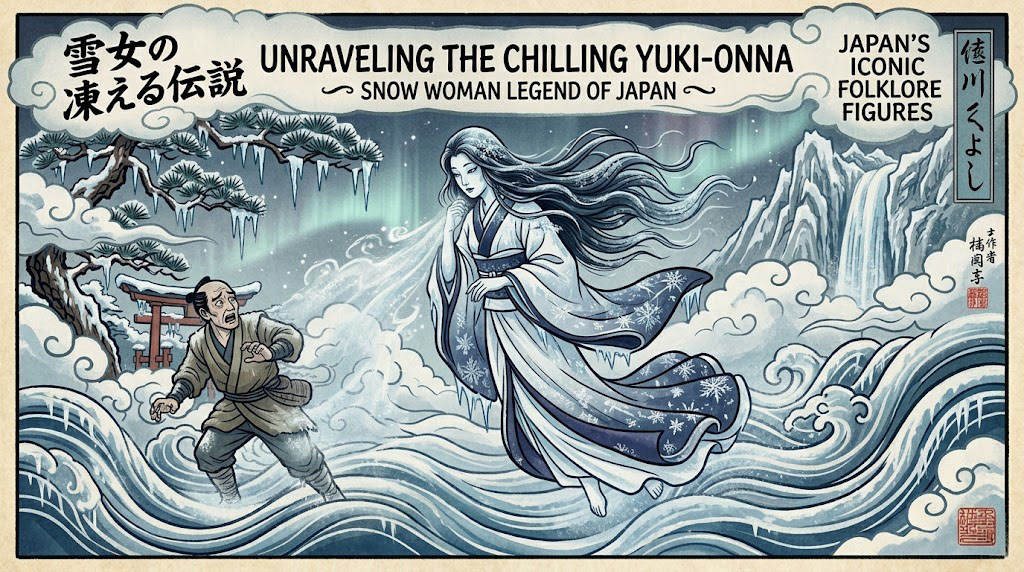
The Yuki-Onna legend tells of Japan’s most beautiful and terrifying spirit — the Snow Woman who appears during blizzards, her pale form indistinguishable from the storm, bringing death or mercy on a whim.
Imagine wandering alone through Japan’s remote mountains during a brutal winter storm. The snow falls relentlessly, muffling all sound, transforming the landscape into an endless expanse of white. The air bites with an icy chill that seeps into your bones, and disorientation sets in. Just as despair begins to take hold, a figure emerges from the swirling flakes: a woman of breathtaking, unearthly beauty, her skin as pale as the snow, her hair as dark as midnight. Her presence brings a strange calm, a promise of warmth amidst the cold… but beware, for this ethereal vision is the Yuki-Onna, the chilling snow woman of Japanese legend. Her seductive allure is merely a prelude to a frosty embrace that can steal your very life force. For centuries, her tales have haunted the hearths of snow-bound villages, serving as a powerful reminder of nature’s formidable power and beauty. But who is this enigmatic spirit, and what dark secrets does she hold? Join us as we unravel the captivating and terrifying Yuki-Onna snow woman legend.
Quick Facts: Yuki-Onna (Snow Woman)
| Detail | Information |
|---|---|
| Japanese Name | 雪女 (ゆきおんな, yuki-onna) |
| Type / Category | Winter Yokai / Spirit |
| Origin | Nationwide, deeply rooted in snowy regions (e.g., Tohoku, Hokuriku). Medieval Japan onwards. |
| Element / Domain | Snow, ice, winter mountains, blizzards. |
| Known For | Unearthly beauty, appearing during blizzards to lost travelers, preying on men, sometimes capable of mercy or even love. |
| Modern Appearances | Kwaidan (film), GeGeGe no Kitaro (anime/manga), Bleach (anime/manga), Nioh (video game), Pokémon (Froslass). |
What Is the Yuki-Onna?
The Yuki-Onna (雪女, yuki-onna), quite literally the “snow woman,” is one of Japan’s most iconic and feared yokai, or supernatural entities. She is a spirit irrevocably tied to the harsh beauty and perilous nature of winter, particularly the deep snows of Japan’s northern and mountainous regions. Described universally as a woman of unparalleled, albeit chilling, beauty, her allure is as dangerous as the blizzards she often accompanies. Her presence signifies both the ethereal elegance and the deadly power inherent in a snow-laden landscape, making her a compelling figure in Japanese folklore. More than just a monster, the Yuki-Onna embodies the very essence of winter’s dual charm: serene and breathtaking, yet unforgiving and lethal.
Unlike some yokai who are grotesque or mischievous, the Yuki-Onna’s horror lies in her deceptive grace. She often appears to travelers lost or stranded in snowstorms, offering a silent, mesmerizing presence that draws them in before delivering a fatal, icy kiss or breath. Her legends serve as cautionary tales, warning against the dangers of venturing unprepared into the mountains during winter and respecting nature’s raw power. Yet, her stories also explore themes of love, betrayal, and sacrifice, revealing a complexity that has cemented her place in the hearts and fears of the Japanese people for centuries.
Origins and History
Tales of the Yuki-Onna have a long and venerable history in Japan, with mentions dating back at least to the Muromachi period (1336-1573). One of the earliest written accounts appears in the 14th-century anthology, the Sōgi Shū (宗祇集), attributed to the monk Sōgi. While these early mentions established her existence, the Yuki-Onna’s mythology truly solidified and spread throughout the Edo period (1603-1868), fueled by popular collections of ghost stories (kaidan) and local legends passed down through generations in regions known for heavy snowfall.
One of the clearest signs of her growing popularity is visual: Edo-period artist Toriyama Sekien included Yuki-Onna in his 1781 supernatural bestiary, Gazu Hyakki Yagyō (画図百鬼夜行) — giving her a standardized visual form more than a century before Hearn ever wrote about her.
Her legend is deeply rooted in the practical dangers faced by people living in mountainous and snow-bound areas, where blizzards and freezing temperatures could prove deadly. Over time, the personification of this natural danger into a beautiful yet malevolent spirit helped explain unfortunates who succumbed to the cold. Lafcadio Hearn’s retelling of the Yuki-Onna story in his seminal collection Kwaidan: Stories and Studies of Strange Things (1904) introduced her to a wider international audience, cementing her status as one of Japan’s most recognizable supernatural beings. Her widespread presence across the country, with variations from Tohoku to Hokuriku, underscores her profound connection to the Japanese experience of winter.
Yuki-Onna’s Appearance, Powers, and Behavior
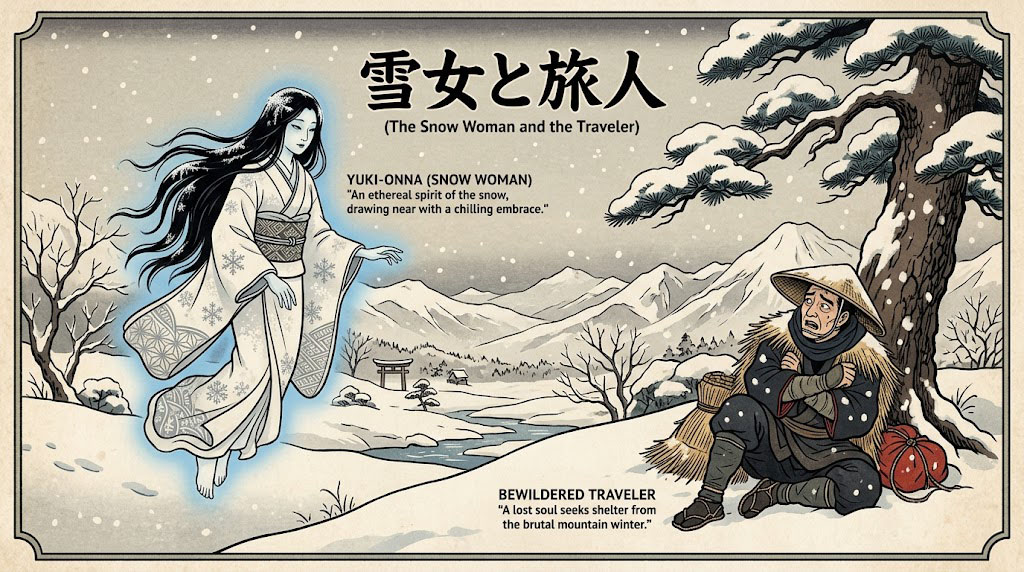
The Yuki-Onna is almost universally depicted as a woman of ethereal, almost supernatural beauty. Her skin is often described as impossibly pale, translucent even, sometimes with a bluish tint, reflecting the cold from which she springs. She typically has long, flowing black hair, though occasionally white or silver hair is mentioned. She is often seen wearing a pure white kimono, which blends seamlessly with the snowy landscape, making her difficult to discern until she is dangerously close. She floats rather than walks, leaving no footprints in the snow, adding to her ghostly and otherworldly presence. Her voice is described as melodic yet chilling, and her breath, like ice, can freeze her victims solid.
Deadly Charms and Chilling Abilities
The Yuki-Onna’s primary power lies in her absolute command over ice and snow, and her ability to lure victims to their deaths. She can conjure blizzards, create freezing gusts of wind, and solidify moisture in the air. Her most infamous method of killing is to simply drain the life force from her victims with an icy kiss, or to exhale a freezing breath that leaves them as frozen corpses. She is also known to create illusions, confusing travelers and leading them deeper into dangerous, snow-bound terrain. Her beauty is a potent weapon, disarming men who, captivated by her charm, become easy prey for her deadly touch. This combination of allure and lethal power makes her exceptionally dangerous and unpredictable.
Regional Variations and Unique Tales
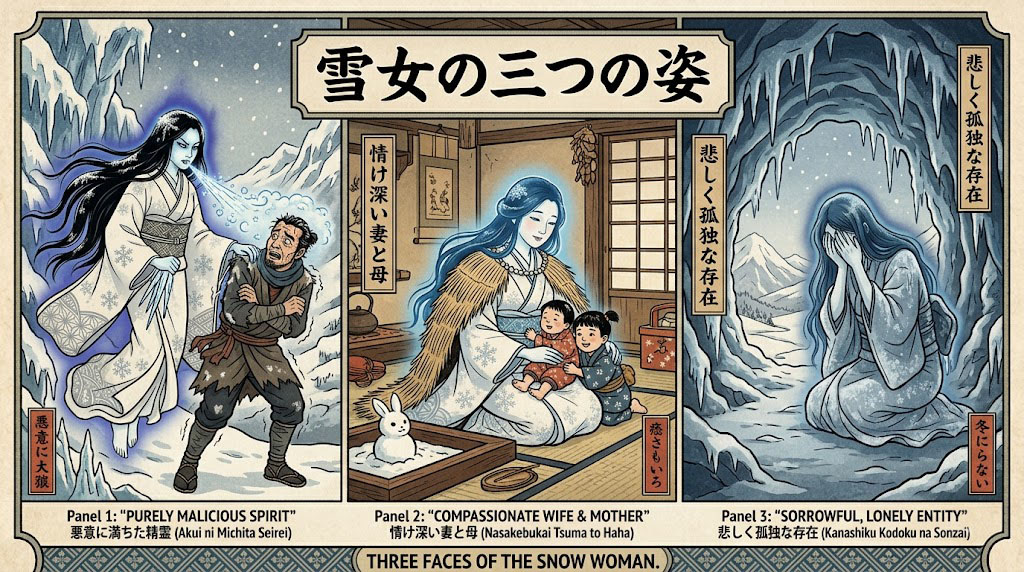
While the core essence of the Yuki-Onna remains consistent across Japan, her legends vary subtly depending on the region, particularly concerning her motives and the outcomes of her encounters. In some areas, like Niigata and Miyagi prefectures, she is depicted as a purely malevolent spirit, intent on freezing anyone she encounters. However, other tales, famously retold by Lafcadio Hearn, present a more nuanced character. In the tale of “Yuki-Onna” from Kwaidan, she spares a young woodcutter named Minokichi on the condition that he never reveals their encounter. Years later, she returns as a human woman, marries him, and they have children. When he breaks his vow, she transforms back into her spirit form, revealing her true nature, but often spares him for the sake of their children, threatening him if he ever mistreats them. These variations illustrate a complexity beyond simple evil, sometimes hinting at a capacity for love, sorrow, or a strict adherence to vows. Other stories portray her as a lonely spirit, seeking companionship or driven by a past tragedy, further enriching her legend.
Yuki-Onna vs Similar Yokai
| Feature | Yuki-Onna | Yama-uba (Mountain Hag) | Kuchisake-onna (Slit-Mouthed Woman) |
|---|---|---|---|
| Type | Winter spirit, yokai | Mountain hag, yokai | Vengeful spirit, urban legend |
| Domain | Snowy mountains, blizzards, cold regions | Deep mountains, forests, remote areas | Urban environments, crossroads, schools |
| Danger Level | Deadly, hypnotic, lures victims to freeze | Dangerous, sometimes helpful, eats humans | Deadly, psychological horror, mutilates victims |
| How to appease | Often none, sometimes spares if promise kept or for family | Offer food, avoid paths, sometimes outwit her | Answer questions carefully, sometimes repel with specific items |
| Modern pop culture | Kwaidan (film), Bleach, Nioh | Princess Mononoke, games like Nioh | J-horror films, manga, popular urban myths |
Yuki-Onna in Modern Japan and Pop Culture
The Yuki-Onna snow woman legend continues to exert a powerful grip on the Japanese imagination and has captivated international audiences. Her enduring appeal lies in her combination of chilling beauty, inherent danger, and the mysterious allure of the natural world’s more formidable aspects. In modern Japan, she is a perennial favorite in yokai-themed media, appearing across a wide spectrum of pop culture. From classic anime like GeGeGe no Kitaro, where she is often depicted as a recurring character with various allegiances, to manga and video games like Nioh, where she poses a formidable boss challenge, the Yuki-Onna adapts to new narratives while retaining her core characteristics. She has also inspired characters in global franchises, such as Froslass in Pokémon, who clearly draws on her icy elegance and spirit qualities. Her tales resonate because they speak to universal fears of the unknown, the seductive power of beauty, and the harsh, indifferent might of nature, making her a symbol that transcends cultural boundaries.
Where to Experience This in Japan
While encountering a real Yuki-Onna is, thankfully, purely legendary, travelers can immerse themselves in the atmosphere that gave rise to her tales. Visiting Japan’s snowiest regions during winter, such as the Tohoku or Hokuriku regions, offers a visceral connection to the legends. Places like Niigata, Yamagata, and Fukushima prefectures, known for their heavy snowfall, hold many local folk tales about the Yuki-Onna. Exploring the “Snow Country” on the Sea of Japan coast allows one to appreciate the stark beauty and potential dangers of the winter landscape. For those interested in folklore, the Miyoshi Mononoke Museum in Hiroshima (though not in a snowy region) or the Tono Folktale Village in Iwate (a snowy region) offer insights into various yokai, including general discussions of winter spirits. Enjoying a hot spring bath (onsen) after a day in these snow-laden mountains provides a safe and traditional way to experience the very environment where the Yuki-Onna’s legend feels most alive.
Yuki-Onna belongs to a rich tradition of shapeshifting and spectral yokai, including the cunning Kitsune and the broader debate over yokai versus yurei.
Frequently Asked Questions
Is the Yuki-Onna always evil or malevolent?
Not always. While many stories depict the Yuki-Onna as a purely malevolent spirit who preys on humans, there are notable regional variations and specific tales where she shows mercy or even compassion. Lafcadio Hearn’s famous rendition, for example, portrays her as capable of falling in love and raising a family as a human woman, only reverting to her spirit form when a vow is broken. In such cases, she may still deliver a threat but spares her family, indicating a more complex character than simple evil.
How can one protect themselves from a Yuki-Onna?
Traditional folklore offers little in the way of direct defense against a Yuki-Onna, as her powers are formidable and her beauty disarming. The most common advice is to avoid wandering into deep snow-covered mountains alone during a blizzard, as this is when she typically appears. Some legends suggest that if confronted, showing no fear or offering a respectful greeting might sometimes cause her to leave, or at least delay her fatal approach. However, her true nature is often inescapable, emphasizing the dangers of nature itself.
Are there different types of Yuki-Onna across Japan?
Yes, while the core concept of a beautiful snow woman remains, there are subtle regional differences in her portrayal. Some areas emphasize her purely murderous intent, while others include stories of her becoming a wife or mother, or even appearing as a lonely, sorrowful spirit. These variations often reflect local values, superstitions, and the specific relationship a community had with the harsh winter environment, contributing to a rich tapestry of Yuki-Onna legends.
What is the most famous story about a Yuki-Onna?
The most widely known and influential story about the Yuki-Onna is undoubtedly Lafcadio Hearn’s adaptation titled “Yuki-Onna,” found in his 1904 collection Kwaidan: Stories and Studies of Strange Things. This particular tale tells of a young woodcutter named Minokichi who encounters the Yuki-Onna during a blizzard. She spares his life on the condition that he never speaks of their encounter. Years later, she appears to him as a human woman, marries him, and they have several children, only for their bond to shatter when he recounts the forbidden tale, revealing her true identity and the poignant consequences of his broken vow.