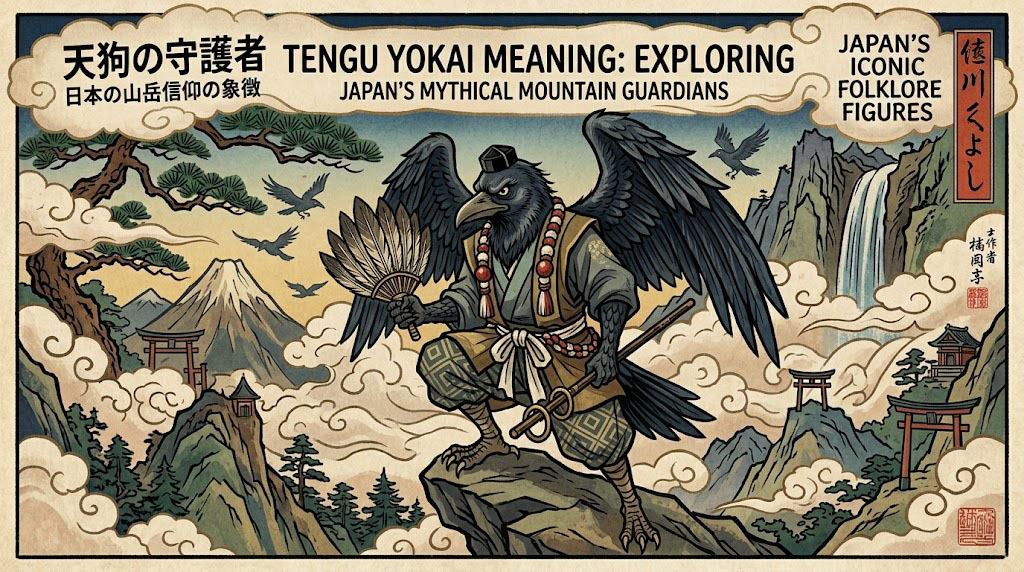
The tengu yokai is one of Japan’s most powerful supernatural beings — a proud, bird-like mountain spirit that evolved from a feared demon into a revered guardian and patron of martial arts.
Imagine traversing ancient, mist-shrouded mountain paths in Japan, the air thick with the scent of pine and damp earth, when a sudden gust of wind rattles the trees. Was it merely nature’s breath, or the powerful flapping of a hidden, unseen wing? For centuries, such phenomena, and countless others, have been attributed to the Tengu (天狗, tengu) — formidable and enigmatic mountain spirits whose presence looms large in Japanese folklore. These legendary beings are far more than simple boogeymen; they embody a profound interplay of divine power, martial prowess, and often, mischievous or even malevolent intent, acting as both revered guardians and terrifying instigators. Their meaning and symbolism have evolved dramatically over centuries, reflecting Japan’s own spiritual journey through Buddhism, Shintoism, and local folk beliefs. Prepare to delve into the feathered, fiery, and often fierce world of the Tengu as we unravel the deep cultural significance and multifaceted nature of these iconic yokai.
Quick Facts: Tengu
| Detail | Information |
|---|---|
| Japanese Name | 天狗 (Tengu) |
| Type / Category | Yokai / Kami (Divine Spirit) / Buddhist Intermediary |
| Origin | Ancient Japan (initially Buddhist texts, influenced by Chinese Dog-Heaven demon) |
| Element / Domain | Mountains, Wind, Forests, Martial Arts |
| Known For | Exceptional martial arts skill, shapeshifting, causing storms, trickery, spiritual guardianship, abducting humans |
| Modern Appearances | The Legend of Zelda, Nioh, Sekiro: Shadows Die Twice, Naruto, Pokémon (Shiftry), GeGeGe no Kitaro |
What Is Tengu?
The Tengu are a fascinating class of supernatural beings in Japanese folklore, often depicted as a hybrid of human and avian characteristics. The name “Tengu” itself translates literally to “heavenly dog,” a curious etymology that hints at their complex origins and evolution. Unlike many yokai who are purely mischievous or monstrous, Tengu occupy a unique space in the Japanese spiritual landscape, often blurring the lines between deities, demons, and powerful spirits. They are typically associated with sacred mountains and forests, serving as their protectors, though they are equally capable of causing great calamity, from inciting wars to kidnapping humans. Their dual nature makes them one of the most compelling figures in Japan’s vast pantheon of supernatural entities.
Culturally, Tengu are deeply intertwined with Shugendō, a syncretic religion that combines elements of ancient Japanese mountain worship, Shinto, and esoteric Buddhism. Yamabushi, the mountain ascetics who practice Shugendō, are often depicted with attire strikingly similar to that of Tengu, further emphasizing the close relationship between these powerful spirits and those who seek spiritual enlightenment in the wilderness. This connection underscores the Tengu’s role not just as supernatural creatures, but as embodiments of the untamed, powerful, and often fearsome aspects of nature and the spiritual journey.
Origins and History
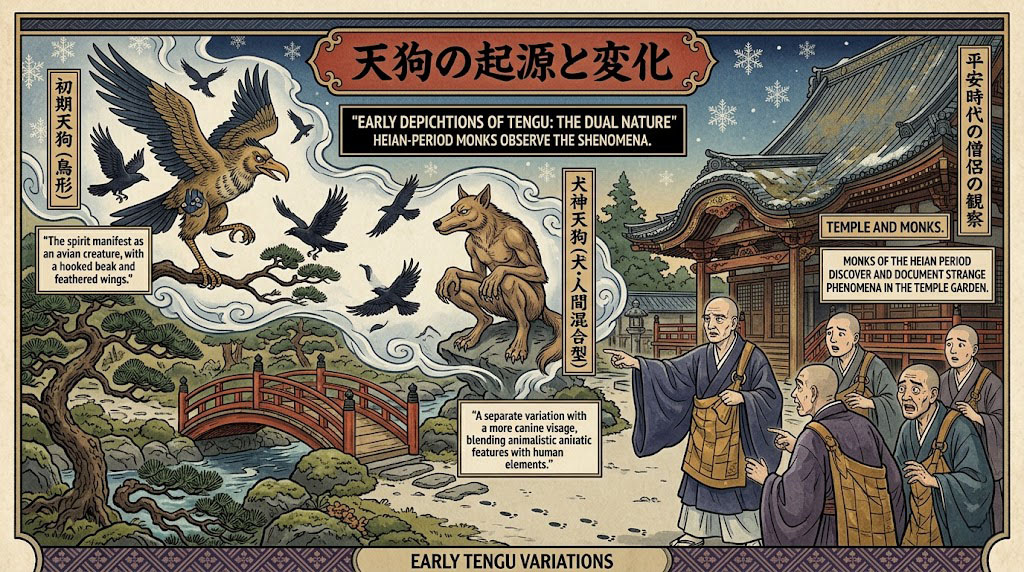
The earliest mentions of Tengu in Japan can be traced back to the 8th century, appearing in the Nihon Shoki (日本書紀, Chronicles of Japan), where they were described as a celestial fox-like creature or a meteor, drawing parallels to the Chinese Tiangou (天狗), a dog-like demon associated with comets and meteors. However, it wasn’t until the 12th century that the Tengu began to take on the more familiar bird-like or human-like forms we recognize today, largely influenced by Buddhist narratives.
Early Buddhist texts in Japan often portrayed Tengu as disruptive demons who plagued the Buddhist establishment, misleading the pious and tempting monks with worldly desires. They were seen as arrogant beings who, through their pride and attachment to worldly power, fell from the Buddhist path and were reborn in the Tengu realm. Over time, their image softened somewhat, evolving from purely malevolent entities to complex figures who could act as guardians of Buddhist teachings or even martial arts masters, albeit with a penchant for arrogance and trickery. This transformation reflects the fluid nature of folklore and how spiritual beliefs adapt and incorporate new influences over centuries.
This shift is documented in the historical record itself. The early 12th-century Konjaku Monogatarishū (今昔物語集), one of Japan’s great classical story collections, already depicts Tengu disguising themselves as monks to lead the pious astray. As scholar Haruko Wakabayashi explores in The Seven Tengu Scrolls: Evil and the Rhetoric of Legitimacy in Medieval Japanese Buddhism (University of Hawai’i Press, 2012), it was Buddhist institutions themselves that later recast Tengu — turning former villains into guardians of mountain asceticism.
Tengu’s Appearance, Powers, and Behavior
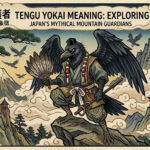
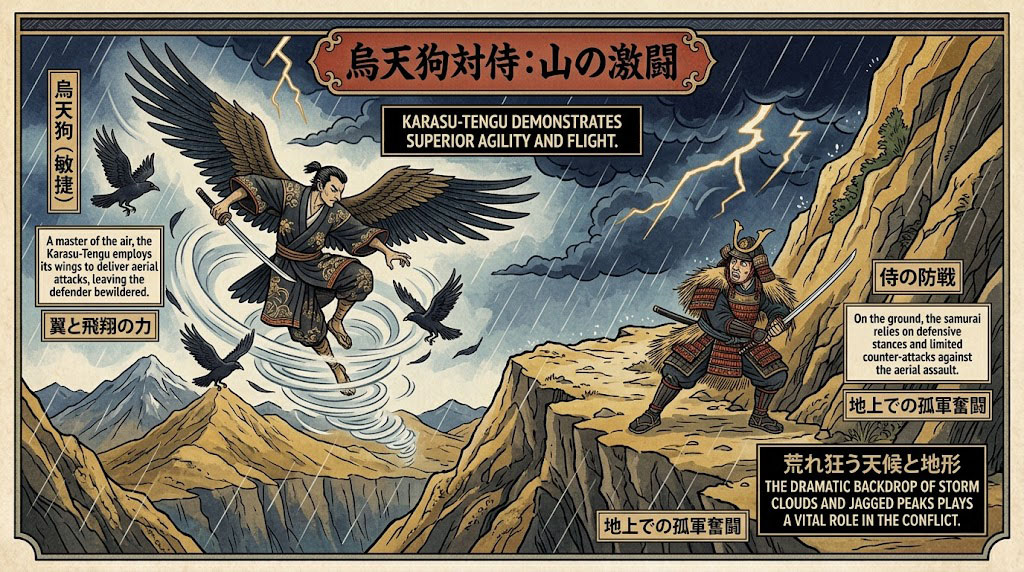
Tengu are renowned for their distinct appearances, which typically fall into two main categories. The most recognizable is the Daitengu (大天狗, Great Tengu), characterized by their human-like form, often with a long, red face and an even longer nose, sometimes impossibly extended. They are typically depicted as powerful warrior monks, dressed in the robes of a yamabushi, carrying a feather fan (羽団扇, ha-uchiwa) which can summon strong winds, and sometimes a sword. The other common form is the Karasu-Tengu (烏天狗, Crow Tengu), who possess a more overtly avian appearance with a crow’s head or beak, wings, and talons, while still maintaining a human-like body. Both types are often shown with powerful wings, enabling them to fly swiftly through the mountains and skies.
Powers and Abilities
The powers attributed to Tengu are vast and formidable. They are master shapeshifters, capable of assuming human forms to interact with people or animal forms to observe undetected. Their control over the wind is legendary, using their feather fans to conjure gales, storms, and even whirlwinds. Tengu are also exceptional martial artists, often credited with teaching legendary warriors like Minamoto no Yoshitsune the art of swordsmanship. Beyond physical prowess, they possess potent spiritual abilities, capable of reading minds, teleportation, and even possessing humans. They are known for their wisdom and knowledge, though they tend to impart it only to those they deem worthy, often after a series of challenging trials or mischievous tests.
Their Dual Nature: Protectors or Pranksters?
The behavior of Tengu is as complex as their appearance. While often portrayed as arrogant and prone to mischief, such as leading travelers astray, starting fires, or even causing epidemics, they also serve as protectors of forests and sacred sites, fiercely guarding their mountain domains from those who would desecrate them. They have been known to punish corrupt monks and arrogant samurai, reflecting a sense of justice, albeit one delivered with a stern hand. Their reputation as abductors of children and sometimes adults is well-documented, though these abductees (known as tengu-kakushi) are sometimes returned with mysterious knowledge or enlightenment, suggesting that the Tengu’s actions, even seemingly malicious ones, can serve a higher, transformative purpose. This duality ensures their enduring grip on the Japanese imagination.
Tengu vs Similar Yokai / Concepts / Traditions
| Feature | Tengu | Oni | Kami |
|---|---|---|---|
| Type | Yokai / Kami / Buddhist Intermediary | Yokai / Demon / Ogre | Divine Spirit / Deity |
| Domain | Mountains, forests, skies | Hell (Jigoku), human world (often as invaders) | Nature, ancestors, specific places (shrines) |
| Danger Level | High (can be benevolent or malevolent, very powerful) | Very High (destructive, vengeful, devour humans) | Variable (can be benevolent, wrathful, or neutral) |
| How to appease | Respect for mountains, spiritual practice, offerings, avoidance of arrogance | Rituals like Setsubun (bean-throwing), prayers, offerings | Prayers, offerings (sake, rice), shrine visits, respectful living |
| Modern pop culture | Zelda, Nioh, Naruto | Demon Slayer, Dragon Ball, One Piece | Princess Mononoke, Spirited Away, various anime/manga focusing on nature/spirits |
Tengu in Modern Japan and Pop Culture
The enduring mystique of the Tengu ensures their prominent place in contemporary Japanese culture and beyond. Their iconic imagery, particularly the distinctive long nose of the Daitengu, is instantly recognizable and has permeated various forms of media. In manga and anime, Tengu often appear as powerful, wise, or sometimes comically proud figures, such as in the classic GeGeGe no Kitaro or the martial arts training arcs of series like Naruto. Video games frequently feature Tengu as formidable bosses, wise mentors, or challenging enemies, as seen in titles like Nioh, Sekiro: Shadows Die Twice, and even possessing some design elements in creatures like Shiftry from Pokémon.
Beyond entertainment, Tengu symbolism is deeply ingrained in martial arts traditions, where they are revered as mythical grandmasters. Many dojos incorporate Tengu iconography, symbolizing strength, discipline, and mastery. Their association with mountains and nature also resonates with modern environmental consciousness, subtly reminding people of the power and sacredness of the natural world. Whether as fearsome deities or trickster figures, the Tengu continue to capture the imagination, offering a powerful link to Japan’s rich spiritual past while remaining relevant in a globalized world.
Where to Experience This in Japan
To truly connect with the spirit of the Tengu, a visit to their mountain domains is essential. Mount Takao (高尾山, Takaosan), just outside Tokyo, is a prime example, boasting a temple (Yakuo-in) dedicated to Tengu, complete with large statues and intricate carvings. Visitors can even buy special Tengu-themed souvenirs. Mount Kurama (鞍馬山, Kuramayama) in Kyoto Prefecture is another legendary Tengu stronghold, famously associated with Minamoto no Yoshitsune’s training under a Daitengu. The Kurama-dera temple complex offers a profound spiritual journey. Finally, the Daisen-ji Temple (大山寺, Daisenji) on Mount Daisen in Tottori Prefecture also has a strong connection to Tengu, with a museum dedicated to their folklore. These locations offer a tangible link to the legends and allow travelers to immerse themselves in the Tengu’s powerful presence.
Tengu are often mentioned alongside other legendary yokai such as the water-dwelling Kappa and the demonic Oni, each representing a different corner of Japan’s supernatural world.
Frequently Asked Questions
What does a Tengu symbolize in Japanese culture and folklore?
Tengu symbolize a complex array of concepts in Japanese culture. They represent the untamed and awe-inspiring power of nature, particularly mountains and forests. They can also symbolize spiritual arrogance and pride, especially in their early Buddhist interpretations. Over time, they evolved to symbolize martial prowess, discipline, and even wisdom, acting as guardians of sacred places and teachers to worthy individuals, though often with a mischievous or stern approach. Their duality embodies both divine guardianship and disruptive forces.
Are Tengu considered good or evil spirits in Japanese mythology?
The nature of Tengu is ambiguous, making them neither purely good nor purely evil. Early Buddhist texts often depicted them as malevolent demons who tempted monks and caused destruction. However, their role evolved to include benevolent aspects, such as protecting temples, punishing corrupt individuals, and imparting wisdom. They can be fierce guardians of their mountain domains but also mischievous tricksters or abductors. Their morality often depends on their specific legend and the context of their interaction with humans, making them fascinatingly complex.
How did Tengu get their distinctive long noses in their common depiction?
The distinctive long nose of the Daitengu is believed to be a later development in their iconography, possibly emerging around the medieval period. While the exact origin is debated, it may be a physical representation of their pride, arrogance, or even a phallic symbol representing their immense power and connection to nature. Some theories suggest it could be a stylized beak evolving from earlier bird-like depictions or an exaggeration inspired by grotesque masks used in folk performing arts, transforming their avian features into a distinctly human, yet exaggerated, characteristic.
Can Tengu grant wishes or offer special blessings in Japanese folklore?
While Tengu are powerful spiritual beings, they are not typically depicted as wish-granters in the same vein as some Shinto kami or Buddhist deities. Instead, their blessings usually come in the form of martial arts training, spiritual enlightenment, or protection for those who show proper respect for the mountains and their domain. They might impart secret knowledge or guide individuals on a path to greater skill or wisdom, but they rarely fulfill direct requests or material desires. Their favor is earned through arduous effort and respect, rather than simple wishing.