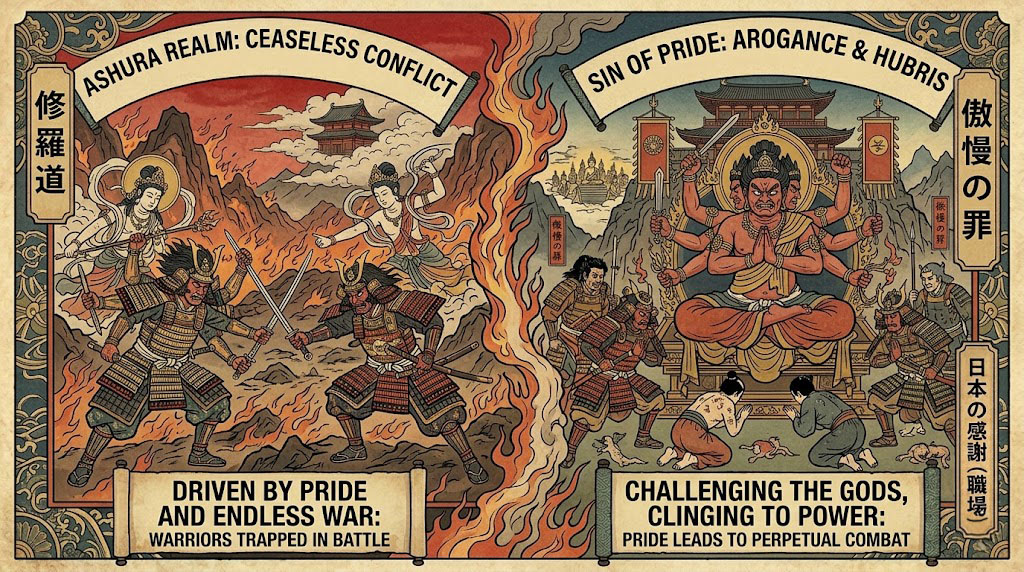
Ashura meaning in Japanese refers to the warrior demigods of Buddhist cosmology — powerful beings forever trapped in pride and endless battle. What does Ashura mean in Japanese, and why does this ancient concept still captivate us today?
During years of long-term travel through Buddhist Southeast Asia — Thailand, Laos, Cambodia — what stayed with me most was the gold: opulent temples, monks a constant, visible presence in daily life. I never quite figured out the local etiquette, so more often than not I just fell back on doing things the Japanese way, the only way I really knew.
Because Japan, in my experience, doesn’t feel like that at all. What’s everywhere here are shrines, not temples — Shinto priests, not monks. It’s quieter, more austere, and honestly, that’s the atmosphere I love. So it genuinely surprised me to learn, later, that Japan has its own serious Buddhist tradition too — including Ashura (阿修羅), one of the most striking statues in Japanese Buddhism, quietly housed at Kofuku-ji in Nara.
This isn’t a scene from an epic fantasy novel, but a foundational concept within Japanese Buddhism: the Ashura Realm (阿修羅道, Ashuradō), also known as Shuradō (修羅道). It’s a plane of existence that sits precariously between the blissful heavens and the suffering human world, a stark reminder of the destructive power of uncontrolled passion. Here, powerful demigods…
What Does Ashura Mean in Japanese?
Ashura (阿修羅) are warrior demigods in Japanese Buddhism — powerful, multi-armed beings driven by pride, jealousy, and an endless thirst for battle. The name comes from the Sanskrit asura, meaning “non-god” or “non-heaven,” reflecting their place just outside the heavenly realms. Though immensely strong, they are trapped in perpetual conflict, which is why the Ashura realm is considered a place of suffering despite its power.
Quick Facts: Ashura Realm
| Detail | Information |
|---|---|
| Japanese Name | 阿修羅道 (Ashuradō) / 修羅道 (Shuradō) |
| Type / Category | Buddhist Concept / One of the Six Realms of Rebirth (Rokudō) |
| Origin | Ancient Indian Vedic and Hindu traditions, adopted into Buddhism, then Japan. |
| Element / Domain | Conflict, pride, jealousy, rage, constant struggle, warfare. |
| Known For | A realm of powerful demigods (Ashura) perpetually fighting due to intense passions and envy. |
| Modern Appearances | Ashura often appear as powerful, often antagonistic figures in anime (e.g., *Asura’s Wrath*, *Dragon Ball Z*), manga, and video games. |
What Is the Ashura Realm?
Within the grand tapestry of Japanese Buddhist cosmology lies the concept of the Six Realms of Rebirth (六道, Rokudō), a cyclic journey through different planes of existence determined by one’s karma. The Ashura Realm is one of these six, positioned as a turbulent domain inhabited by powerful, yet deeply flawed, beings known as Ashura (阿修羅). These demigods are often depicted as formidable warriors, possessing immense strength and supernatural abilities, but their existence is far from peaceful. Instead, they are consumed by overwhelming passions – primarily pride, envy, and anger – which condemn them to an eternity of strife and conflict, often against the Deva (heavenly beings).
While the inhabitants of the Ashura Realm experience a degree of power and pleasure that surpasses human existence, their internal turmoil prevents them from achieving true contentment or spiritual liberation. Their world is one of constant rivalry, battles for supremacy, and insatiable desire. The Ashura Realm serves as a potent allegory for the human condition, illustrating how unchecked pride and anger, even when coupled with strength or merit, can lead to a state of perpetual suffering and hinder spiritual progress. It’s a reminder that true liberation comes not from power, but from overcoming one’s own destructive impulses.
Origins and History
The concept of Ashura predates Buddhism, finding its roots in ancient Indian Vedic and Hindu traditions where they were known as Asuras. In early Vedic texts, Asuras were celestial beings, sometimes seen as benevolent deities, while at other times antagonists of the Devas (gods). With the rise of Brahmanism and later Hinduism, the Asuras increasingly became associated with anti-godly, demonic figures, embodying power, ambition, and often malevolence.
When Buddhism emerged, it reinterpreted the Asuras, integrating them into its own cosmology as powerful beings caught in the cycle of rebirth. They were classified as one of the six destinies, and their realm became a vivid illustration of the karmic consequences of pride, jealousy, and belligerence. This concept traveled from India to China and then to Japan, evolving culturally but retaining its core message. In Japan, Ashura became a recognizable figure in Buddhist art and sculpture, their multi-faced and multi-armed forms powerfully conveying their internal conflict and warrior nature. The Kōfuku-ji temple in Nara, for instance, houses one of the most famous and exquisite Ashura statues, a poignant depiction that showcases the complex emotions beneath the warrior’s facade.
Ashura Realm’s Characteristics and Inhabitants
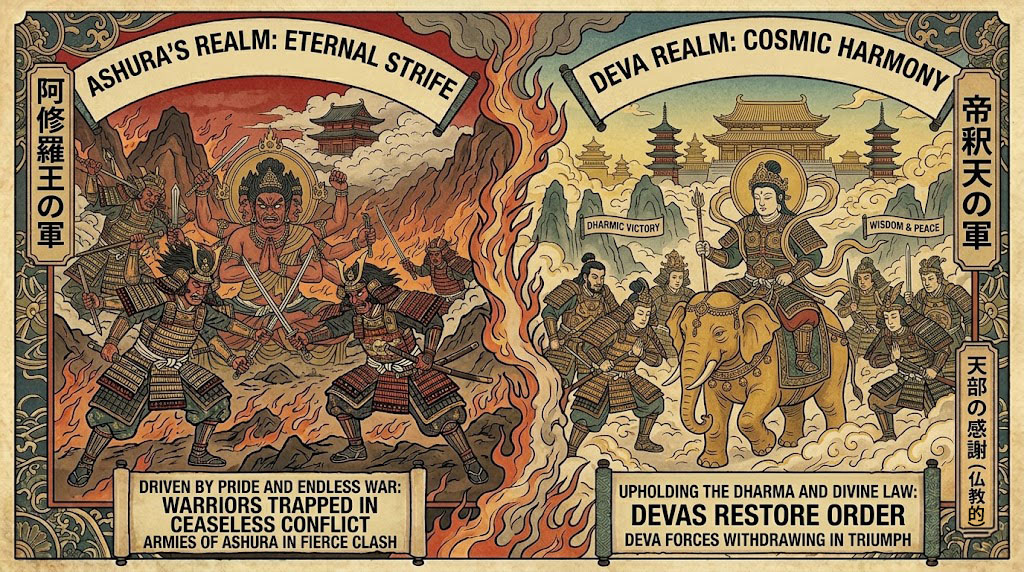
The Ashura Realm is fundamentally defined by its turbulent nature. It is a domain of constant warfare, not always physical, but also psychological. Its inhabitants, the Ashura, are demigods renowned for their physical prowess, towering stature, and formidable strength. They are often depicted with multiple faces and many arms, each face expressing a different emotion—rage, sorrow, pride, or desire—and each hand wielding a weapon or gesturing defiance. This multi-faceted portrayal symbolizes their complex inner lives, perpetually torn between their inherent power and their consuming passions.
Unlike the blissful inhabitants of the Deva (Heavenly) Realm, who enjoy pleasures and long lifespans due to good karma, the Ashura’s existence is marred by their inability to find peace. Their realm is characterized by a lack of sunlight, metaphorically representing their internal darkness, and a ceaseless pursuit of dominance. They are often depicted living beneath the mythical Mount Sumeru, at the root of the celestial world, constantly striving to usurp the Devas above them, making their realm a perpetual battlefield for supremacy and revenge.
The Nature of Ashura: Conflict and Pride
At the core of the Ashura’s being lies an overwhelming sense of pride (慢, man) and jealousy (嫉妬, shittō). Though they possess great merits and virtues from past lives, these positive karmic seeds are overshadowed by their fierce ego and competitive spirit. Ashura cannot tolerate anyone being superior to them, leading to an insatiable desire to be the best, the strongest, and the most revered. This pride often manifests as arrogance and a belligerent attitude, driving them into conflicts even when peace is an option. They are also intensely jealous of the Devas, who enjoy a more serene and joyful existence, perceiving the Devas’ happiness as an injustice against themselves.
The Ashura’s battles are not just external; they are deeply internal. Their multi-faceted depictions emphasize their struggle with their own conflicting emotions. One face might be filled with righteous anger, another with sorrow over past defeats, and yet another with resolute pride. This constant internal strife prevents them from achieving true spiritual progress, trapping them in a cycle of suffering despite their immense power. The Ashura Realm serves as a powerful warning against letting pride and jealousy dictate one’s actions, demonstrating how even great virtues can be corrupted by unchecked ego.
The Cycle of Rebirth: Ashura’s Place in Rokudō
The Ashura Realm holds a significant position within the Buddhist Rokudō Rinne (六道輪廻, Six Realms of Rebirth). Rebirth into the Ashura Realm is a karmic consequence for those who performed good deeds in a previous life but were driven by strong negative emotions such as intense pride, jealousy, anger, and a desire for conflict. It’s a realm for those who might have cultivated virtue but did so with a competitive spirit, or who were charitable but with an arrogant heart. They are considered superior to humans due to their greater merit and power, yet they suffer more than humans due to their incessant internal and external conflicts.
The Ashura Realm is often depicted as lying just below the Deva Realm and above the Human Realm. While not as grim as the Animal, Hungry Ghost, or Hell (Jigoku) realms, it is still a place of suffering, albeit a higher form of suffering driven by passion rather than abject deprivation. The Buddha is said to appear in all six realms to teach the Dharma, offering a path to liberation even to the Ashura. This underscores Buddhism’s universal message that escape from suffering is possible from any realm, provided one cultivates wisdom, compassion, and overcomes destructive karmic tendencies.
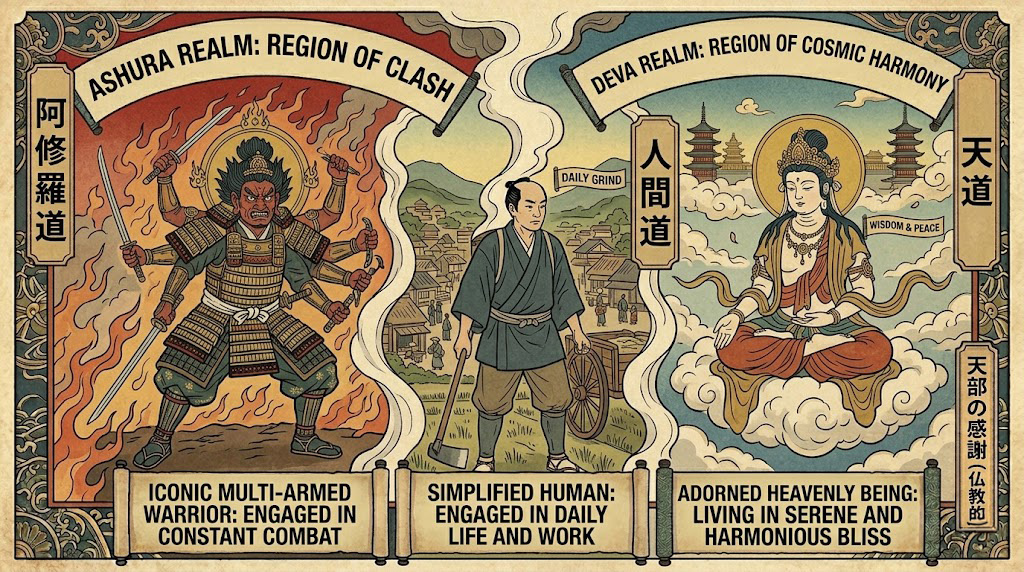
Ashura Realm vs Similar Realms in Rokudō
| Feature | Ashura Realm | Human Realm (Nindō) | Deva Realm (Tendō) |
|---|---|---|---|
| Type | Demigod Realm | Mortal Realm | Heavenly Realm |
| Domain | Conflict, Pride, Jealousy | Suffering, Joy, Opportunity | Bliss, Long Life, Pleasure |
| Danger Level | High (due to constant conflict and internal turmoil) | Moderate (potential for suffering, but also enlightenment) | Low (blissful, but still part of samsara; complacency) |
| How to appease | Overcome pride, jealousy, and anger; cultivate humility and compassion. | Practice mindfulness, compassion, and wisdom; follow the Dharma. | Enjoy merits, but still subject to rebirth; practice wisdom to avoid falling to lower realms. |
| Modern pop culture | *Asura’s Wrath*, *Dragon Ball Z*, *One-Punch Man* | Most human-centric narratives, e.g., *Your Name*, *Spirited Away* | Often depicted as antagonists or sources of divine power, e.g., *Noragami*, *Saint Seiya* |
Ashura Realm in Modern Japan and Pop Culture
While the Ashura Realm might seem like an abstract Buddhist concept, its core themes of intense passion, conflict, and the struggle against one’s inner demons resonate deeply within modern Japanese culture and beyond. The image of the powerful, multi-armed Ashura warrior, forever locked in battle, has transcended its religious origins to become a compelling archetype in contemporary media. Video games like *Asura’s Wrath* directly draw from the Ashura mythos, placing players in the role of a demigod consumed by vengeance, while characters with immense, often destructive, power and complex moral dilemmas in anime and manga (e.g., certain powerful characters in *Dragon Ball Z*, or the concept of ‘inner demons’ in many shonen series) echo the Ashura’s tormented strength. This enduring appeal lies in the Ashura’s embodiment of raw power tempered by profound flaws, offering a rich narrative foundation for stories exploring themes of pride, redemption, and the consequences of unchecked ambition. It serves as a universal mirror, reflecting humanity’s own struggle with ego and the destructive potential of our deepest emotions, making the Ashura Realm a timeless cautionary tale.
Where to Experience This in Japan
To truly connect with the concept of Ashura and its place in Japanese Buddhism, a visit to certain temples and museums is highly recommended:
* Kōfuku-ji Temple (Nara): Home to the famous Ashura statue (阿修羅像), a designated National Treasure. This iconic sculpture, dating back to the 8th century, depicts Ashura as a slender, contemplative youth with three faces and six arms, capturing the nuanced struggle of the demigod with remarkable artistry. It’s a profoundly moving piece.
* Nara National Museum (Nara): Often displays Buddhist art and artifacts, including other depictions of Ashura and the broader cosmology of the Rokudō, providing excellent historical and cultural context.
* Tokyo National Museum (Tokyo): Also houses significant collections of Buddhist sculpture and art from various periods, where you might encounter different interpretations of Ashura and related deities.
Frequently Asked Questions
What is the difference between Ashura and Deva in Japanese Buddhism?
In Japanese Buddhism, both Ashura and Deva are powerful beings, but they represent different karmic realms. Devas (heavenly beings) inhabit the Deva Realm, a plane of pleasure and long life, resulting from good karma and virtuous deeds. Ashura, however, despite their power, reside in a realm of conflict, driven by pride, jealousy, and anger, born from good deeds tainted by negative emotions. Devas enjoy peace; Ashura are perpetually at war, often against the Devas themselves.
Is the Ashura Realm considered a hell (Jigoku) realm?
While the Ashura Realm is a place of suffering and struggle, it is not considered one of the true hell (Jigoku) realms. Jigoku realms are the lowest and most severe of the Six Realms, characterized by intense, direct physical and mental torment as a result of grave negative karma. The Ashura Realm, though turbulent and filled with conflict, is a higher realm where suffering stems more from internal passions, pride, and jealousy rather than direct torture, and its inhabitants possess greater power than those in Jigoku.
What kind of karma leads to rebirth in the Ashura Realm?
Rebirth in the Ashura Realm is typically a consequence of performing good or meritorious deeds in a previous life, but with a heart full of pride, jealousy, anger, or competitive spirit. For example, someone might be generous or courageous, but do so with an arrogant attitude, seeking to prove their superiority over others. This combination of positive action and negative motivation leads to the power of an Ashura but condemns them to a life of ceaseless internal and external conflict.
Can one escape the Ashura Realm in Buddhist cosmology?
Yes, according to Buddhist teachings, escape from any of the Six Realms, including the Ashura Realm, is possible through the cultivation of wisdom, compassion, and the practice of the Dharma. An Ashura, despite their immense suffering from pride and jealousy, still has the potential for spiritual understanding and liberation. The Buddha’s teachings are available to all beings in all realms, offering a path to overcome their karmic conditioning and achieve enlightenment, thereby breaking free from the cycle of rebirth.
Are Ashura Demons or Gods?
Ashura are best understood as demigods — beings that occupy a middle ground between gods and demons rather than belonging fully to either. They possess divine-level power and were born from genuine merit and virtue, yet their overwhelming pride, jealousy, and rage give them a fearsome, demon-like character. Their nature has even shifted across history: the early Indian Asuras were sometimes benevolent deities before being recast as adversaries of the gods. In Japanese Buddhism, Ashura also appear as protective guardians — they are counted among the Hachibushū (八部衆), the eight legions who defend the Buddhist teachings — which is why the famous statue at Kōfuku-ji portrays Ashura not as a monster, but as a contemplative, almost sorrowful youth.