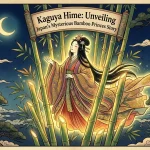
The Kaguya Hime story is Japan’s oldest surviving narrative — a mysterious tale of a radiant princess discovered inside a glowing bamboo stalk who ultimately returns to her true home on the moon.
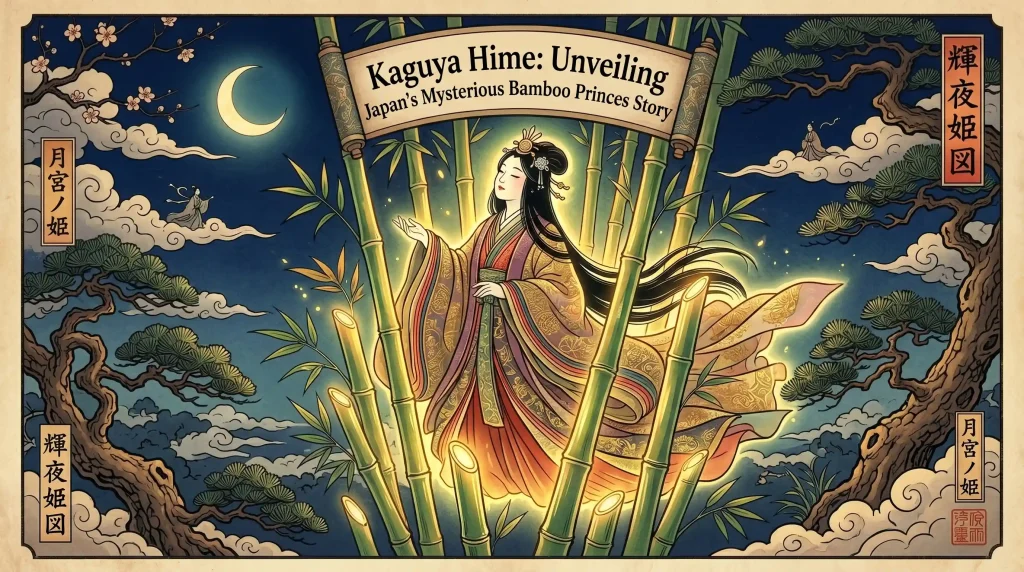
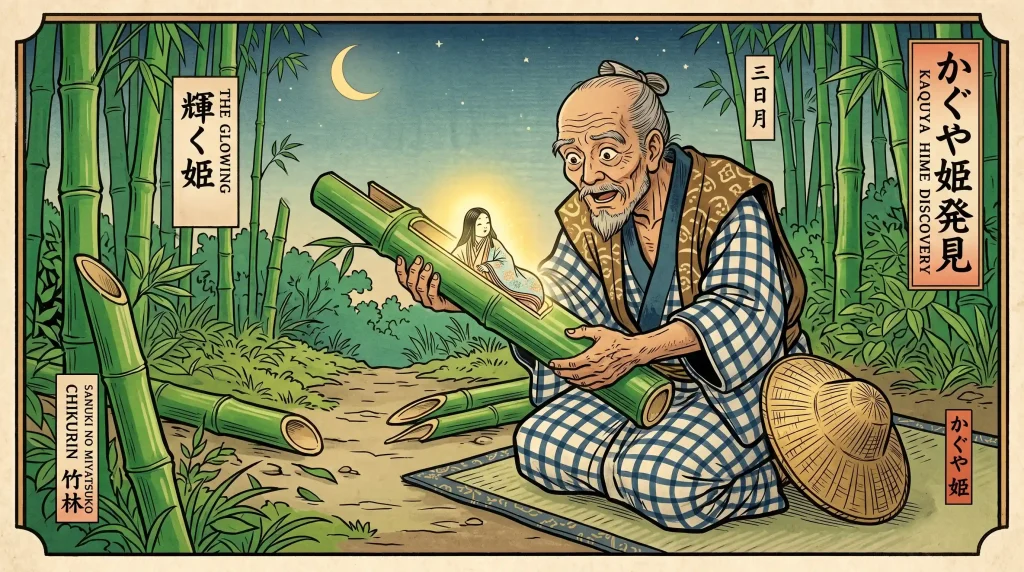
Imagine stumbling upon a shimmering bamboo stalk in a quiet forest, only to find a tiny, radiant child nestled within. This is the magical genesis of Kaguya Hime, (かぐや姫, Kaguya-hime), often known as “The Tale of the Bamboo Cutter” (竹取物語, Taketori Monogatari), Japan’s oldest prose narrative and a cornerstone of its rich folklore. For centuries, this enchanting story has captivated hearts, spinning a yarn of impossible beauty, celestial origins, and the bittersweet nature of earthly love. It’s a journey that takes us from a humble bamboo grove to the majestic courts of the Emperor and beyond, to the moon itself. Prepare to be swept away as we unravel the layers of mystery and magic surrounding the extraordinary life and ultimate destiny of Japan’s most famous celestial princess.
Quick Facts: Kaguya Hime, The Bamboo Princess
| Detail | Information |
|---|---|
| Japanese Name | かぐや姫 (Kaguya-hime) / 竹取物語 (Taketori Monogatari) |
| Type / Category | Folktale / Celestial Maiden (Tenshi-sama) |
| Origin | Heian period Japan (c. 9th-10th century AD) |
| Element / Domain | Moon, Bamboo, Divinity, Beauty, Earthly Love |
| Known For | Japan’s oldest prose narrative; a princess of celestial origin found in bamboo; her impossible tasks for suitors; her return to the Moon. |
| Modern Appearances | “The Tale of the Princess Kaguya” (Studio Ghibli film), “Sailor Moon” (Princess Serenity parallels), various manga, anime, and video games. |
What Is Kaguya Hime?
Kaguya Hime, meaning “Princess Kaguya” or “Shining Princess,” is the central figure in one of Japan’s most beloved and ancient folktales, “The Tale of the Bamboo Cutter.” This narrative describes the mystical discovery of a tiny, luminous girl inside a bamboo stalk by an old, childless bamboo cutter. Believing her to be a divine gift, he and his wife raise her as their own, bestowing upon her the name Kaguya Hime due to her radiant beauty. As she grows with astonishing speed into a woman of unparalleled grace and charm, her fame spreads throughout the land, attracting a host of noble suitors and even the Emperor himself. However, Kaguya Hime’s earthly existence is tinged with a profound secret: she is not of this world.
The story of Kaguya Hime delves into themes of beauty, desire, the futility of material wealth, and the bittersweet nature of attachment. It explores the idea that true beauty and divine grace are beyond human possession. Her character embodies an ideal of purity and detachment, yet also a deep capacity for sorrow and love for her adoptive parents. More than just a princess, Kaguya Hime represents a link between the earthly realm and the celestial, a poignant reminder of the transient nature of life and the unreachable ideal. It’s a foundational text in Japanese literature, influencing countless works of art and continuing to captivate audiences with its blend of magic, romance, and philosophical depth.
Origins and History
“The Tale of the Bamboo Cutter” (竹取物語, Taketori Monogatari) is widely considered to be the oldest surviving example of Japanese prose narrative, or monogatari, dating back to the early Heian period, likely the late 9th or early 10th century. While the exact author remains unknown, scholars speculate it could have been written by an educated courtier, possibly even by a woman, given the subtle psychological insights and emotional depth. The story itself circulated orally for some time before being recorded, drawing on various older folk motifs prevalent in East Asian cultures, such as the tale of a celestial maiden descending to earth and the motif of impossible tasks.
The tale’s setting and cultural details reflect the aristocratic society of Heian Japan, with its emphasis on poetry, courtly love, and elaborate rituals. Its widespread popularity is evident from early mentions in other historical texts and literary works, solidifying its place as a canonical piece of Japanese literature. It set a precedent for later narratives like “The Tale of Genji,” establishing many narrative conventions and themes that would become characteristic of Japanese literature. Its enduring legacy is a testament to its compelling storyline and the universal appeal of its central character, the mysterious and ethereal Kaguya Hime.
Kaguya Hime’s Appearance, Powers, and Behavior
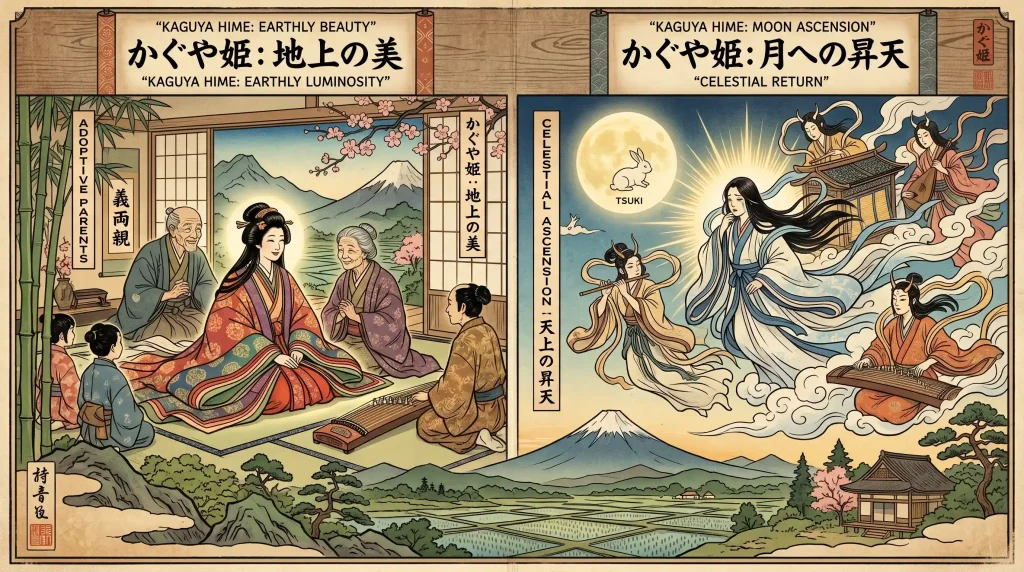
Kaguya Hime is renowned for her extraordinary, almost otherworldly beauty, described as radiant and luminous, glowing faintly from within. She is depicted as growing from a tiny infant to a full-grown woman in just three months, a testament to her non-human origin. She often wears exquisite Heian-era kimonos, reflecting her adoptive parents’ newfound wealth, which also mysteriously emanates from the bamboo the cutter fells. Her demeanor is initially joyful and loving towards her adoptive parents, but as she grows and her celestial destiny draws closer, she becomes increasingly melancholic, gazing wistfully at the moon, which is her true home.
Impossible Tasks and Royal Suitors
The central drama of the story unfolds as five high-ranking noblemen, captivated by Kaguya Hime’s beauty, vie for her hand in marriage. To deter them, she sets each suitor an impossible task: to retrieve a legendary item from distant, mythical lands. These items include the Buddha’s begging bowl from India, a jeweled branch from Mount Horai, a fire-rat’s fur robe from China, a dragon’s jewel from its neck, and a swallow’s cowrie shell. Each suitor fails spectacularly, either through deception, cowardice, or sheer impossibility, highlighting Kaguya Hime’s celestial discernment and her rejection of earthly vanity and ambition. Even the Emperor, who falls deeply in love with her, is ultimately unable to win her hand, for her heart and destiny lie elsewhere.
The Celestial Return
As the time for her departure approaches, Kaguya Hime’s sadness deepens, and she reveals her true identity as a princess from the Moon, sent to Earth as a temporary exile. Her true family, the people of the Moon, send a retinue of celestial beings to retrieve her, descending from the heavens in a radiant chariot. Despite the heartbreaking pleas of her adoptive parents and the Emperor, who even dispatches his guards to prevent her departure, Kaguya Hime must fulfill her destiny. Before ascending, she leaves behind a letter of farewell for her parents and a potion of immortality for the Emperor, who, heartbroken, orders it burned on the highest mountain, Mount Fuji (富士山, Fuji-san), as he cannot bear to live forever without her.
Kaguya Hime vs Similar Celestial Maidens and Magical Figures
| Feature | Kaguya Hime | Orihime (Weaving Princess) | Hagoromo-Tenshi (Robe of Feathers Maiden) |
|---|---|---|---|
| Origin | Found in bamboo, from the Moon | Daughter of the Heavenly King, star deity (Vega) | Celestial being, robe stolen by a fisherman |
| Domain | Earthly exile, Moon | Heaven, stars (associated with Tanabata) | Heaven, sometimes Mt. Fuji or coastal areas |
| Earthly Status | Adopted princess, sought by suitors | Weaver, falls in love with a cowherd (Altair) | Becomes fisherman’s wife for a time |
| Tragic Love? | Yes, leaves adoptive parents and Emperor | Yes, separated from beloved by Milky Way | Yes, separated from beloved when robe is returned |
| Modern pop culture | Ghibli film, Sailor Moon parallels, various anime/manga/games | Tanabata festivals, numerous anime/manga references | Noh plays, manga, regional tourism |
Kaguya Hime in Modern Japan and Pop Culture
The enduring allure of Kaguya Hime continues to resonate deeply within modern Japanese culture and beyond. Her story is a timeless exploration of beauty, desire, separation, and the mysteries of the cosmos, making it fertile ground for reinterpretations and homages. Perhaps the most celebrated modern adaptation is Studio Ghibli’s 2013 animated masterpiece, “The Tale of the Princess Kaguya” (かぐや姫の物語, Kaguya-hime no Monogatari), directed by Isao Takahata. This visually stunning film captures the original tale’s emotional depth and artistic beauty, bringing it to a new global audience with breathtaking hand-drawn animation.
Beyond Ghibli, Kaguya Hime’s influence can be seen in numerous anime, manga, and video games. Her archetype—a mysterious, beautiful, and often melancholic celestial being—has inspired characters in series like “Sailor Moon” (Princess Serenity’s connection to the moon and an earthly love story echoes Kaguya Hime’s narrative). Themes of longing for a lost home, dealing with the expectations of suitors, and a bittersweet farewell are common threads derived from her tale. She often appears in historical or fantasy-themed games and light novels, embodying grace, power, and an ethereal presence. Her story serves as a cultural touchstone, taught in schools and celebrated as a fundamental piece of Japan’s literary heritage, its universal themes ensuring its continued relevance.
Where to Experience This in Japan
While Kaguya Hime’s story is ancient and transcends specific locations, there are places where her legend can be felt.
1. Mount Fuji (富士山, Fuji-san): The tale concludes with the Emperor ordering the elixir of immortality to be burned on Mount Fuji, giving the mountain its name and its perpetual smoke (in ancient times). Visiting this iconic mountain provides a tangible link to the story’s poignant ending.
2. Kyoto (京都): As the imperial capital during the Heian period, Kyoto is where the Emperor and noble suitors would have resided. Exploring its ancient temples, palaces, and gardens evokes the aristocratic world Kaguya Hime briefly inhabited. While there’s no specific “Kaguya Hime Shrine,” the entire city breathes the history that inspired the tale.
3. Bamboo Groves (e.g., Arashiyama Bamboo Grove, Kyoto): While not directly linked to the specific bamboo cutter’s home, walking through the ethereal beauty of a large bamboo forest, such as the famous Arashiyama Bamboo Grove in Kyoto, allows one to imagine the magical discovery of the shining princess. The serene atmosphere provides a perfect backdrop for reflecting on the tale.
Frequently Asked Questions
What is the main moral or lesson of the Kaguya Hime story?
The story of Kaguya Hime carries several profound morals. It often highlights the futility of worldly possessions and human desire when confronted with something truly divine and unattainable. It also emphasizes the bittersweet nature of life’s attachments, particularly the sorrow of separation and loss, even when it’s part of a greater cosmic order. Ultimately, it’s a tale about the transient beauty of earthly life and the yearning for the unreachable ideal.
Is Kaguya Hime considered a kami (deity) in Shinto?
While Kaguya Hime possesses divine characteristics and celestial origins, she is not typically worshipped as a Shinto kami in the traditional sense, nor is she a part of the formal Shinto pantheon. She is primarily a figure from Japanese folklore and literature. Her story, however, reflects underlying Shinto and Buddhist themes, such as the sacredness of nature (bamboo, moon) and the impermanence of existence.
What makes “The Tale of the Bamboo Cutter” so significant in Japanese literature?
“The Tale of the Bamboo Cutter” holds immense significance as Japan’s oldest surviving prose narrative, predating even “The Tale of Genji.” It established many literary conventions for the monogatari (tale) genre, including narrative structure, character development, and the integration of poetic elements. Its themes of love, loss, and the supernatural set a foundational precedent for centuries of Japanese storytelling.
How does Kaguya Hime relate to the moon in Japanese mythology?
Kaguya Hime is intrinsically linked to the moon as her true home and the source of her celestial origin. She is revealed to be a princess from the Moon who was sent to Earth for a temporary period, possibly as a punishment or to experience human life. Her eventual return to the Moon is the story’s poignant climax, firmly establishing her as a lunar deity or a being deeply connected to the celestial body.