The Tanabata legend is one of Japan’s most beloved stories — a celestial love tale of two stars separated by the Milky Way, reuniting just once a year on the seventh day of the seventh month.
Imagine a summer night, clear and warm, with the Milky Way arching across the sky like a shimmering river of stars. For centuries, across countless cultures, humanity has gazed heavenward, weaving dreams and legends among the celestial bodies. In Japan, one such tale shines brightest, a poignant romance that inspires an annual festival of wishes and vibrant celebration: the Tanabata Star Festival. It’s a story of diligent work, forbidden love, heartbreaking separation, and the enduring hope for reunion – a narrative so powerful it has shaped customs and captured imaginations for over a thousand years. Prepare to journey into the heart of Japanese folklore as we uncover the enchanting legend of Orihime and Hikoboshi, whose stellar love continues to light up the summer sky.
Quick Facts: Tanabata Star Festival Legend
| Detail | Information |
|---|---|
| Japanese Name | 七夕 (Tanabata) |
| Type / Category | Celestial Love Story / Folklore / Seasonal Festival |
| Origin | Ancient China (Qixi Festival), introduced to Japan during Nara Period |
| Element / Domain | Stars, Love, Weaving, Agriculture, Wishes |
| Known For | The tragic romance between Orihime and Hikoboshi, celebrated annually on July 7th (or August 7th in some regions). |
| Modern Appearances | Anime, manga (e.g., Sailor Moon, Fruits Basket), traditional festivals nationwide, literature. |
What Is Tanabata Star Festival?
The Tanabata Star Festival (七夕, Tanabata), also known as the “Star Festival,” is one of Japan’s most enchanting summer traditions, celebrated on July 7th or August 7th, depending on the region. More than just a beautiful display of lights and decorations, Tanabata is deeply rooted in an ancient celestial love story that speaks to themes of hard work, love, separation, and the power of wishes. It’s a time when people gather, often dressed in traditional yukata, to gaze at the summer sky and make heartfelt wishes, hoping the star-crossed lovers will grant their desires.
At its core, Tanabata is a celebration of the stars Vega (Orihime) and Altair (Hikoboshi), which shine prominently in the summer night sky. The festival transforms cities and towns with colorful bamboo decorations, vibrant streamers, and countless strips of paper bearing wishes. It’s a moment for reflection, connection, and embracing the romantic allure of the cosmos, reminding everyone that even in separation, love and hope can bridge vast distances.
Origins and History
The legend behind Tanabata has a rich and ancient history, tracing its roots back to China’s Qixi Festival (七夕節, Qīxī jié), which celebrates the mythical tale of the Weaver Girl and the Cowherd. This narrative arrived in Japan during the Nara period (710-794 AD) and gradually merged with existing Japanese traditions, including local agricultural customs and purification rituals, as well as the Buddhist O-bon festival. One significant adaptation was the introduction of Kikkoden (乞巧奠, Kikkōden), a festival where people prayed for improved sewing and artistic skills, believed to be influenced by Princess Kōmyō, the Empress Consort of Emperor Shōmu.
Over centuries, the celestial love story and the practice of making wishes on strips of paper, known as tanzaku (短冊, tanzaku), became central to the festival. Originally, wishes were written with ink on mulberry leaves, a practice that evolved into using colorful paper. The bamboo branches, integral to the decorations, were believed to carry the wishes directly to the heavens, protecting against misfortune. This fusion of foreign legend with native practices created the unique and beloved Tanabata festival we know today, a testament to Japan’s ability to adapt and enrich cultural elements into its own vibrant tapestry.
Tanabata’s Celestial Lovers, Their Work, and Separation
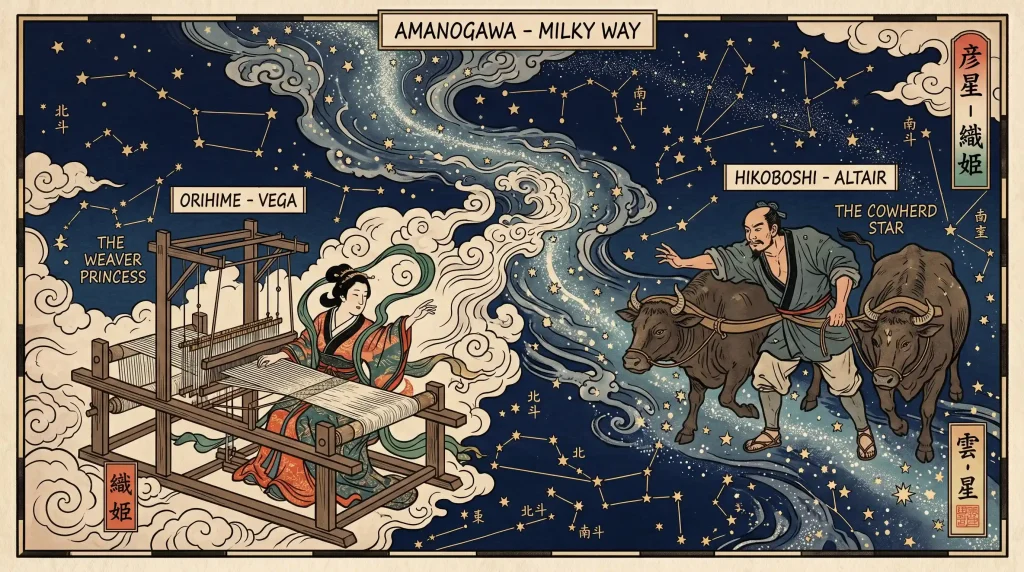
The heart of the Tanabata Star Festival legend lies in the poignant romance between Orihime (織姫, Orihime), the Weaver Princess, and Hikoboshi (彦星, Hikoboshi), the Cowherd. Orihime, identified with the star Vega, was the daughter of Tentei (天帝, Tentei), the Sky King, and a diligent weaver of beautiful garments by the banks of the Amanogawa (天の川, Amanogawa), the Celestial River (the Milky Way). Her beautiful creations were loved by all, but her dedication to her craft left her lonely and longing for love. Tentei, noticing her sadness, arranged for her to meet Hikoboshi, represented by the star Altair, a hardworking and kind cowherd who lived on the opposite side of the Amanogawa.
The Magpies’ Bridge and Wish-Making Rituals
It was love at first sight. Orihime and Hikoboshi fell deeply in love, their days filled with joy and affection. However, their newfound happiness led them to neglect their important duties. Orihime stopped weaving, and Hikoboshi let his cattle wander, causing chaos in the heavens. Enraged by their idleness, Tentei decided to separate the lovers, banishing them to opposite sides of the Amanogawa, allowing them to meet only once a year, on the seventh night of the seventh month, provided they had diligently resumed their work throughout the year.
The annual reunion, however, comes with a caveat: if it rains on Tanabata, the Amanogawa swells, preventing the lovers from crossing. In such an unfortunate event, a flock of magpies (鵲, kasasagi) is said to form a bridge with their wings, allowing Orihime to cross and reunite with Hikoboshi. This moment of reunion is what inspired the tradition of writing wishes on colorful strips of paper called tanzaku and hanging them on bamboo branches, along with other intricate paper decorations like fukinagashi (吹き流し, fukinagashi), which represent Orihime’s weaving threads. People believe that if Orihime and Hikoboshi are granted their meeting, they will bless the wishes made on Earth, making Tanabata a festival of hope and dreams.
Regional Variations and Observances
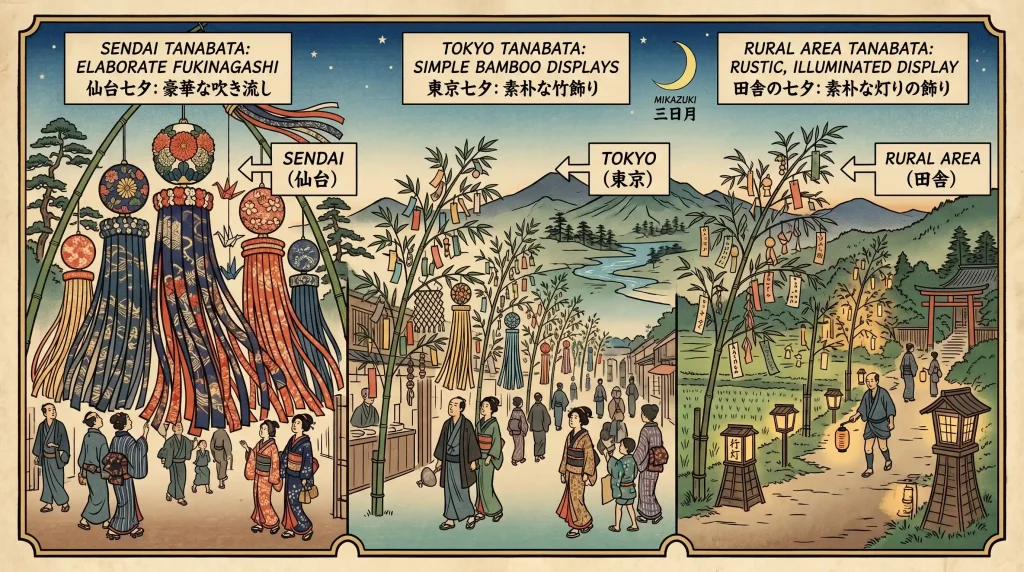
While the core legend remains consistent, the celebration of Tanabata varies across Japan, most notably in its observance date. Many regions, particularly in Kanto and Tohoku, celebrate on July 7th, following the Gregorian calendar. However, other areas, like Sendai and parts of Kyushu, follow the traditional lunisolar calendar, celebrating around August 7th, which more closely aligns with the actual seventh day of the seventh month on the old calendar, ensuring the full summer moon is visible. This distinction impacts when the brightest star-gazing occurs, with the August celebrations often featuring more spectacular night skies.
Tanabata Star Festival vs Similar Japanese Traditions
| Feature | Tanabata Star Festival | Obon Festival | Hanami (Cherry Blossom Viewing) |
|---|---|---|---|
| Type | Celestial Legend / Wishing Festival | Ancestor Veneration / Buddhist Custom | Nature Appreciation / Social Gathering |
| Domain | Stars, Love, Wishes | Ancestors, Family, Remembrance | Nature, Beauty, Transience |
| Purpose | Celebrate star lovers, make wishes for skills and happiness | Honor and welcome spirits of ancestors | Enjoy ephemeral cherry blossoms, socialize |
| Key Activity | Write wishes on tanzaku, decorate bamboo branches | Visit graves, offer prayers, Bon Odori dance | Picnics under cherry trees, strolls through parks |
| Time of Year | Summer (July 7th or August 7th) | Summer (mid-August or mid-July) | Spring (late March to early May) |
Tanabata Star Festival in Modern Japan and Pop Culture
The Tanabata Star Festival legend continues to resonate deeply in modern Japan, influencing everything from local community events to global pop culture. Its themes of love, separation, hope, and diligence are universal, making it a powerful narrative that transcends cultural boundaries. In contemporary Japan, Tanabata is a beloved summer tradition, celebrated with enthusiasm in homes, schools, and major cities. Shopping districts are often adorned with elaborate, vibrant decorations, and local festivals feature food stalls, games, and performances, all centered around the magical atmosphere of the star festival. It’s a testament to the enduring appeal of traditional folklore in a rapidly modernizing world, providing a link to ancient beliefs and a sense of shared cultural identity.
Beyond traditional celebrations, the story of Orihime and Hikoboshi has found its way into countless forms of Japanese pop culture. Anime series like “Sailor Moon” and “Fruits Basket” have incorporated Tanabata themes, with characters making wishes or referencing the celestial lovers. Manga often features special Tanabata chapters, and video games frequently include events or quests tied to the festival. The timeless appeal of star-crossed lovers and the inherent hope of wishes make the Tanabata legend a fertile ground for creative interpretation, allowing new generations to connect with this ancient tale and find inspiration in its enduring message of love and perseverance.
Where to Experience This in Japan
For travelers eager to experience the magic of Tanabata firsthand, Japan offers several spectacular celebrations. The Sendai Tanabata Matsuri (仙台七夕まつり, Sendai Tanabata Matsuri), held from August 6th to 8th, is arguably the most famous, renowned for its incredibly elaborate and massive paper decorations (fukinagashi) that stretch across entire shopping arcades. Another grand celebration is the Hiratsuka Tanabata Matsuri (平塚七夕まつり, Hiratsuka Tanabata Matsuri) in Kanagawa Prefecture, held in early July, which features similarly impressive decorations and a lively parade. Beyond these major festivals, numerous local shrines and shopping streets nationwide host smaller, charming Tanabata events on either July 7th or August 7th, offering a more intimate glimpse into this beautiful tradition, where visitors can often write their own tanzaku wishes.
Frequently Asked Questions
What is the main story behind the Tanabata Star Festival legend?
The Tanabata Star Festival legend tells the story of Orihime, the Weaver Princess (star Vega), and Hikoboshi, the Cowherd (star Altair). They fell deeply in love, neglecting their duties, which angered Orihime’s father, Tentei (the Sky King). As punishment, he separated them across the Amanogawa (Milky Way), allowing them to meet only once a year on the seventh night of the seventh month, provided they had diligently worked. If it rains, magpies form a bridge for their reunion.
Why is Tanabata celebrated on two different dates in Japan?
Tanabata is celebrated on two different dates – July 7th and August 7th – primarily due to the shift from the traditional lunisolar calendar to the Gregorian calendar. Many regions now observe it on July 7th, aligning with the modern calendar. However, some areas, like Sendai, adhere to the traditional timing, which places the seventh day of the seventh month closer to August in the Gregorian calendar, ensuring a better chance for clear summer night skies to view the stars.
What do the bamboo decorations and tanzaku represent during Tanabata?
During Tanabata, bamboo branches are decorated with colorful paper ornaments, most notably tanzaku (strips of paper where wishes are written). The bamboo is believed to carry these wishes directly to the heavens, and its straight, upright growth symbolizes reaching for the stars. The various paper decorations, such as the streamer-like fukinagashi, represent Orihime’s weaving threads and symbolize prayers for good harvests and improved skills, drawing a direct connection to the celestial weaver princess.
Are there real stars associated with the Orihime and Hikoboshi legend?
Yes, the Tanabata legend is directly tied to two prominent stars that are visible in the summer night sky. Orihime is represented by Vega, the brightest star in the constellation Lyra. Hikoboshi is represented by Altair, the brightest star in the constellation Aquila. These two stars, along with Deneb, form the Summer Triangle, and they appear to be separated by the Milky Way, or Amanogawa, creating a celestial map of the legendary lovers’ eternal longing and annual reunion.